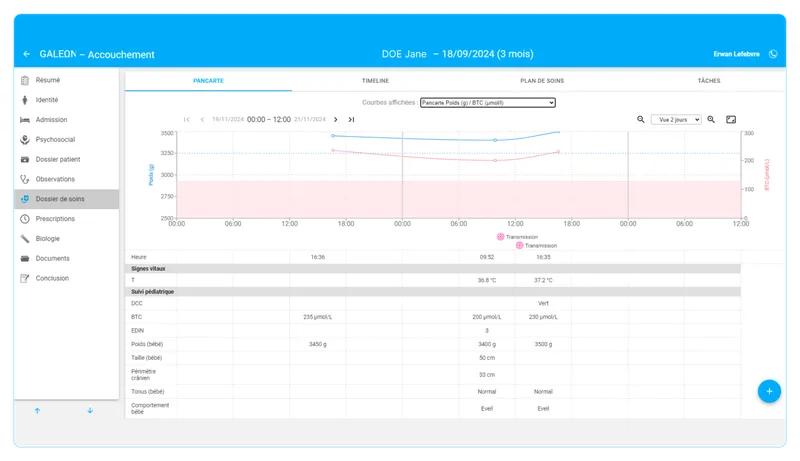
 See Galeon for real
At a glance
One contact, one plan, and nobody stops working.
The method
Eight steps, from kick-off to review.
The order of units and the dates are set with the hospital; the method does not change.
Kick-off
A meeting sets the functional and technical scope, the organisation, the schedule and the go-live rules. It ends with signed minutes, and a quality assurance plan agreed with the hospital becomes the reference.
Configuration
A common foundation, then a version for each unit. Galeon’s clinical consultants, with nursing and pharmacy backgrounds, configure; the hospital’s key users validate on real scenarios.
Interoperability
Each connector with the rest of the information system is specified, tested, then signed off after an observation period.
Data migration
Scoped early, loaded fast: a validated sample, a bulk load, then successive loads up to the switchover, with record counts and a migration report.
Acceptance testing
On a complete patient pathway, using a test book supplied by Galeon. The steering committee decides on go-live: no blocking issue may remain open.
Training
Key users first, then end users, profession by profession, in the weeks before their unit goes live.
Go-live
Go-live happens on a Monday, with Galeon staff on site, day and night. For thirty days, issues and data flows are monitored daily.
Review
One month after go-live, the regular-service check closes the deployment of that scope. Ongoing follow-up takes over.
Who does what
Two teams, one steering.
At Galeon
A single project lead, backed by project management; clinical consultants, an interoperability lead, a data migration lead, trainers, the product team, the information security officer and the data protection officer.
At the hospital
The IT department, a clinical project lead, an interoperability lead, key users in each unit, the medical information officer and the pharmacist.
Governance
An operational committee every week during deployment, a steering committee every two to three months, and signed minutes at each step.
Right now: Saint-Joseph, unit after unit
Hôpital Saint-Joseph in Marseille chose the Galeon EHR. It is being deployed there unit after unit. See also EHR interoperability and what an EHR migration pays back.
FAQ
What we are asked about deployment.
How long does a deployment take?
For a 1,000-bed hospital, allow 9 to 12 months. The duration depends mostly on the number of units and of connectors with the rest of the information system.
Do we have to switch off the old software?
No. The existing system stays in service until each scope goes live, and data is migrated in successive loads up to the switchover. No unit stops working to change records.
What happens to the history held in the old record?
It is decided data type by data type: structured migration, document migration (indexed, with full-text search), read-only access in the old tool, or no migration with an organised alternative. Every migration is checked by sampling and record counts, and documented in a report.
What do we expect from the hospital’s teams?
An engaged IT department, a clinical project lead, an interoperability lead and key users in each unit, together with the medical information officer and the pharmacist. Key users validate the configuration on real scenarios and set up the training groups.
Who decides on go-live?
The steering committee, after acceptance testing: no go-live with a blocking issue still open.
Let’s talk about your schedule.
A first conversation with the project team, about your units, your connectors and your constraints.