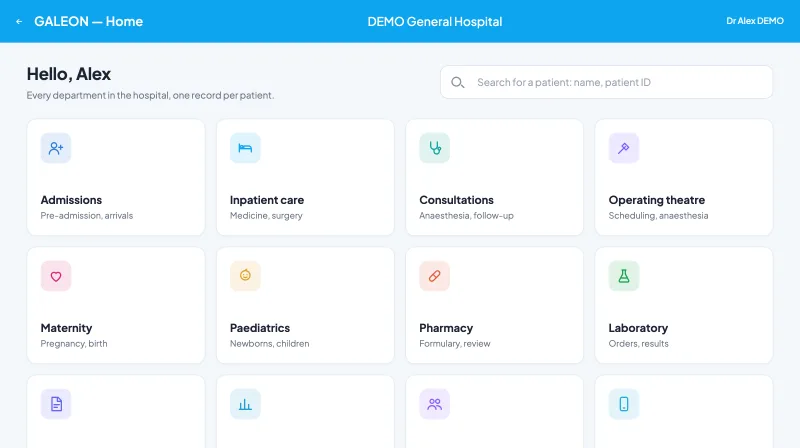
 See Galeon for real

Tool · ROI calculator
Calculate the ROI of migrating to Galeon EHR
Your hospital already has an EHR. By migrating to Galeon, it can capture unclaimed revenue, reduce IT infrastructure costs, and give clinical time back to caregivers. Estimate your annual gain.
The method
Four levers, one amount per bed.
The return on investment of migrating to Galeon is measured across four main areas. Each starts from real Galeon deployment data in a 1,000-bed French public hospital, scaled pro rata to your number of beds.
Each lever: one amount per bed, multiplied by the number of beds. The sources behind each assumption are listed under the calculator.
Clinical time
19 days per caregiver per year, freed from admin work.
Caregivers spend 35% of their working time on admin tasks. An AI-powered EHR cuts documentation time by 24.5%, about 38 minutes per caregiver per day.
Sources: Medscape 2024 and Higgins 2016; systematic review of 28 studies, ScienceDirect 2018.
Galeon EHR
Galeon has created an AI-powered shared patient record that saves lives
Our Electronic Health Record is used daily by 10,000 caregivers in 19 public hospitals. HDS certified, ISO 27001 compliant, 3× CES Las Vegas Award Winner about cybersecurity.
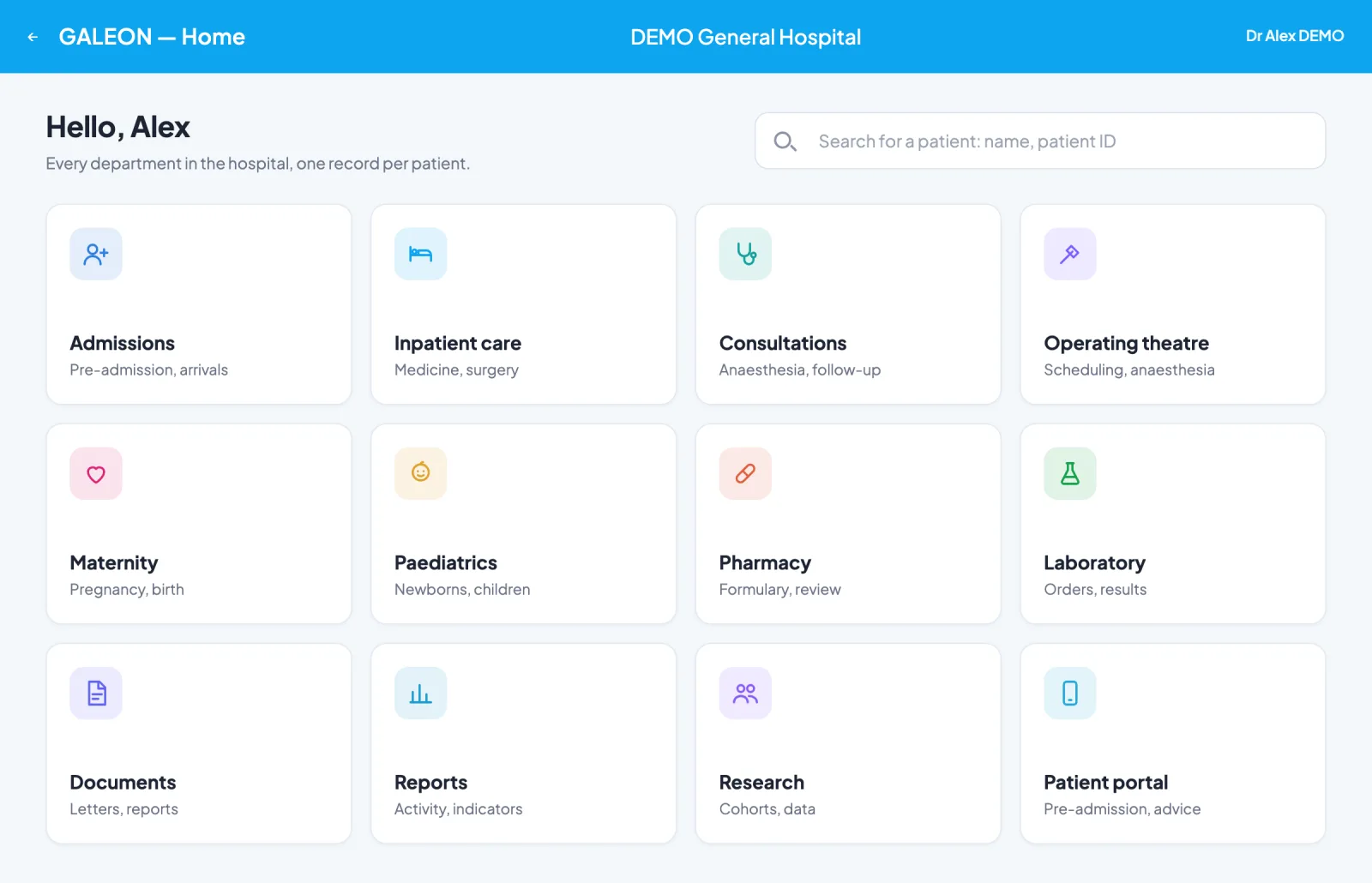
What clinicians say.
“With Galeon, I save precious time. I can finally focus fully on my patients.”

“It is fluid, the 4h training was enough […]. AI on a patient’s record would prevent us from rewriting 10 times the same thing.”

“There’s no lack of information, it is simple to use. […] You get the patient’s biology, echography reviews in a few clicks.”
“Galeon is a revolution for us, a shift from a paper method to digital one, which is the future.”
19 facilities, from university hospitals to maternity clinics.


















FAQ
Frequently asked questions about migrating to Galeon EHR
What is the ROI of migrating to Galeon EHR?
The return on investment of migrating to Galeon is measured across four main areas. UHCD emergency billing and day hospital structuring generate T2A revenue that was previously uncaptured. AI-powered PMSI coding detects missing billable procedures, the CHRU de Tours measured an average gain of €1,470 per recoded stay. Finally, switching to SaaS eliminates on-premise infrastructure: on average, 70% of a hospital's VMs are allocated to the EHR, at €1,700/VM/year. Combined, these levers can generate over €2M in annual gains for an 800-bed hospital. European benchmarks (Care Insight) confirm a gain of 3 to 8% additional T2A revenue within 18 months of deployment. Our estimate, based on French hospital data, sits at the lower end of this range, making it a conservative projection.
Why migrate to a SaaS EHR when you already have one?
An on-premise EHR carries a permanent and growing infrastructure cost: server renewal every five years, Oracle and Vidal licences, 24/7 IT on-call, HDS and ISO 27001 certifications to maintain, and technical rooms to operate. Moving to SaaS eliminates all of these items. Galeon handles HDS hosting, security, updates, and regulatory compliance — with no additional annual cost to the facility.
How many procedures does a hospital lose each year through incomplete coding?
Two French university hospitals (EMOIS 2022) demonstrated that shifting from clinician to DIM coding increased the Average Treated Case Value by +13 to +22% depending on the department. European benchmarks (Care Insight) estimate the revenue gap at 3–8% of annual T2A income.
What is UHCD billing and why is it so often missed?
The Unité d'Hospitalisation de Courte Durée (UHCD) allows emergency stays lasting several hours to be billed as inpatient admissions, at a significantly higher rate than a standard consultation. This billing is only triggered if the patient record is correctly structured at the point of care. Without an intelligent EHR, a large proportion of these stays go uncoded as UHCD — representing hundreds of thousands of euros in lost revenue annually depending on facility size.
How many VMs does a hospital typically dedicate to its EHR?
On average, 70% of the hospital's virtual machines are allocated to the EHR, at an average cost of €1,700/VM/year - covering HDS hosting, electricity, Wallix security, backups, and 24/7 support. For a 1,000-bed hospital, this typically represents between €400,000 and €600,000 in annual infrastructure costs directly tied to the EHR.
How long does a Galeon EHR deployment take?
Galeon is deployed progressively, department by department. The first units can go live within a few months. A full deployment across an 1000-bed facility typically spans 9 to 12 months depending on the complexity of the existing IT environment. The SaaS model ensures automatic updates with no intervention required from the hospital's IT team.
Let's talk about your migration.

 2 sales reps available from tomorrow
Your IT, your interfaces, your timeline. Pick a slot: Valérie or Yohan will call you back.
- HDS certified
- ISO 27001
- GDPR compliant
- LAP certified (HAS)