 See Galeon for real
AI in Healthcare 2026: What Nurses and Doctors Really Fear
AI in healthcare 2026: what nurses, midwives and doctors really fear and expect, measured time savings, shadow AI, liability and why a structured EHR comes first.
The essentials in 30 seconds
| Question | Short answer | Key takeaway |
|---|---|---|
| Are healthcare workers afraid of being replaced by AI? | Less than people think. Their main fear is losing their clinical judgement and their empathy, or being monitored. | The fear is about control, not jobs. |
| What do emergency triage nurses fear? | Being "policed": a tool that lets managers go back over every triage decision after the fact. | Record the human decision, not every deviation. |
| What do healthcare workers expect from AI? | Less paperwork, useful alerts on night shifts, no longer entering the same information ten times. | AI is welcome when it takes a task away. |
| Does AI save a lot of time? | Randomised trials on ambient scribes measure roughly one minute saved per consultation. | Attention given back to the patient matters more than the minutes. |
| Are healthcare workers already using AI? | Yes, often outside any official framework: one university hospital measured up to 700,000 connections a month to consumer AI tools. | Banning it is not enough, you have to offer something better. |
| Who is responsible if AI gets it wrong? | The clinician remains responsible for their decision, hence the importance of recording why they followed or rejected a suggestion. | AI assists, it does not decide. |
| Why does structured data matter? | Because AI can do nothing with information scattered across free text. | No useful AI without a structured EHR. |
Introduction
AI in healthcare is reaching hospitals from every direction: scribes that draft clinical reports, triage support in the emergency department, prescribing alerts. Among healthcare workers, the reception is mixed. Many see potential relief, others a threat to the very heart of their profession.
A midwife at a maternity unit in Burgundy sums up this tension in one sentence: "I don't want artificial intelligence to take away our capacity to think and our empathy." In the same breath, she hopes AI will help them "save time on the paperwork that takes up so much of it."
At Galeon, an EHR (electronic health record) built with healthcare workers since 2016, we see these two sentences as a set of requirements. This article covers the most common fears, what the available measurements say, and the conditions for an AI to be accepted by clinical teams.
An AI that healthcare workers accept is an AI that removes a task, not one that adds a layer of control.
Will AI in medicine replace healthcare workers?
Not really. When asked, healthcare workers talk less about their jobs than about their judgement, their relationship with the patient and the possibility of their work being monitored.
A medical secretary at a large hospital in the Var, asked whether she feared being "replaced by a robot", answers without hesitation: the software "provides support", but "our oversight will always be needed behind it." A head of a maternity department sees AI rather as a way to "avoid missing things in screening" and to flag contraindications or drug interactions, especially "in an on-call unit that works at night and around the clock."
The nuance matters: healthcare workers do not reject AI, they reject an AI that would decide in their place or turn every action into a performance indicator.
AI and emergency triage: why are triage nurses afraid of being "policed"?
Because a tool that records everything makes it possible to revisit every decision after the fact. At the emergency triage desk, where working conditions are extreme, this prospect worries nurses more than being replaced.
At the URGENCES 2025 congress, a presentation on triage by IOA nurses (triage nurses who greet and direct patients in French emergency departments) reported what the nurses had said in meetings: the fear of being replaced, and above all of being "policed", because a tool would let their nurse manager revisit a triage decision after the fact (URGENCES 2025). The same presentation recalled the working conditions of the post: 5 to 6 minutes per patient according to the guidelines, average noise of 59 dB with much higher peaks (URGENCES 2025).
The answer is not to give up traceability, but to change what is recorded. Recording the human decision and its reasoning protects the nurse; recording every deviation from a triage scale puts her in the dock.
Does AI really save clinical documentation time?
A little, but less than trade shows claim. The benefit most often reported lies elsewhere: in the attention paid to the patient and the completeness of the record.
At SantExpo 2026, a cardiologist cited two randomised trials published in NEJM AI on ambient scribes (tools that draft the clinical report from the conversation): about one minute saved per consultation in one, 22 minutes per day in the other. He insisted that time saved is the easiest criterion to measure, not the most important one (SantExpo 2026).
Real-world adoption is also slower than announced. In one hospital in northern France, around thirty doctors out of 220 were using AI tools routinely (SantExpo 2026). In a regional university hospital, an AI office tool tested on 50 people saved about one hour per week, judged insufficient against a cost of €400 per user per year (SantExpo 2025).
ChatGPT and doctors: are healthcare workers already using AI without saying so?
Yes, and on a large scale. "Shadow AI", the use of consumer tools outside the hospital's official framework, is already being measured in hospitals.
A speaker at SantExpo 2026 reported that a mid-sized university hospital recorded 500,000 connections a month to generative AI tools in August 2025, then 700,000 in February 2026 (SantExpo 2026). These uses are often discovered through the firewall, and they raise a real question about the confidentiality of health data.
For a doctor, using ChatGPT or another consumer tool with patient information is a confidentiality problem: that health data leaves the hospital's framework. The figure therefore says two things. Healthcare workers have a real need for writing support. And a ban alone does not hold: hospitals need to offer an integrated tool that is traceable and hosted in a compliant environment, as we explain in our article on AI and GDPR applied to health data.
Who is responsible when AI gets it wrong?
The clinician remains responsible for their decision. That is why the record must keep track of what they did with the AI's suggestion, and why.
At the URGENCES 2026 congress, an emergency physician described automation bias: accepting or rejecting an AI suggestion without examining it is dangerous either way. He recommends recording in the patient record why a suggestion was rejected, otherwise it is the clinician who will be found at fault in a morbidity and mortality review (URGENCES 2026). The legal framework is detailed in our guide on liability when clinical AI makes a mistake.
Why does AI in healthcare depend first on a well-structured EHR?
Because AI can only use information that is reliable and stored in the right place. A record full of free text lends itself neither to alerts, nor to statistics, nor to diagnostic support.
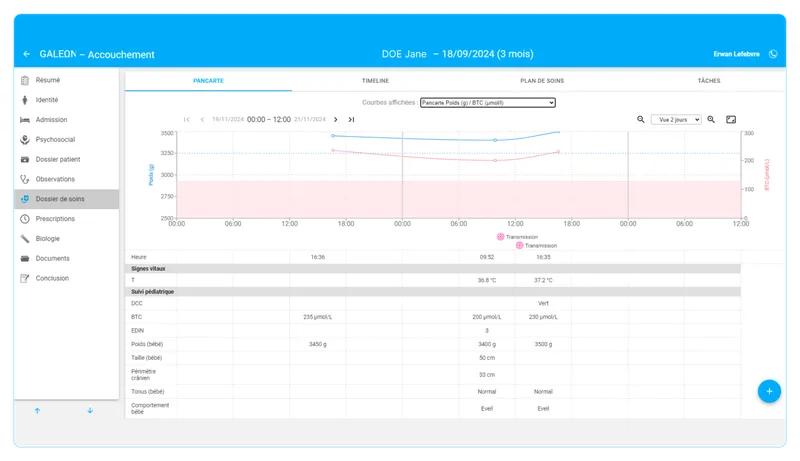
One hospital illustrated this point publicly: in its former EHR, looking up a patient's weight meant finding several values scattered across free-text fields, in other words having none at all (SantExpo 2025). A midwife at a maternity unit equipped with Galeon puts it differently: the data is "well shelved", stored in drawers from which it can be pulled out again. This organisation is what makes a useful AI possible, and it is the work we have been doing with healthcare workers since 2016.
AI bolted onto the EHR or AI built into the record: what are the differences?
| Criterion | AI added alongside the EHR | Galeon approach |
|---|---|---|
| Place in the workflow | Separate tool, output to copy and paste | Goal: an AI that writes into the structured record |
| Data used | Free text, often incomplete | Structured data validated by clinicians |
| Traceability | Suggestion rarely kept | Human decision and reasoning recorded in the patient record |
| Relationship to control | Risk of measuring every deviation | Decision support, not a monitoring tool |
| Patient identity safety | Risk of a report attached to the wrong patient | Work done within the record of the patient concerned |
| Hosting | Variable, sometimes outside HDS certification | Certified health data hosting (HDS) |
| Night-time use | Rarely designed for on-call shifts | Priority on useful alerts in round-the-clock activity |
| Design | Designed by the AI vendor | Built with clinical teams |
Limits and points of caution
- Measured time savings remain modest. No vendor can honestly promise hours freed up every day.
- The triage AIs tested remain imperfect. Figures presented at congresses show performance still insufficient to decide alone.
- The AI Act does not classify every clinical AI as high-risk: the level of requirements depends on the use, which calls for a case-by-case analysis.
- AI depends on data quality. Without structured and complete data entry, its suggestions will be fragile.
- Acceptance has to be built. Even a good tool will be rejected if it is experienced as control; involving teams from the design stage is essential.
FAQ
Will AI in healthcare replace nurses or midwives?
No. Realistic uses concern administrative work, documentation and alerts. Clinical judgement and the relationship with the patient remain human.
Can an AI tool be used to monitor healthcare workers?
Technically yes, which is why design matters: recording the decision and its reasoning protects the clinician, measuring every deviation puts them in the dock.
How much time does an ambient scribe save?
The randomised trials cited at SantExpo 2026 measure about one minute per consultation in one case, 22 minutes per day in the other.
Can a doctor use ChatGPT with patient data?
Not with a consumer tool: health data requires a GDPR-compliant framework and appropriate hosting.
Who is responsible if a clinician follows a bad suggestion?
The clinician remains responsible for their decision; the record must keep track of their reasoning.
Why talk about structured data before AI?
Because AI can only use information that is reliable and organised; free text leaves it blind.
In summary
Healthcare workers are less afraid of being replaced by AI than of losing their judgement, their empathy, or of being monitored. Their expectations are clear: less paperwork, useful alerts at night, a record that does not ask for the same information ten times. The available measurements show modest time savings and slower adoption than announced, but a real benefit in the attention given back to the patient. To be accepted, an AI must live inside the patient record, rely on structured data, record the human decision and be built with clinical teams. That is the direction Galeon is taking with healthcare workers.
Want to know more about our smart EHR ?
Book a demoRead also: the EU AI Act and healthcare, concrete obligations for hospitals
Sources
- URGENCES 2025: thoughts on patient triage by IOA nurses
- URGENCES 2026: how AI is already changing emergency medicine
- SantExpo 2026: clinical AI, conditions for large-scale adoption
- SantExpo 2026: AI and agents in hospitals, moving beyond pilots
- SantExpo 2026: hospital AI, sovereignty and regulation (shadow AI)
- SantExpo 2025: AI for hospital efficiency
- Galeon: who is responsible when clinical AI gets it wrong?
- Galeon: AI and health data, what every hospital must master
They trust us
19 hospitals running Galeon in France.















Join the pioneers of care.
A short first call with someone who knows your hospital.