 See Galeon for real
Why Do Doctors Spend So Much Time Looking at Their Computers?
Why do doctors spend so much time on computers? Behind the screen: patient data, documentation, fragmented tools and admin work.
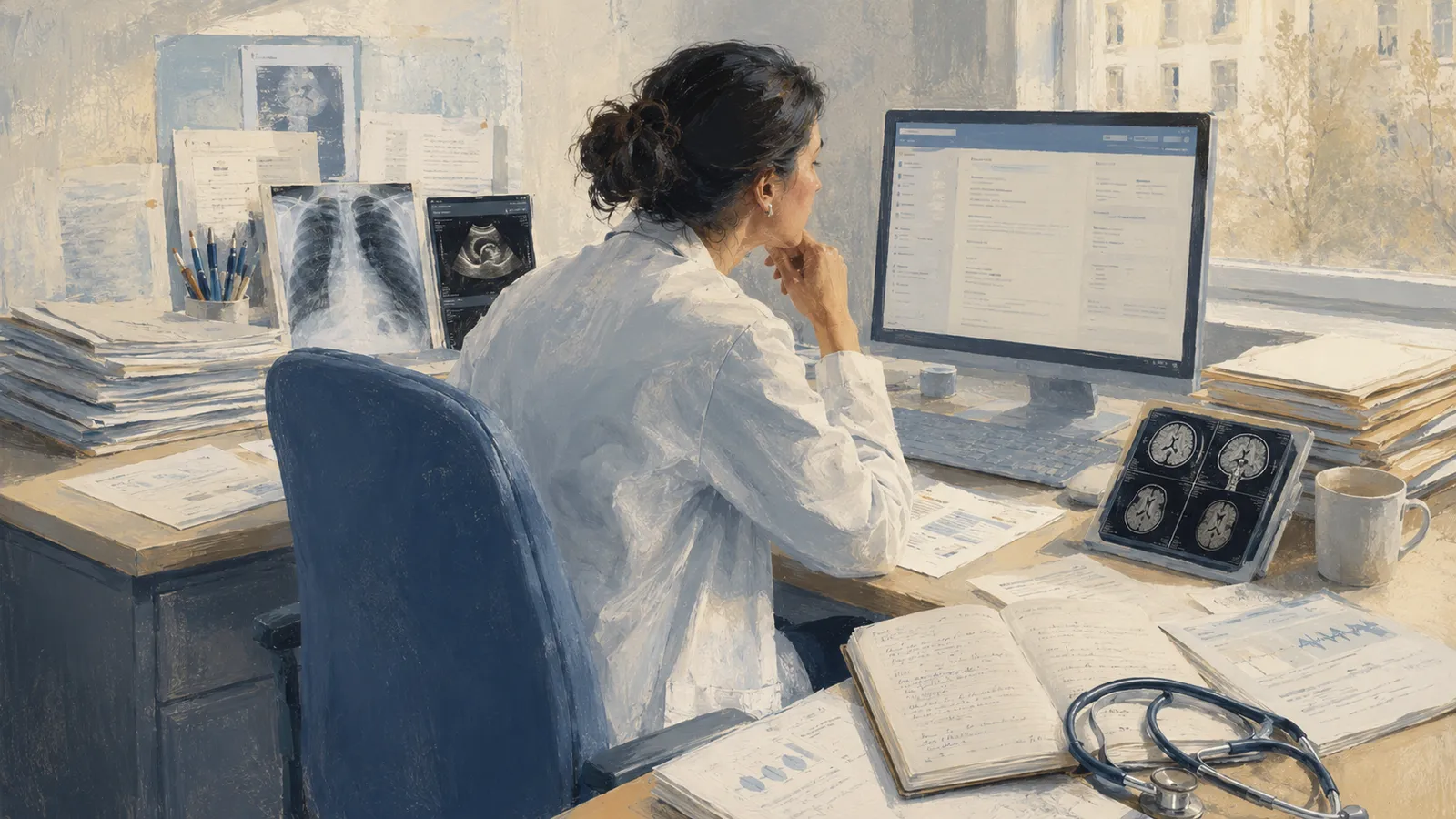
You’re sitting across from your doctor. You explain what brought you in, they ask you a few questions… then their attention shifts back to the screen.
They click. They type. They look for information. They listen to you while continuing to write.
And sometimes, you can’t help but wonder: why are they spending so much time looking at their computer when I’m sitting right in front of them?
It’s a fair question.
Digital tools have become a major part of healthcare professionals’ daily work. But behind that screen is also a part of medical care that patients rarely see.
So what is a doctor actually doing on their computer? Is all that screen time really necessary?
And most importantly: could we give them more time with their patients?
That’s what we’re going to explore.
Behind the screen is your story, too
During a consultation or hospital stay, your doctor isn’t just listening to what you’re telling them at that moment.
They also need to understand the bigger picture.
Your medical history. Your allergies. Your current medications. Your latest test results. A report written a few months earlier. Medical imaging. Notes from another healthcare professional.
Some of this information is stored in your patient record.
In a way, the computer has become the memory of your healthcare journey.
When your doctor looks away for a few seconds to check their screen, they may simply be verifying an important piece of information before making a decision.
And that’s only part of what they need to do.
Caring also means documenting
A consultation doesn’t end when the patient leaves the room.
The doctor needs to leave a record of what they observed, understood and decided.
Why?
Because they may not be the next healthcare professional to look after you.
Another doctor, a nurse, a pharmacist or a team in another department may need to understand what happened: why a particular test was ordered, why a treatment was changed, or what information needs to be monitored.
This documentation directly contributes to the continuity and safety of care.
It also helps maintain a consistent medical history over time.
Documenting the patient record is therefore part of providing care.
The problem isn’t that doctors use computers.
The real question is: how much of their time do those computers demand?
Is all that screen time really necessary?
Not always.
And this is where things get more complicated.
Over the years, digital tools have multiplied across healthcare facilities. The patient record is not necessarily the only piece of software a healthcare professional uses throughout the day.
Depending on their working environment, they may have to switch between different tools to check results, prescribe medication, access an image, find a document or complete certain administrative tasks.
Sometimes, the same information has to be entered several times.
Sometimes, it already exists somewhere… but they still have to find it.
And sometimes, two different systems each hold part of the patient’s story without communicating properly with one another.
A few seconds here, a few minutes there: over the course of a day, these small points of friction add up.
And every minute spent searching, re-entering information or navigating between different tools is a minute that cannot be spent directly interacting with the patient.
Why can’t we just “get rid of admin work”?
Because not everything that looks like an administrative task is unnecessary.
A medical report, a prescription or the verification of medical information are not mere formalities.
They are part of providing care.
The goal, therefore, isn’t to eliminate medical documentation.
It’s to eliminate as much as possible the tasks that add nothing to care: re-entering information that is already known, spending too long searching for a document, copying data from one place to another or unnecessarily navigating between multiple interfaces.
The distinction may seem subtle.
But it is essential.
Digital technology shouldn’t allow healthcare professionals to document less.
It should help them document better, while spending less time doing it.
And what about AI?
This is probably one of the areas where AI could have a very tangible impact in hospitals.
Not necessarily by making medical decisions instead of healthcare professionals.
But by helping with everything surrounding those decisions.
Summarising a particularly long patient record. Finding relevant information more quickly. Preparing parts of a medical report. Automatically structuring information that is already available. Avoiding repetitive data entry.
In other words: using technology to reduce the amount of time spent dealing with technology.
It may sound paradoxical.
Yet this is probably one of the most interesting applications of AI in healthcare.
On one condition: the information it works with must be reliable, structured and available at the right time.
AI cannot easily retrieve information that was never properly recorded, or that remains locked inside a system it cannot access.
So before we even talk about artificial intelligence, we need to talk about the quality and flow of information.
The best tool may be the one you notice the least
For a long time, digital transformation in hospitals mainly meant replacing paper with software.
The next step could be different.
It could mean making sure those tools demand less attention from healthcare professionals.
Information entered once could be reused whenever relevant. Important data could surface at the right moment. Different healthcare professionals could easily find what they need.
And the screen could become what it should always have been: a tool that supports the care relationship, rather than a barrier between the patient and the healthcare professional.
That obviously doesn’t mean doctors will stop looking at their computers.
But perhaps they could spend less time searching and re-entering information… and more time using the information that actually matters.

So why does your doctor spend so much time looking at their screen?
Because part of your medical history is right there in front of them.
Because they need to understand what happened before you arrived.
Because they need to document what happens today for those who may take over your care tomorrow.
And sometimes, because the tools they use could simply be easier to use, better connected and less time-consuming.
That last part is where digital technology can still make a difference.
The goal isn’t to remove computers from consultations.
It’s much simpler: to make sure computers give doctors time back, rather than take it away.
Related reading
They trust us
19 hospitals running Galeon in France.
















Join the pioneers of care.

 2 sales reps available from tomorrow
Your IT, your interfaces, your timeline. Pick a slot: Valérie or Yohan will call you back.
- HDS certified
- ISO 27001
- GDPR compliant
- LAP certified (HAS)