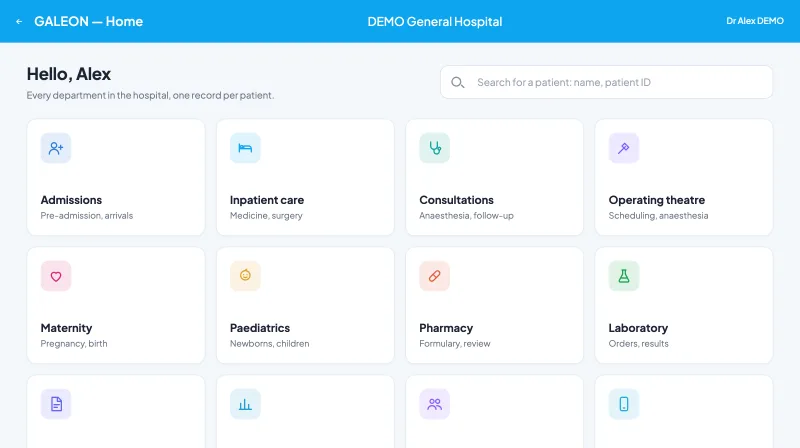
 See Galeon for real
What Really Happens to Your Medical Record After a Hospital Stay?
You leave the hospital, but your medical record stays. Where does your data go, who can access it, and does it really follow you?
You leave the hospital.
You collect your belongings, a few documents, perhaps a prescription and some instructions for what comes next.
Then you go home.
But your medical record stays behind.
During your time at the hospital, a great deal of information has been produced: test results, examinations, prescriptions, observations, reports, treatments administered…
Some of it existed before you arrived. Some was created during your care. And some of it may still prove useful months — or even years — later.
So what really happens to all this information once you leave the hospital?
Where is it stored? Who can access it? Is it sent to your doctor? And does it really follow you if you receive care somewhere else?
That’s what we’re going to explore.

Leaving the hospital doesn’t mean the end of your medical record
A hospital stay generates a significant amount of information.
From the moment you arrive, your identity is recorded and your medical record is completed with the information needed for your care.
Then, throughout your stay, it grows.
A doctor writes a clinical note. A nurse records a procedure. A test produces a result. A treatment is prescribed and then administered. Medical imaging is performed. A specialist provides an opinion.
All this information allows different care teams to understand what is happening and monitor changes in your health.
But it also serves another purpose: keeping a record of your care.
So when you leave the hospital, your medical record doesn’t disappear.
It becomes part of your medical history.
But where is all this information actually stored?
This is where things become a little less visible to patients.
We often talk about a “medical record” as though it were a single document stored somewhere.
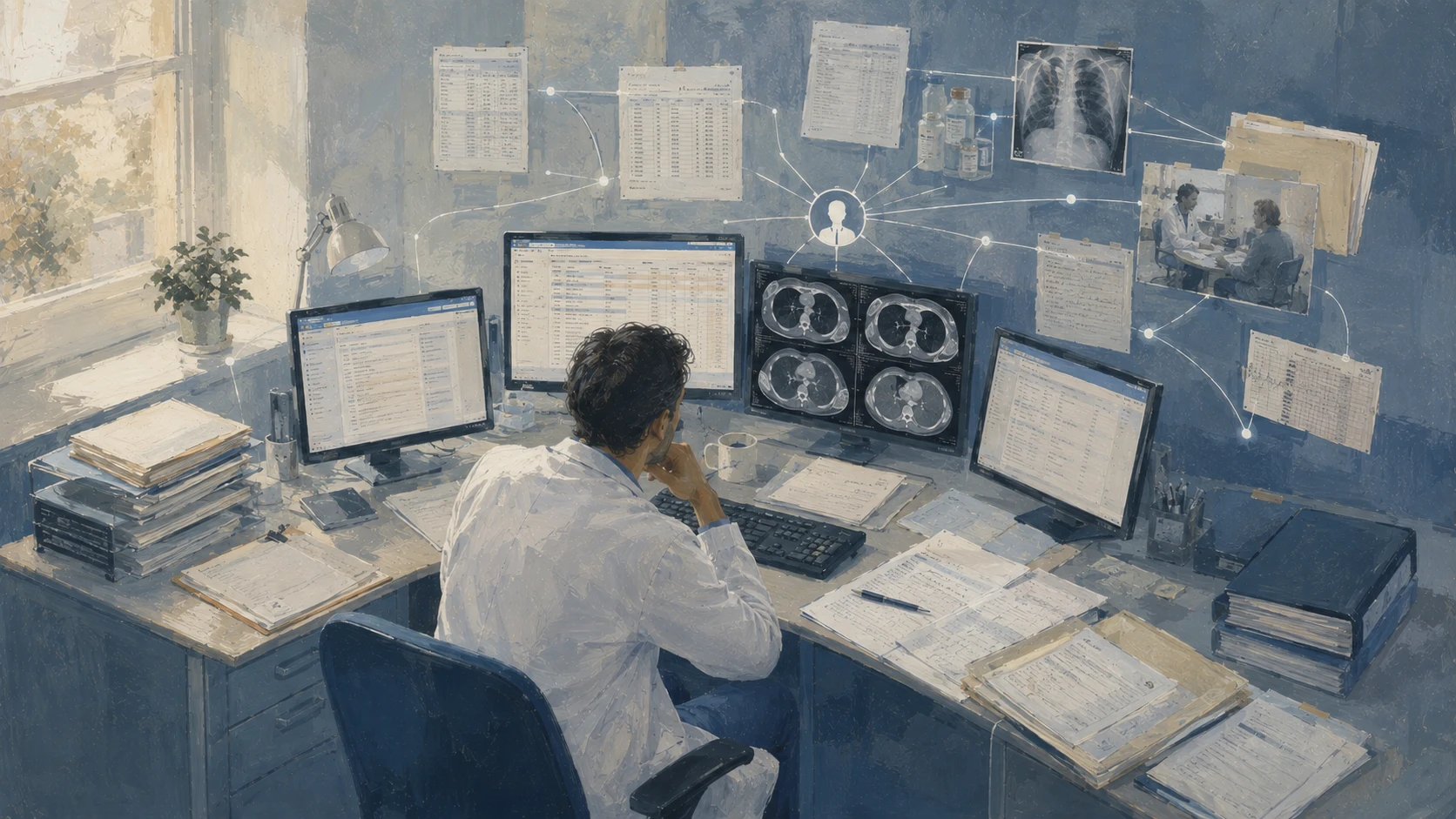
In reality, your hospital history may consist of many different pieces of information.
The Electronic Health Record (EHR) brings together a significant part of it, but some information may also come from other systems used by the hospital: laboratories, medical imaging, pharmacies or specialised software.
The challenge, therefore, isn’t simply to store this information.
It must also be possible to retrieve it, understand it and connect it when needed.
A perfectly preserved test result that cannot be found quickly loses some of its usefulness.
Information stored in one system but invisible from another can create friction.
And data that can only be understood by the system that produced it will be harder to reuse elsewhere.
Storing data is one thing.
Making sure it remains useful is another.
Does your primary care doctor receive everything?
Not necessarily.
And that wouldn’t always be useful anyway.
After a hospital stay, the main objective is to ensure that the information that matters for the next steps in your care can be shared with the relevant healthcare professionals.
A discharge report, for example, may explain what happened during your stay, the tests that were performed, the decisions that were made, the treatments that were prescribed or anything requiring follow-up.
The goal isn’t to send every piece of information produced during your hospital stay.
It’s about sending the right information to the right person at the right time.
That sounds obvious.
Technically, it isn’t always.
Why doesn’t your medical information automatically follow you everywhere?
You might imagine something very simple.
You receive care at one hospital.
A few months later, you visit another healthcare provider.
They open your record and immediately find the relevant information from your previous hospital stay.
In some cases, part of this journey is already possible.
But healthcare ecosystems rely on many different hospitals, professionals and software systems.
And these systems weren’t all built at the same time, in the same way or using the same formats.
For information to flow, two systems must do more than simply be able to “send something” to each other.
They must also be able to understand what they are exchanging.
That is the whole challenge of interoperability.
Imagine two people who each hold part of your story but don’t speak the same language.
The information exists.
It can even be transmitted.
But without a common language, using it becomes much more complicated.
For healthcare systems, the problem is quite similar.
And where does Mon espace santé fit into all this?
That is precisely one of the objectives of France’s national digital health services: enabling certain important pieces of information to follow patients beyond the healthcare organisation that originally produced them.
Through Mon espace santé and the Dossier Médical Partagé (DMP), patients can access certain documents and information related to their care journey.
One of the goals is to make this information more readily available to patients and, under the appropriate conditions, to the professionals involved in their care.
But once again, everything depends on the ability of the different stakeholders to properly feed information into these services and integrate them into their everyday workflows.
Creating a place where information can be stored isn’t enough.
The information has to get there, it has to be usable, and healthcare professionals need to be able to access it without adding even more complexity to their work.
Why keep all this information?
Because medical information can become important again long after it was first created.
An old examination can help compare how a condition has evolved.
An allergy identified several years earlier may change a prescription.
A previous procedure may explain a current situation.
A treatment that didn’t work can prevent the same strategy from being repeated.
Your medical record therefore creates continuity over time.
The doctor treating you today may not be the one who treated you yesterday.
And the person caring for you tomorrow may work in another healthcare organisation.
But your medical history needs to remain coherent.
You also have rights over your medical record
The fact that this information is stored by a healthcare organisation obviously doesn’t mean it can be freely accessed or used.
Health data is particularly sensitive.
Its access, storage and use are regulated, and healthcare professionals cannot simply access medical records just because they exist.
As a patient, you also have rights regarding your medical information, including the right to access your medical record under the applicable conditions.
The challenge of digital healthcare is therefore twofold:
Allow information to flow when it is needed for care, while protecting it when it isn’t.
These two objectives may seem contradictory.
In reality, they are inseparable.

Tomorrow’s medical record may be less of a “record”
For a long time, imagining a medical record meant picturing a folder filled with sheets of paper.
Digital technology reproduced some of that logic on a screen: documents, reports, results and forms.
But health data can do much more than simply be stored.
When it is structured, understandable and properly connected to the rest of the patient journey, it can be retrieved more easily, reused when relevant and transmitted without having to be systematically entered again.
This is also what will allow future digital tools — particularly artificial intelligence — to become genuinely useful.
AI can help retrieve or summarise information.
But it cannot invent data that was never properly recorded, nor can it easily use information locked away in an inaccessible system.
Once again, the quality of the tool depends first and foremost on the quality and flow of information.
So what happens to your medical record when you leave the hospital?
It remains a record of what happened.
It allows healthcare professionals to understand the decisions made during your care.
Some of its information may be shared to ensure continuity of care.
And some of it may become useful again much later, sometimes in another context or with another healthcare professional.
The real challenge, then, isn’t simply to preserve your medical record.
It’s making sure your medical history can follow you without requiring you to rebuild it at every stage of your care journey.
Because ultimately, your health data shouldn’t belong to a piece of software or remain locked inside a healthcare organisation.
Above all, it tells your story.
Related reading
They trust us
19 hospitals running Galeon in France.















Join the pioneers of care.

 2 sales reps available from tomorrow
Your IT, your interfaces, your timeline. Pick a slot: Valérie or Yohan will call you back.
- HDS certified
- ISO 27001
- GDPR compliant
- LAP certified (HAS)