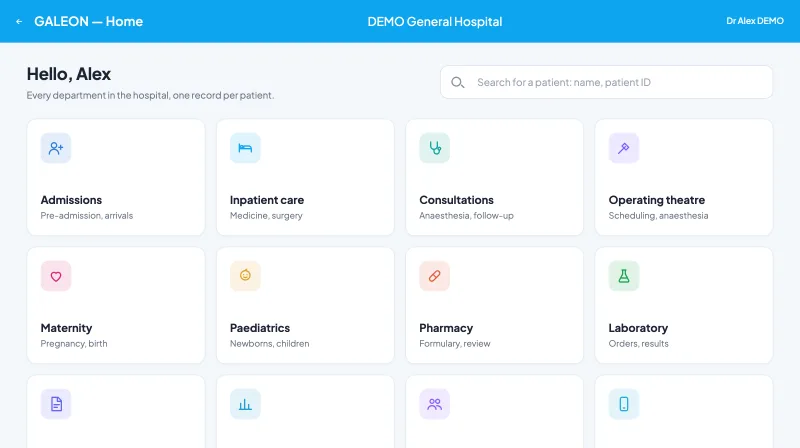
 See Galeon for real
The 5 Types of Medical AI Transforming Hospitals in 2026
The 5 types of medical AI in hospitals in 2026: CPOE, voice, scanning, billing and diagnostics, with the benefits and risks of each family.
The Essentials in 30 Seconds
| Question | Short Answer | What to Remember |
|---|---|---|
| What is medical AI? | Algorithms assisting clinical and admin tasks | It is not a single tool: several families exist, each with its own specific scope, benefits, and risks. |
| What are the 5 types of medical AI? | CPOE, Voice, Scanning, Billing, Diagnostics | These 5 families cover virtually all hospital use cases currently deployed and operational. |
| Does medical AI replace the physician? | No — it assists and secures | AI handles repetitive tasks and frees up time; clinical judgment and empathy remain strictly human. |
| Does CPOE reduce medication errors? | Yes, significantly | WHO notes drug-related harm affects 1 in 30 patients—CPOE is the primary line of defense. |
| Is voice recognition reliable in hospitals? | Yes, under right conditions | Medical-grade solutions achieve over 95% accuracy in continuous dictation using specialized vocabulary. |
| What is automatic billing coding? | AI translation of care into codes | Poor coding (PMSI) costs hospitals millions in lost revenue every year. AI ensures financial accuracy. |
| Are these AIs GDPR-compliant? | Yes, with sovereignty | HDS certification and data decentralization are essential prerequisites for compliant medical AI. |
Introduction
Medical artificial intelligence is often presented as a homogeneous revolution. In reality, it covers very different realities depending on whether one is talking about prescription support, voice recognition, automatic prescription scanning, hospital activity coding, or early disease detection. Each AI family addresses a specific problem, integrates differently into the electronic health record (EHR), and comes with its own regulatory requirements.
In 2026, hospital CIOs and CEOs can no longer rely on generic discourse about "AI in hospitals." They need to know precisely what each type of AI delivers, what it costs in terms of integration, and what it requires in terms of data quality. Because AI is only as effective as one condition allows: the data it is fed must be structured, reliable and accessible.
Galeon currently operates in 19 hospitals, manages more than 3 million patient records and supports thousands of caregivers daily. This field experience confirms a reality that software vendors often downplay: the quality of medical AI depends entirely on the quality of the structured data upstream. That is where everything is decided.
This article details the 5 major types of medical AI currently deployed in healthcare facilities, their concrete benefits, their real limitations and the conditions for a successful integration into a modern EHR.
Why is Medical AI Not a Single Tool?
The most common mistake in hospital procurement is treating "medical AI" as a feature. It is in reality an ecosystem of distinct modules, each trained on different data, addressing different objectives and subject to different levels of certification.
Five major families can be distinguished based on their point of application in the care pathway:
- Clinical decision support, of which CPOE is the most regulated application
- Enhanced data capture, via voice recognition and prescription scanning
- Administrative valuation, via automatic activity coding (PMSI, CCAM)
- Diagnostic support and early disease detection
- Multi-hospital predictive analysis, still emerging, which anticipates risks at scale
It is the first four types that are now operationally deployed at scale in French hospitals.
Type 1 — What is CPOE and Why is it the First Defence Against Medication Errors?
What exactly is CPOE?
Computerised Physician Order Entry (CPOE) — known in France as LAP (Logiciel d'Aide à la Prescription) — is a module integrated into the EHR that analyses every medication prescription in real time and alerts the physician to any risk. It checks for contraindications, drug interactions, overdosages and the appropriateness of the prescribed molecule for the patient's profile (allergies, weight, associated pathologies).
This is not optional: in France, healthcare facilities have been required to deploy a certified CPOE system since the decree of 13 March 2015. Certification is issued by the Haute Autorité de Santé (HAS) ¹.
Why is CPOE critical?
According to the WHO, drug-related harm affects 1 in 30 patients in healthcare settings, and half of all preventable harm in healthcare is attributable to medication ². Globally, medication errors alone represent an estimated annual cost of $42 billion ³.
A well-integrated CPOE system reduces these errors at source. But its effectiveness is directly conditioned by the quality of EHR data: if the patient record is incomplete (unrecorded allergies, missing pathologies), the AI cannot detect real risks.
CPOE is only as intelligent as the patient record it relies on. This is the fundamental principle every CIO must internalise before choosing a solution.
What Galeon contributes on CPOE
Galeon's EHR structures patient data from the point of caregiver input, with mandatory fields and validation by the healthcare professional. CPOE therefore has a reliable, up-to-date data foundation, which reduces false alerts and improves detection of genuine risks.
Type 2 — How Does Voice Recognition Transform Medical Documentation?
The problem: physicians spend more time documenting than caring
According to a Les Echos Études / Nuance survey conducted among French healthcare facilities, healthcare professionals spend an average of 40% of their time on medical documentation and patient record management ⁴. In the same panel, 73% of physicians consider EHR systems insufficiently ergonomic and poorly adapted to their practice ⁴.
Medical voice recognition — also known as digital medical dictation — allows the caregiver to dictate notes, observations and prescriptions verbally, during or after the consultation. The AI transcribes in real time, into the correct EHR field, using a specialised medical vocabulary.
What are the real performance figures for voice recognition in hospital settings?
Solutions specialised in medical vocabulary now achieve accuracy rates above 95% in continuous dictation under normal operating conditions ⁵. Documented time savings range from 30 to 50% on report writing tasks — which represents, for a facility of 350 physicians, a potential saving estimated at several million euros per year ⁴.
These performances require three conditions:
- Training on specialised medical vocabulary (not a general-purpose model)
- Direct integration into the EHR (not a separate application layer)
- Controlled acoustic environment, which remains a challenge in some emergency departments
What is the link with data quality?
Voice recognition produces unstructured text if it is not coupled with an intelligent structuring layer. A dictated report must be readable, indexed and exploitable by other EHR modules — including CPOE and automatic coding. Without this intermediary layer, voice recognition creates textual data that is unusable by AI.
Galeon integrates this structuring downstream of transcription: dictated data is normalised, coded and made interoperable without any additional manual intervention.
Type 3 — What is Prescription Scanning and Intelligent OCR?
The use case
When a patient arrives at the emergency department or a consultation with a paper prescription issued by an external physician, the care team must manually re-enter the medications into the EHR. This is a time-consuming task prone to input errors (dosages, frequencies, drug names).
Prescription scanning uses computer vision (OCR + AI) to read the prescription, identify medications, dosages and dosing schedules, and import them directly into the EHR. CPOE then takes over to validate the prescription.
What are the current limitations?
Prescription scanning is one of the types of medical AI most sensitive to the quality of the source document. An illegible handwritten prescription, a non-standard abbreviation, a drug name spelled phonetically: each deviation reduces model accuracy.
In practice, complete recognition rates without correction range from 75 to 90% depending on handwriting quality and prescription standardisation ⁶. A caregiver must always validate the automatic entry before saving it in the EHR. This is not an AI limitation — it is a regulatory and ethical requirement.
Why is this type of AI strategic for care continuity?
By streamlining the import of external prescriptions into the EHR, this AI reduces breaks in the care pathway and shortens medication management timelines. It is particularly valuable in emergency departments and critical care units, where speed of action is critical.
Type 4 — How Does AI Automate PMSI Coding and Hospital Billing?
What is PMSI?
The Programme de Médicalisation des Systèmes d'Information (PMSI) is France's hospital activity classification and billing system. Every stay, procedure and consultation must be coded according to the CCAM (procedures) or ICD-10 (diagnoses) nomenclature to generate the facility's revenue through Activity-Based Funding (T2A).
This coding is currently performed manually or semi-manually by medical information technicians (TIM) or medical information department physicians (DIM). It is a lengthy, complex task prone to interpretation errors.
What is the real cost of coding errors to hospitals?
Coding errors have two direct consequences: revenue loss (under-coding) and risk of audit by the Health Insurance fund (over-coding). The ATIH, the national agency for hospital information, publishes annual results of checks revealing significant coding discrepancies in both public and private facilities ⁷. These discrepancies represent hundreds of millions of euros in uncaptured revenue at system level.
The automatic coding AI analyses the patient record — reports, procedures performed, retained diagnoses — and automatically proposes the corresponding PMSI and CCAM codes. The DIM physician validates, corrects if necessary, and publishes.
What are the performance conditions?
Automatic coding can only function under one non-negotiable condition: the clinical data entered in the EHR must be structured and exhaustive. A vague report, an incomplete observation, an unrecorded procedure: the AI cannot code what it cannot see.
This is why Galeon structures data from the point of caregiver input, with guided entry frameworks and normalised fields. The DIM then accesses a complete record, readable by the coding AI, without having to reconstruct activity from scattered notes.
Type 5 — How Does AI Support Diagnosis and Early Disease Detection?
Why is diagnostic support the most strategic type of medical AI?
The first four types of AI primarily act on the administrative and documentary chain of care. The fifth acts on the clinical decision itself: detecting a pathology earlier, more accurately, and sometimes where the human eye would have missed the signal.
It is also the type of AI that creates the most value for medical research — and the one that requires the most structured data, drawn from multiple hospitals, to achieve clinically reliable performance. A diagnostic AI trained on data from a single hospital cannot be generalised.
What are the concrete applications in 2026?
In radiology, deep learning algorithms analyse medical images (CT, MRI, X-ray) and detect anomalies sometimes invisible to the naked eye. Some FDA-cleared systems achieve sensitivity above 98% for detecting intracranial haemorrhages ⁸. A study by Imperial College London showed that AI detects 13% more breast cancers than imaging alone during screening trials ⁹. As of 2025, 54% of US hospitals with more than 100 beds report using AI in radiology ¹⁰.
For sepsis detection, predictive models continuously analyse vital signs, laboratory results and clinical notes to identify at-risk patients several hours before clinical signs appear. A systematic review of 52 studies published in 2025 shows that early sepsis detection AI models achieve AUCs (area under the ROC curve) of 0.79 to 0.96 — significantly outperforming traditional clinical scores such as qSOFA ¹¹.
For emergency department triage, AI systems have reduced average radiology report turnaround times from 11.2 days to 2.7 days in some facilities ¹⁰.
Why does this type of AI require a multi-hospital infrastructure?
A study published in Nature Medicine in 2024 showed that chest X-ray models trained at a single institution experienced up to a 20% drop in diagnostic performance when tested on external data ¹². This training data bias is the primary barrier to the generalisation of diagnostic AI.
The model benefits from the clinical diversity of the entire network, with no transfer of sensitive data. Data stays in the hospital. Only intelligence travels.
What is the difference between diagnostic support and replacing the physician?
Diagnostic AI is a decision support tool, not an autonomous diagnosis. It proposes, flags and prioritises — the physician interprets, confirms and decides. The European AI Act classifies these systems as high-risk AI, requiring transparency, traceability and mandatory human oversight ¹³.
How to Compare These 5 Types of AI Against a CIO's Criteria?
| Criterion | CPOE | Voice Recognition | Prescription Scan | Auto PMSI Coding | Diagnostic Support |
|---|---|---|---|---|---|
| Maturity | Very mature (HAS-certified) | Mature (Medical vocab.) | Progressing | Rapidly developing | Variable (Advanced in Rad) |
| Certification | HAS Mandatory | HDS-certified EHR | Human validation | DIM oversight | AI Act / CE marking |
| Impact | Reduces critical errors | Saves 30–50% doc time | Reduces manual entry | Reduces TIM/DIM load | Early detection/delay red. |
| Risk if failed | Alert fatigue | Unstructured unusable data | Undetected import errors | ATIH audit risk | Data bias / Accuracy drop |
| Traditional EHR | Generic alerts (disconnected) | Manual re-entry | OCR only, no AI semantics | 100% manual coding | Local AI, not generalisable |
What are the Real Limitations of Medical AI That CIOs Must Know?
Absolute dependence on data quality. All these modules — without exception — are only as good as the data they rely on. A poorly completed EHR, unstructured free-text fields, duplicate entries in the patient record: every imperfection translates into degraded AI performance. In France, the Les Echos Études / Nuance study reveals that only 16% of patient records are genuinely complete ⁴. This is the primary barrier to effective medical AI deployment — far ahead of the technology itself.
Alert fatigue in CPOE. According to a review of clinical literature, between 72 and 99% of alerts generated by clinical decision support systems are false alarms ¹⁴. Another study shows that up to 71.9% of alerts are ignored by pharmacists ¹⁵. When CPOE is poorly calibrated, caregivers become desensitised, which nullifies its safety benefit.
Bias risk in diagnostic AI. A Nature Medicine study (2024) shows that a radiology model trained on data from a single hospital can lose up to 20% precision on external data ¹². This bias is invisible until the AI is tested on a population different from its training set.
Regulatory risk in automatic coding. The ATIH regularly audits hospital billing ⁷. Unsupervised automatic coding can generate anomalies that are difficult to justify during a T2A audit. DIM physician validation remains essential, even with a high-performing AI.
Technical integration into existing information systems. The CNIL documented, through thirteen checks between 2020 and 2024, recurring shortcomings in EHR traceability and authentication ¹⁶. Grafting AI modules onto non-compliant legacy systems creates cumulative regulatory and security risks.
FAQ — Questions Caregivers and CIOs Actually Ask
Can medical AI prescribe on behalf of the physician?
No. In France, as throughout the European Union, the prescribing decision remains an exclusively human medical act, engaging the practitioner's responsibility. Medical AI — including CPOE — is a decision support tool. The European AI Act, fully applicable since 2024, classifies medical decision support systems as high-risk AI, imposing strict requirements for transparency and human oversight ¹³.
What is the difference between CPOE and a simple drug interaction checker?
A drug interaction checker consults a static database and returns a binary alert. An HAS-certified CPOE goes further: it takes into account the patient's complete profile, analyses the appropriateness of the prescription in that specific context and prioritises alerts by severity level. HAS certification guarantees clinical validation and regular updates ¹.
Does medical voice recognition work in all departments?
Not under all conditions. Emergency departments present specific acoustic challenges (ambient noise, frequent interruptions) that can reduce accuracy. In consultations, internal medicine and standard inpatient wards, results are very good with solutions specialised in medical vocabulary, with time savings of 30 to 50% ⁴.
Can automatic PMSI coding be used without a DIM physician?
No. The AI proposes; the DIM physician validates. This validation is not a constraint: it is a quality and compliance guarantee during ATIH audits ⁷. The objective is to allow the DIM to focus on complex cases, not to replace them.
Are these AIs GDPR and HDS-compliant?
They can be, provided the underlying architecture meets the requirements of French Health Data Hosting (HDS) certification and that data processing is governed by a GDPR-compliant subcontracting agreement ¹⁷. Galeon's decentralised architecture, where data never leaves the hospital's servers, provides an additional layer of sovereignty.
How long does it take to deploy these AIs in a hospital?
CPOE can be operational within a few weeks if the EHR is interoperable. Voice recognition requires a model adaptation phase (2 to 4 weeks). Automatic coding requires a prior data quality audit (1 to 3 months). Diagnostic support is the longest to deploy: it requires local clinical validation and integration into the radiology or clinical workflow (3 to 6 months minimum).
Is diagnostic AI reliable for all pathologies?
No, and this is a crucial point. Performance varies significantly by specialty and by the volume of training data available. AI performs very well in radiology (AUC > 0.90 for several pathologies) and in sepsis detection on structured data ¹¹.
In Summary
In 2026, the five major types of medical AI operational in hospitals — CPOE, voice recognition, prescription scanning, automatic PMSI coding and diagnostic support — are not interchangeable. Each addresses a specific problem in the care pathway, requires specific integration conditions and presents limitations that must be anticipated. Their absolute common point: performance depends on the quality of structured data in the EHR. Yet only 16% of French patient records are genuinely complete today ⁴ — making this the primary barrier to medical AI, well ahead of the technology itself. Galeon starts from this observation to build an EHR where data is structured at the point of caregiver input: clean, normalised and exploitable by every AI module, in real time, across 19 hospitals and over 3 million patient records.
If you’d like to find out more, take a look at our article Smart EHR vs traditional EHR : why hospitals are switching to AI in 2026
Want to know more about our medical AI ?
Book a demoSources
⁵ Nuance Communications / Dragon Medical — Performance data published by the manufacturer, corroborated by independent hospital evaluations. Accuracy > 95% with specialised medical vocabulary under standard conditions.
⁶ Medical OCR literature review — Performance documented in several European hospital pilot studies on handwritten prescription recognition. Accuracy without correction: 75–90% depending on handwriting quality and document standardisation.
Related reading
They trust us
19 hospitals running Galeon in France.













Join the pioneers of care.

 2 sales reps available from tomorrow
Your IT, your interfaces, your timeline. Pick a slot: Valérie or Yohan will call you back.
- HDS certified
- ISO 27001
- GDPR compliant
- LAP certified (HAS)