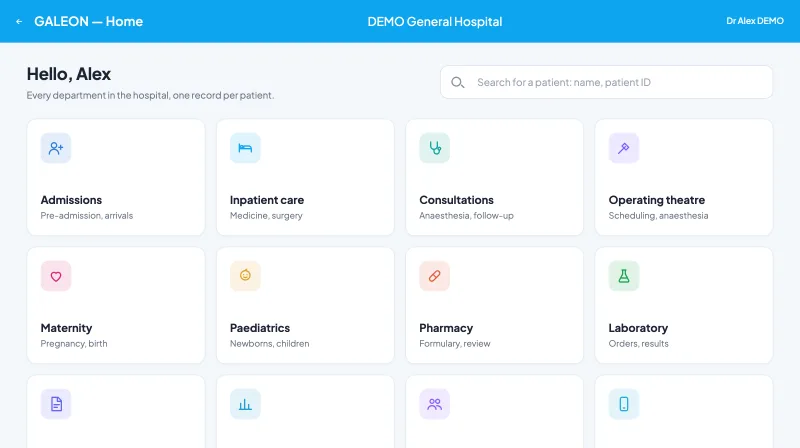
 See Galeon for real
Smart EHR vs traditional EHR : why hospitals are switching to AI in 2026
In 2026, AI turns data into care. Less admin, native security, and AI-assisted medical decisions for hospitals.
Essential insights in 30 seconds
| Question | Short Answer | What to remember |
|---|---|---|
| What is a traditional EHR? | An entry and archiving tool | Designed to store data, not to analyze or exploit it |
| What is the main difference? | Active data processing | One preserves, the other makes data "speak" to improve care |
| Does it change the daily life of caregivers? | Yes, profoundly | Less administrative entry, more time devoted to the patient |
| Is it GDPR and HDS compatible? | Yes, natively | New generation intelligent EHRs are designed with privacy by design |
| How many hospitals have already taken the plunge? | 19 Galeon partner facilities | Over 3 million structured records, thousands of caregiver users |
| Where to start concretely? | With an audit of the existing IT system | Before any migration, evaluating the existing system is the essential first step |
How should one choose an electronic health record in 2026 ?
When selecting an EHR in 2026, a hospital must, as a minimum, verify HDS certification, compatibility with the European Health Data Space, FHIR/HL7 interoperability, the presence of integrated AI to assist healthcare professionals, and data sovereignty. Galeon meets these criteria with 19 partner hospitals.
Introduction
Hospitals accumulate millions of medical data points every day. Yet, the vast majority of this data remains untapped, locked in systems designed to archive, not to analyze. This is the paradox of the traditional EHR: the more it stores, the less it helps.
An intelligent EHR does not replace the patient record, it transforms it into a medical decision tool. This is the shift currently being experienced by the 19 Galeon partner hospitals, where more than 3 million patient records are structured, secured, and exploited by AI algorithms trained on a decentralized inter-hospital network.
In 2026, the question is no longer whether hospitals will switch to intelligent EHRs. The question is to understand what this transition changes concretely for caregivers, for CIOs, for CEOs and what the real obstacles to anticipate are.
This article gives you a structured answer, without unnecessary jargon: the fundamental differences between the two models, the measurable benefits, the honest limitations, and the criteria for evaluating if your facility is ready.
Why have traditional EHRs reached their limits ?
The traditional EHR represented a major breakthrough when it replaced paper records in the 2000s. It allowed patient information to be centralized, made accessible to the healthcare team, and secured archiving.
But this model was designed for an era when medical data was simple, low in volume, and rarely shared between facilities. In 2026, this assumption no longer holds.
Health data is exploding and traditional EHRs are suffocating
The volume of global medical data doubles every 73 days according to estimates from the IDC (International Data Corporation). A single hospitalized patient generates thousands of data points per stay: vital signs, biological results, prescriptions, reports, imaging.
Traditional EHRs were not designed to process this volume. They store it, but do not exploit it. This data remains inert, whereas it could detect clinical degradation before it is visible, or suggest a therapeutic adjustment based on thousands of similar cases.
Caregivers spend more time in front of screens than with patients
According to a study published in the Journal of the American Medical Association, doctors devote an average of 44% of their working time to administrative tasks, a large part of which is directly linked to entry and navigation in EHRs.
This figure is an alarm. In a context of medical shortage, every hour lost in a heavy interface is an hour stolen from care. More than half of French hospital doctors state that IT tools degrade their quality of life at work, according to data from the National Council of the Order of Physicians.
The digital administrative burden has become one of the identified causes of hospital burnout.
Data silos slow down care coordination
In the majority of hospitals, data from the cardiology department does not communicate with that of intensive care. Information for a patient transferred from one facility to another does not follow automatically. Each application boundary is additional friction for the caregiver, and an additional risk for the patient.
This fragmentation is not a technical fatality. It is the result of architectures designed without interoperability, in a context where inter-hospital data sharing was not yet a priority.
What is an intelligent EHR, and how does it work concretely ?
It is not a replacement for the EHR: it is its natural evolution.
AI integrated into the care pathway : what it really changes
In an intelligent EHR, AI algorithms analyze data entered by caregivers in real-time and generate alerts, suggestions, and automations directly in the work interface.
Here is what this means in practice for a healthcare team:
- Early detection of clinical degradations : the AI crosses dozens of parameters simultaneously and alerts the team before signs are visible in a classic clinical examination.
- Diagnostic decision support : the system suggests differential diagnoses by relying on thousands of similar cases treated in the network.
- Alerts on drug interactions : at the precise moment a prescription is written, not downstream.
- Automatic generation of reports : a first version is produced from the data entered, the doctor validates and adjusts.
These features are not prospective. They are operational today in the 19 facilities of the Galeon network.
Native interoperability : the end of data silos
An intelligent EHR relies on international standards for medical data exchange, notably HL7 FHIR (Fast Healthcare Interoperability Resources), which allow different systems to share information in a structured and secure way.
In the Galeon model, this interoperability takes on an additional dimension : it extends to an inter-hospital network of 19 facilities.
The data does not move. It is the algorithms that travel. This is the founding principle of Galeon's proprietary technology.
What are the concrete benefits for a hospital CIO ?
For a Chief Information Officer, the question of the intelligent EHR arises first in terms of risk, compliance, and return on investment.
How to reduce technical debt without rebuilding everything ?
Most French hospital IT systems are composed of application layers accumulated over twenty years. Each update is a risk, each integration a project. A well-designed intelligent EHR allows this stack to be consolidated around a modular and scalable architecture.
Galeon does not force a brutal replacement of the existing system. The platform integrates progressively into the existing IT system, by structuring and enriching the data already produced without starting from scratch.
Would you like to discover the benefits of our EHR ?
Book a demoHow to guarantee HDS and GDPR compliance on an AI project ?
Health Data Hosting (HDS) is a legal obligation in France. Any service provider that processes personal health data must be HDS certified by ANSSI. New generation intelligent EHRs integrate this constraint from the design stage, with a privacy by design architecture compliant with GDPR.
Regulatory compliance must not be an extra layer added after the fact. It must be architectural.
How to position the hospital IT system for the next ten years ?
Investing in an intelligent EHR today means preparing the facility to participate in the medical research of tomorrow, to offer predictive diagnoses, and to attract the most qualified medical and technical profiles. Hospitals that structure their data now will take an irreversible lead.
What are the concrete benefits for a Hospital General Director ?
For a CEO, the question arises differently: quality of care, attractiveness of teams, and financial balance of the facility.
How to give medical time back to caregivers ?
The first feedback from hospitals that have deployed an intelligent EHR shows measurable gains: significant reduction in entry time, automation of reports, preventive alerts that avoid complications and therefore unscheduled prolonged stays.
Every minute given back to the caregiver is a minute given back to the patient. In a context of structural medical shortage, this is a performance lever directly linked to the quality of care.
How to make the hospital an attractive facility for recruitment ?
Young doctors and nurses grew up with fluid and intuitive digital interfaces. Offering a heavy, unresponsive, and poorly integrated EHR has become a barrier to recruitment. Conversely, a facility equipped with modern AI tools sends a strong signal about its culture of innovation and its investment in working comfort.
How to transform data into a source of income ?
With the Galeon model, the data produced by the hospital is no longer an IT burden, it becomes a valuable resource. Every time an algorithm uses data from a partner facility as part of the Galeon network, that facility receives remuneration. This is an unprecedented economic model in the public hospital sector.
Intelligent EHR vs. Traditional EHR : The Full Comparison
| Criterion | Traditional EHR | Intelligent EHR (Galeon) |
|---|---|---|
| Main function | Store and archive patient data | Analyze, anticipate risks and help medical decision |
| Interoperability | Limited, siloed architecture by facility | Native, based on FHIR/HL7 standards and inter-hospital network |
| Decision support | Absent, the doctor interprets alone | Integrated AI that analyzes data in real-time and generates alerts |
| Admin burden | High, heavy and unintuitive interface | Reduced by automation of reports and simplified entries |
| Data sovereignty | Theoretically with the hospital, but poorly controlled | Technically guaranteed: data never leaves the facility's servers |
| Economic value | Untapped, pure cost | Valuable via the Galeon network, remuneration proportional to contribution |
| GDPR compliance | Managed as an extra layer, often incomplete | Privacy by design, integrated from the architecture |
| Scalability | Limited by accumulated technical debt | Modular architecture, progressive integration into the existing IT system |
| Impact on recruitment | Identified barrier for young profiles | Attractiveness argument for medical and technical teams |
What are the real limits and stakes of this transition?
A serious article cannot ignore the real difficulties. Here are the five stakes that every facility must honestly anticipate.
- Adoption by caregivers remains the first factor of success or failure. The best tool in the world fails if the teams do not use it. Change management, training, involvement of doctors from the design phase, progressive support, is often more decisive than the technological choice itself.
- The migration of existing data is a heavy technical project. Years of data in heterogeneous formats do not transfer in a few weeks. This project requires a rigorous methodology, an experienced partner, and a phase of coexistence of the two systems that is often underestimated.
- The regulatory framework is evolving rapidly. The European AI Act and the European Health Data Space (EHDS) are being deployed. Facilities must choose partners capable of adapting their solution in real-time to these developments without generating operational disruption.
- Data quality conditions the quality of AI. An algorithm trained on poorly structured, incomplete, or heterogeneous data will produce mediocre results. Structuring the data upstream is the heart of Galeon's work and is a non-negotiable prerequisite for any AI ambition.
- The question of sovereignty remains a political as well as a technical debate. Who controls health data? Who benefits from the value created by algorithms? These are questions that facility management must explicitly ask their technological partners before signing.
FAQ : Questions that CIOs and CEOs ask about the intelligent EHR
Can we deploy an intelligent EHR without replacing the entire existing information system ?
Yes. New generation solutions like Galeon are designed to integrate progressively into the existing IT system. The approach consists of structuring and enriching the data already produced, without imposing a brutal migration that would paralyze the facility. The transition is done in layers, preserving operational continuity.
How long does it take to deploy an intelligent EHR in a hospital ?
Deployment varies according to the size of the facility and the complexity of the existing IT system. In practice, the first AI features can be operational in a few months. Full deployment, including team training and historical data migration, generally takes 12 to 24 months.
How to guarantee that patient data will not be used without their consent ?
This is a legal obligation framed by the GDPR and French law. In the Galeon model, patient consent is integrated into the system: a patient who has given their consent to the use of their data can withdraw it at any time.
What are the criteria for evaluating if an intelligent EHR is HDS compliant ?
HDS certification is issued by ANSSI in France. It covers hosting, security management, service continuity, and reversibility. Every healthcare facility must verify that its service provider is indeed HDS certified before any deployment. This is a non-negotiable criterion, not an option.
Summary : what you should remember about the intelligent EHR in 2026
The traditional EHR has fulfilled its role for two decades. But faced with the explosion of medical data, the pressure on caregivers, and the requirements of personalized medicine, its structural limits are now insurmountable. The intelligent EHR is not an improved version of the previous one — it is a paradigm shift: data ceases to be an archive to become a real-time medical decision tool.
The benefits are measurable at three levels. For caregivers, less administrative burden and more patient time. For CIOs, a modern, compliant, and scalable architecture. For general directors, a more attractive, more efficient facility, and for the first time capable of economically valuing its health data.
The medicine of tomorrow is built with the data of today. Hospitals that structure their IT system now will be the ones that provide better care tomorrow.
In addition to this article, you can consult our article ‘What is an Electronic Patient Record?’
Would you like to know more about our Smart EHR ?
Book a demoSources
- Shanafelt T. et al., Relationship Between Clerical Burden and Characteristics of the Electronic Environment With Physician Burnout and Professional Satisfaction, JAMA Internal Medicine, 2017.
- International Data Corporation (IDC), Data Age 2025: The Digitization of the World, world report, 2018.
- National Council of the Order of Physicians (CNOM), Atlas of medical demography and survey on practice conditions, 2023 edition.
- Commission Nationale de l'Informatique et des Libertés (CNIL), Practical GDPR guide for healthcare facilities, 2022.
- Health Digital Agency (ANS), Interoperability and security framework, 2023.
- European AI Act, Official Journal of the European Union, adopted June 2024.
- Galeon, White paper.
Related reading
They trust us
19 hospitals running Galeon in France.
















Join the pioneers of care.

 2 sales reps available from tomorrow
Your IT, your interfaces, your timeline. Pick a slot: Valérie or Yohan will call you back.
- HDS certified
- ISO 27001
- GDPR compliant
- LAP certified (HAS)