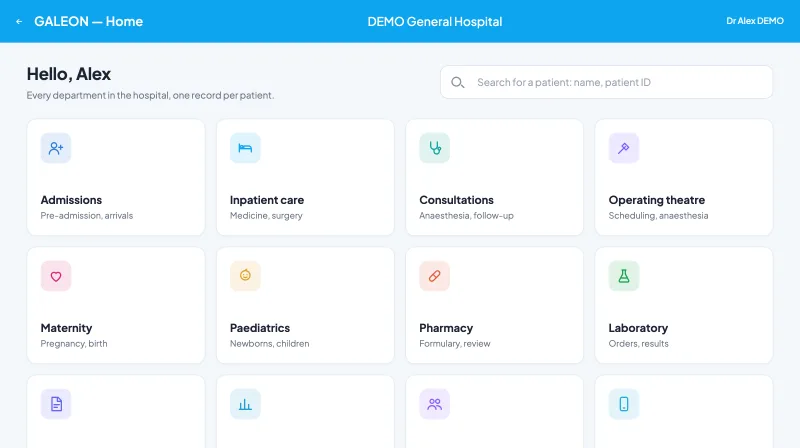
 See Galeon for real

Incomplete RCP File in Oncology: Why a Case Is Postponed in 2026
Incomplete RCP file in oncology: the 10 items expected, the 5 reasons a case is postponed and what the patient record can change.

The essentials in 30 seconds
| Question | Short answer | Key takeaway |
|---|---|---|
| What is an incomplete RCP file? | A record that does not contain, on the day of the meeting, the information needed to discuss treatment: diagnosis, stage, history, imaging, pathology, treatment intent. | The case is postponed, with a possible loss of chance for the patient. |
| Why is a case postponed? | The French communicating cancer record (DCC) offers five reasons: incomplete file, requesting physician absent, quorum not reached, file registered late, other. | Two reasons out of five depend on the record and how it circulates. |
| What can a record structured at the source change? | Generating the form from the record, structuring stage and intent as fields, flagging gaps before the meeting, tracking postponements. | It acts on what depends on it, not on quorum or on physicians' attendance. |
Introduction
An incomplete file is enough to delay a treatment decision. In 2023, the French National Cancer Institute (INCa) and Santé publique France estimated 433,136 new cancer cases in mainland France (INCa, Santé publique France). Every patient's file must go through a multidisciplinary tumor board (RCP, for réunion de concertation pluridisciplinaire) at least once. That step is only as good as what the meeting has in front of it.
The pages that explain the RCP form are mostly documents from regional cancer networks, written for professionals who already know them. This article puts them in plain language: what a file must contain, why it is postponed, and what a record structured at the source can change.
At Galeon, an EHR built with clinicians since 2016 and used by more than 10,000 healthcare professionals, structuring data at the point of entry is the design principle. The RCP form is a textbook case. A tumor board can only inform a treatment if what it looks for already exists, in the right place, before the meeting.
What is an RCP form, and why does its content matter?
The RCP brings together physicians from different specialties around the file of a patient with cancer. According to the French National Authority for Health (HAS), it aims to guarantee care that follows good-practice guidelines. A diagnostic or therapeutic RCP brings together at least three physicians from different specialties.
A decree of 26 April 2022 set the principle of revising the rules that apply to RCPs. The INCa reference framework, updated in December 2023, is now the baseline.
The RCP form is the standardised document that records the request for discussion and the treatment proposal. It most often circulates in the communicating cancer record (DCC), a regional platform for the secure sharing of a patient's documents.
What must a file contain before the RCP?
A complete file holds enough to discuss and propose a suitable treatment plan. OncoNormandie, which draws on the INCa framework here, lists the main items to find:
- The reason for the request to go before the RCP.
- Patient identification.
- The main diagnosis: ICD-10 code, summary of the disease.
- Clinical elements: cTNM stage, extension work-up, clinical status, WHO performance score.
- History: personal and family history, and comorbidities.
- Disease phase (initial or relapse), treatment intent (curative or palliative) and treatment history.
- Imaging results, pathology reports and the operative report where relevant.
- G8 screening or geriatric assessment for patients aged 75 and over.
- Fertility preservation, where relevant.
- The treatment proposal from the referring physician.
This list is not exhaustive. The INCa framework remains the reference, in its current version.
Why is a case postponed at the RCP?
When a case is postponed in the DCC, the author picks one of five reasons: incomplete file (a missing test, for example), requesting physician absent, quorum not reached, file registered late, or other. Choosing "other" requires free text, which the networks then have to sort by hand.
Two reasons that depend on the record
An incomplete file and a file registered late depend directly on the quality of the record and how it circulates. The other three depend on how the meeting is organised. A postponement is not neutral: OncoNormandie mentions a possible loss of chance for the patient.
What the sources do not measure
The documents reviewed define the method for measuring the postponement rate for incomplete files. They give no national rate and do not quantify the loss of chance. Each centre is better off measuring its own before drawing conclusions.
Where does information get lost between consultation and RCP?
An incomplete form can signal information that exists somewhere without having reached the place the RCP looks. Four leads deserve an audit. They are leads, not measurements: none of the public sources reviewed quantifies their respective share.
Reports produced elsewhere
A pathology or imaging report written in another piece of software has to be found, sometimes scanned, sometimes re-entered. Each step adds a delay and a risk of error.
Specialised tools
Radiotherapy and chemotherapy rely on dedicated software for prescription, preparation and planning. If their content does not flow back into the record, two versions of the treatment coexist.
The form outside the record
The DCC is a regional platform. The form and the decision can live next to the hospital record, and the department physician then has to go and fetch them.
Free text
A stage, a WHO score or a treatment intent written in sentences cannot be found at a glance and cannot be counted. A structured field can.
Can a record structured at the source prevent a postponement?
A patient record does not replace how an RCP is organised: it neither brings the requesting physician to the meeting nor reaches quorum. It acts on what depends on it, through four levers.
Generating the form from the record removes a re-entry. Structuring stage, WHO score and treatment intent as fields makes the information findable and checkable. Flagging missing items before the meeting, rather than on the day, leaves time to fix them. Finally, tracking the reason for each postponement lets the hospital measure its own rate.
Silo record or record structured at the source: where is a complete form won?
| Criterion | Silo record | Record structured at the source |
|---|---|---|
| Building the form | Re-entered in another platform | Record fields carried over where they are needed |
| Stage and treatment intent | Free text | Fields that can be found and checked |
| A missing item | Discovered on the day of the meeting | Flagged before the meeting |
| "Other" postponement reason | Free text, sorted by hand | Coded, measurable reason |
Mon espace santé: why will the RCP form and the care plan leave the hospital?
In May 2024, the Digital Health Delegation, the French Digital Health Agency (ANS) and INCa set a goal. Every patient with cancer should receive their personalised care programme (PPS) through Mon espace santé, France's national patient health space.
In 2025, a call for projects funded by ANS and INCa aimed to upgrade regional tools that produce the PPS and the RCP form so that they feed this profile. It was open to regional players, with a deadline of 17 June 2025 and a duration of 36 months.
This trend affects every hospital: what the record produces will increasingly flow out to the patient. A PPS generated from a free-text record will have to be corrected by hand before it is sent.
Limits and points of caution
- The sources are regional and institutional. They describe a framework and methods, not a national survey of case postponements.
- The INCa framework is authoritative. The list in this article summarises it. Each hospital should reread it in its current version.
- Structuring takes work. Configuring fields with the RCP physicians, training teams and following framework updates takes time. A poorly configured tool moves the problem without solving it.
- A record does not act on everything. The attendance of the requesting physician and quorum depend on how the meeting is organised.
- This article describes a framework and principles. It is not a description of the features of an oncology tool.
FAQ
What is an incomplete RCP file? It is a file that lacks, at the time it goes before the RCP, some information about the patient and diagnosis needed for the discussion and the treatment proposal (OncoNormandie's definition).
What happens when a case is postponed at the RCP? Its review is pushed to a later meeting, and the reason for the postponement is recorded in the DCC. OncoNormandie mentions a possible loss of chance for the patient.
How many physicians are needed for an RCP? A diagnostic or therapeutic RCP brings together at least three physicians from different specialties. The INCa framework specifies the expertise expected for each disease.
What is the communicating cancer record (DCC)? It is a regional platform that lets healthcare professionals securely share the documents of a patient treated for cancer, including the RCP form.
Can a patient record prevent postponements? It can reduce those caused by an incomplete or late file, by generating the form, structuring fields and alerting before the meeting. It does not remove those caused by a physician's absence or by quorum.
In summary
A complete file on the day of the RCP comes down to ten items that the record must put in front of the meeting. When one is missing, the case is postponed, with a possible loss of chance for the patient. Four levers depend on the record: generating the form, structuring data, alerting before the meeting and tracking postponements. Quorum and attendance remain a matter of organisation. This is the principle that guides how Galeon is designed: structure data at the source so that it serves wherever it is expected.
Read also: EHR and clinical documentation time · To audit your own record, download our white paper The patient record in oncology: from consultation to RCP, from RCP to treatment.
Sources
- INCa, The multidisciplinary tumor board (RCP) in oncology, framework updated in December 2023
- HAS, Multidisciplinary tumor board in oncology
- OncoNormandie, Evaluation: incomplete RCP forms, version 3 of 29 June 2026
- Santé publique France, cancers: estimated incidence in 2023
- ARS Nouvelle-Aquitaine, Communicating cancer record (DCC)
- ANS, Call for projects: evolution of the communicating cancer record
19 hospitals running Galeon in France.
Related reading
They trust us
19 hospitals running Galeon in France.
















Join the pioneers of care.

 2 sales reps available from tomorrow
Your IT, your interfaces, your timeline. Pick a slot: Valérie or Yohan will call you back.
- HDS certified
- ISO 27001
- GDPR compliant
- LAP certified (HAS)