 See Galeon for real
The pregnant patient’s record, from first ultrasound to delivery
The pregnant patient’s record: why a single, interoperable obstetric record streamlines pregnancy follow-up, from the first ultrasound to de
The essentials in 30 seconds
| Question | Short answer | What to remember |
|---|---|---|
| The main problem? | Data does not flow between exams. | The patient carries everything. |
| What does it cost? | Lost time, less reliable follow-up. | You partly start over at each scan. |
| The solution? | A single, shared obstetric record. | History in one click. |
| The next step? | Connect devices to the record. | Structured data, no re-entry. |
| Who benefits? | Midwives, obstetricians, patients. | Continuity, not paperwork. |
| The condition? | Real interoperability. | Devices and software must talk. |
Introduction
Following a pregnancy is one of the longest and most collaborative journeys in medicine. Over roughly nine months, a woman will see a general practitioner, a midwife, an obstetrician, a radiologist, a laboratory, sometimes an anaesthetist and, in more complex cases, specialists in a referral hospital. Each of them produces information: measurements, images, results, observations, decisions. Taken together, these should form one continuous story. Too often, they form a stack of disconnected documents.
When that information does not flow, two things happen, and neither is acceptable. The professional loses time reconstructing a history that already exists somewhere, and the patient becomes the courier of her own record, asked to re-explain, re-carry and re-remember at every step. For a reassuring, well-followed pregnancy that is merely tiresome. For a pregnancy where something needs watching, it is a genuine safety issue, because the useful piece of information may be exactly the one that did not travel.
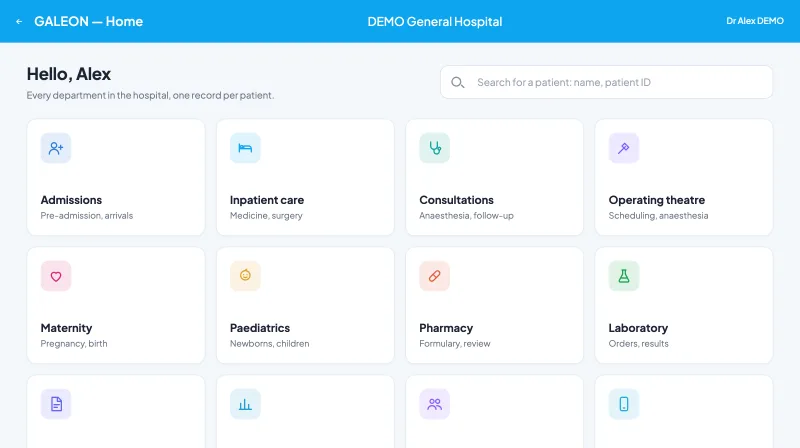
Galeon builds an AI-native electronic health record (EHR, in French DPI) alongside caregivers since 2016. It is used in 19 hospitals, including 2 university hospitals (CHU), across more than 3 million patient records, on HDS-certified infrastructure aligned with ISO 27001:2022, and it covers the full journey from consultation to maternity. Obstetric follow-up is a case where continuity is not a nicety; it is the whole point.
One thing to remember: a single, shared obstetric record turns scattered documents into a continuous, reliable follow-up.
What does the real journey actually look like?
A series of steps that are meant to build on each other, but often do not. A first-trimester ultrasound establishes dating and early biometrics. A second-trimester scan checks morphology. A third looks at growth and position. In between sit blood tests, blood pressure readings, midwife consultations, preparation for birth, and, for some, closer monitoring. Every one of these produces data that the next step needs.
The trouble is that these steps frequently live in different places. The city radiologist prints a report; the hospital laboratory files a result in its own system; the midwife notes observations in another; the maternity unit discovers much of it only when the patient arrives. On paper or in systems that do not talk to each other, each measurement stays isolated. At the next scan, without easy access to the previous biometrics, the professional partly starts over, comparing against a curve they have to rebuild by hand.
Reconstruction like this is not just slow. It is where trends get missed. A single growth measurement means little; the same measurement seen against the two before it can tell a story. When the history is scattered, that story is hard to read, and the value of following a pregnancy over time, rather than in snapshots, is quietly lost.
What does the lack of data flow really cost?
Time first, and a lot of it: time spent searching, re-entering, phoning another facility, or waiting for a document the patient was supposed to bring. This is time taken directly from the consultation, from the human part of the encounter that a pregnancy deserves.
Risk second. When information useful to the follow-up is missing at the right moment, decisions are made on a partial picture. A noted allergy, an earlier abnormal result, a flag raised at a previous scan: any of these can fail to surface precisely when it matters. The professional is competent; the data simply is not there.
And a burden on the patient, who ends up responsible for the continuity of her own care. Being asked, again and again, to repeat her history, carry her own imaging and remember which result went where is exhausting, and it quietly shifts a systemic failure onto the person least equipped to fix it.
Where a shared record changes the day-to-day
The value of a single obstetric record is easiest to see in concrete moments, not in the abstract. A few of them do most of the work.
1. History in one click
Every consultation, result and image sits in one place, so the professional opens the record and sees the whole pregnancy at a glance, instead of assembling it from what the patient happened to bring.
2. Biometrics as a trend, not a snapshot
Because previous measurements are right there, growth is read as a curve over time rather than a single number. This is exactly where following a pregnancy properly earns its value.
3. Risk flags carried forward
A point of vigilance raised early, an abnormal result, a relevant history: these travel with the record instead of depending on someone remembering to mention them at the next step.
4. Continuity between city, hospital and maternity
The record follows the patient across settings, so arriving at the maternity unit does not mean starting the story again. The team already has the thread.
5. Less re-entry, fewer transcription errors
When data arrives from the source rather than being retyped, a whole class of copying mistakes disappears, and the professional's attention stays on the patient rather than the keyboard.
What does a single obstetric record bring?
Continuity, which is the one thing scattered documents can never provide. Bringing the pregnancy follow-up, ultrasounds, biometrics, laboratory results and reports together in one record lets any authorised professional retrieve the full history in a click, from the first consultation to delivery. The record stops being a pile of snapshots and becomes a single, readable trajectory.
That continuity is not only about convenience. It changes what the professional can actually see. Trends become visible, gaps become obvious, and the decision at each step is made against the whole picture rather than the last document to hand. For a journey defined by its length and the number of people involved, having one coherent thread is the difference between following a pregnancy and merely reviewing it in pieces.
What about interoperability with devices?
It is the next step, and the one that turns a shared record from good to genuinely effortless. Making ultrasound machines, monitors and laboratory systems talk to the record means data arrives directly, already structured, with no re-entry. Biometrics land where they belong, results attach themselves to the right pregnancy, and the professional stops being a transcription clerk.
This is also where national infrastructure matters. Connecting the record to shared systems such as the DMP within Mon espace santé extends continuity beyond the walls of a single facility, so the information follows the patient across the whole care landscape. Interoperability is not a technical luxury here; it is the mechanism that makes continuity real rather than aspirational.
The moment of delivery: when continuity matters most
Everything above is convenient during routine follow-up. During labour, it becomes critical. A woman may arrive at night, in a facility that is not the one where she was followed, with a team meeting her for the first time. In that moment there is no time to reconstruct nine months of history from printouts, and the questions that matter (a known allergy, an abnormal result, a flagged risk, the position of the baby at the last scan) need answers immediately.
A shared, interoperable record is what lets the team open the story and act, rather than piece it together under pressure. This is the sharp end of obstetric care, where the cost of a missing piece of information is highest and the time available to find it is shortest. Continuity, built patiently over the months before, pays off in the minutes that count most.
| Criterion | Scattered follow-up (legacy) | Single record in the EHR (Galeon) |
|---|---|---|
| Access to history | Documents re-carried by the patient | Full history in one click |
| Ultrasound data | Printed, isolated | Attached to the record, as a trend |
| Re-entry | Frequent between exams | Avoided via interoperability |
| Continuity | Broken between facilities | Continuous, consultation to delivery |
| At delivery | History reconstructed under pressure | Opened and acted on immediately |
| Patient burden | Carries her own record | Nothing to re-explain |
| Hosting | Varies by contract | HDS certified, ISO 27001:2022 aligned |
Bolt-on maternity module versus an obstetric record inside the EHR
A standalone maternity module can be excellent at what it does and still leave the core problem untouched, because it becomes one more island. If the obstetric follow-up lives in its own tool, disconnected from the rest of the patient's record and from the city, the team still has to bridge the gaps by hand at every transition. The module is good; the continuity is still missing.
When obstetric follow-up is part of a unified EHR, the pregnancy sits inside the patient's whole record and connects outward to shared national systems. History, results and imaging are in one place, interoperability brings data in without re-entry, and the delivery team opens a single coherent story rather than assembling one. As everywhere else in clinical software, the decisive factor is how unified the record is, not how feature-rich any single module happens to be.
Does AI have a place in obstetric follow-up?
It does, but strictly downstream of the record, and it is worth being measured about it. The useful applications, such as helping read biometric trends or flagging a value that departs from the expected curve, all depend entirely on having clean, structured, longitudinal data in the first place. Without that, there is nothing solid for any model to work on; with it, assistance becomes possible.
And here too, not every clinical AI is automatically "high risk" under the AI Act: it depends on the use and on the degree of autonomy. What does not change are the fundamentals, whatever the tool: the professional keeps the decision, suggestions are transparent and traceable, and the data is protected. The record comes first; intelligence is what a good record makes possible, not a substitute for it.
Data protection: pregnancy data is especially sensitive
Obstetric data is among the most sensitive a hospital holds, so continuity can never come at the expense of confidentiality. A shared record only earns trust if access is controlled, every consultation is traceable, and the whole system runs on infrastructure that meets health-data hosting requirements, in France the HDS certification aligned with ISO 27001:2022.
Done properly, protection and continuity reinforce each other rather than compete. A single, well-governed record is both easier to secure and easier to audit than a scattering of documents and exports living in different tools, each with its own, uneven safeguards. Fewer copies in fewer places is not only more convenient; it is safer.
What does it change for the midwife, the obstetrician, the DSI and the patient?
For the midwife
The full follow-up is available at a glance, so consultations start from the whole picture rather than from what the patient remembered to bring. Time shifts from reconstruction back to care and to the relationship a pregnancy calls for.
For the obstetrician
Trends, results and prior flags are visible together, which supports decisions during follow-up and, above all, in the moments that need to move fast. The picture is complete when it needs to be complete.
For the hospital CIO (DSI)
The priorities are unification and interoperability: one record that connects to devices and to shared national systems without re-entry, hosted to HDS standards. The DSI's lever on obstetric continuity is, as ever, upstream in the coherence of the information system.
For the patient
She stops being the courier of her own record. Nothing to re-explain, nothing to re-carry, and the reassurance that whoever she sees, wherever she gives birth, already has the thread of her pregnancy.
Limits and challenges to be aware of
- Real interoperability: everything depends on devices and software being genuinely able to exchange, not just claiming to.
- Migration quality: a single record is only valuable if the history it holds is reliable, so bringing data in has to be done carefully.
- Confidentiality: pregnancy data is sensitive and must be protected through hosting and strict access rules, without exception.
- Change management: buy-in from obstetric and midwifery teams is decisive; the best record fails if it is not adopted.
- Honest expectations: the record removes friction and blind spots, it does not replace clinical judgement or the human care at the heart of a pregnancy.
FAQ
Does a single record replace the patient booklet?
It complements and strengthens it. The information no longer depends on a document carried back and forth, so a lost or forgotten booklet stops being a gap in the follow-up.
Can ultrasound machines feed the record directly?
Yes, via interoperability, which is exactly the goal: data arrives structured and attached to the right pregnancy, without re-entry and without transcription errors.
Is it more complex for caregivers?
On the contrary, done well it removes friction rather than adding it. The aim is fewer tools to juggle and less searching, not another screen to feed.
What happens if the patient gives birth elsewhere?
With a shared, interoperable record, the delivery team can open her history rather than reconstruct it, which is precisely when continuity matters most.
Where are the data hosted?
In France, on HDS-certified infrastructure aligned with ISO 27001:2022, with controlled access and full traceability, because obstetric data is especially sensitive.
Where should a maternity unit start?
With the ultrasound-to-record flow, the step that generates the most re-entry, then extend to laboratory results and connection with the city.
In summary
The pregnant patient's journey is long, collaborative and spread across many hands, which is exactly why it suffers most when information fails to flow. A single, shared and interoperable obstetric record turns a stack of disconnected documents into one continuous, readable follow-up: less administrative time for teams, safer decisions during pregnancy and at delivery, and a patient who no longer has to re-explain her own story.
Here, digital does not add complexity, it removes it, provided the record is unified, connected to devices and national systems, and hosted to protect data that is among the most sensitive there is. As everywhere in clinical software, continuity is built into a coherent record far more effectively than it is bolted on. That is the logic of an AI-native EHR like Galeon.
Want to know more about our smart EHR ?
Book a demoRead next: why interoperability is the backbone of the digital hospital.
Sources
- Haute Autorité de Santé (HAS), suivi de grossesse
- CNGOF, Collège national des gynécologues et obstétriciens français
- Mon espace santé (DMP)
- Galeon, interoperability at the hospital
Related reading
They trust us
19 hospitals running Galeon in France.













Join the pioneers of care.
 2 sales reps available from tomorrow
Your IT, your interfaces, your timeline. Pick a slot: Valérie or Yohan will call you back.
- HDS certified
- ISO 27001
- GDPR compliant
- LAP certified (HAS)