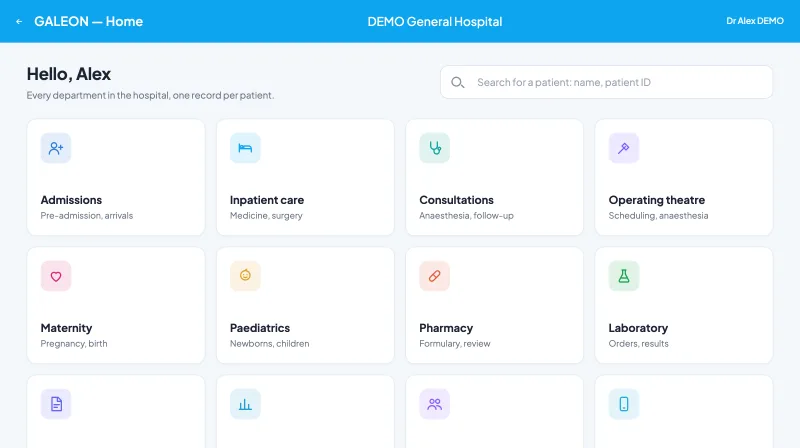
 See Galeon for real

Can AI write a medical report in place of the doctor?
A consultation comes to an end. The doctor has listened to the patient, asked questions, carried out a clinical examination and explained the next steps in their care.
But the doctor’s work isn’t finished yet.
The consultation still has to be documented: summarising the symptoms, noting the key observations, recording the decisions made and the prescriptions, and sometimes writing a letter to a colleague.
This work is essential to continuity of care. It also takes time, attention and rigour.
What if artificial intelligence could prepare part of this documentation while the doctor is talking with the patient?
This is one of the most practical uses of AI in healthcare: helping to write medical reports.
When a consultation becomes a document
A medical report isn’t just a transcript of a conversation.
During a consultation, a patient may come back to a symptom, mention a treatment they forgot, ask a question unrelated to why they came in, or describe how they feel in their own words.
The doctor has to turn that conversation into structured, usable medical information.
They pick out what is relevant, organise it, put it in context and connect it to their clinical reasoning.
That step requires real interpretation.
That is exactly why automatic transcription alone isn’t enough to produce a reliable medical report.
Ambient AI: listening in order to document better
Some AI tools now take an approach known as ambient AI.
The idea is fairly simple. With the right permissions, a system records the conversation during a consultation, transcribes it and then proposes a structured summary.
Take a consultation for abdominal pain.
The patient describes when the symptoms started, how they have changed and which treatments they have already tried. The doctor asks follow-up questions, examines the patient and explains the next steps.
From this conversation, the AI could prepare a draft containing the relevant information: reason for the visit, reported symptoms, background, observations made out loud and the management plan discussed.
The doctor would then no longer need to rebuild the whole consultation from memory after the patient has left.
They would have a first version to review, correct and complete.
The aim isn’t to do away with medical writing. It is to cut down its repetitive part.
A plausible report isn’t necessarily an accurate one
This technology does, however, raise one major difficulty.
AI models can produce fluent, coherent and convincing text, even when it contains errors.
Something misheard can be transcribed wrongly. A negation can be dropped. A symptom mentioned as a possibility can be presented as an established fact.
The system can also add a detail that seems logical but was never mentioned during the consultation.
In a medical setting, these differences matter.
Writing that a patient has a symptom, or doesn’t have it, can change how their health is understood.
Well-written text is therefore no guarantee of clinical reliability.
To be useful, a medical documentation AI must let clinicians check the information it produces, see where it is uncertain and correct errors easily.
The doctor remains responsible for the final document
One distinction is essential: preparing a report is not the same as approving it.
AI can suggest a structure for the text, pick out what was said during the conversation or make writing easier.
But on its own, it doesn’t have all the information the doctor draws on.
Some observations may never have been said out loud. Others need to be interpreted in light of the patient’s history, their medical record or further test results.
Clinicians must therefore always be able to edit, add to or remove any part of the report.
Final approval remains a fundamental step.
A well-integrated AI shouldn’t ask doctors to blindly trust generated text. Instead, it should make reviewing easier and leave them in control of the document.
Assistance is useful when it supports clinical reasoning without trying to replace it.
Confidentiality starts with the conversation
Using AI during a consultation also raises a key question: what happens to the information that is shared?
A medical conversation can contain highly sensitive data about a patient’s health, treatments, personal life or medical history.
Processing that data requires proper safeguards.
In particular, it must be decided whether recording is necessary, how the patient is informed, where the data is processed, who can access it and how long it is kept.
Working with an AI provider does not release healthcare facilities from their data protection obligations.
These tools must therefore be designed with privacy in mind from the start, not have it added afterwards.
Confidentiality, security and traceability are part of what makes them clinically useful.
Useful AI fits into how clinicians work
Another issue is often less visible: how the tool fits into everyday hospital work.
An automatically generated report offers little benefit if the doctor then has to copy it into other software, re-enter patient details by hand or go through several extra steps.
To be truly useful, writing assistance must fit into clinicians’ existing tools and ways of working.
It must take into account the medical context, how the patient record is organised and what information teams need to pass on to each other.
This is where structured data really matters.
A well-organised electronic health record makes it easier to find the information needed, put it in context and reuse it across medical documents.
At Galeon, this thinking is part of a broader goal: building a digital environment that better supports healthcare professionals in their daily work.
That said, what AI could make possible should be kept separate from the features actually available and validated in healthcare facilities.
Less documentation, more time for patients?
The main value of these technologies isn’t that they can produce text quickly.
It lies in what this assistance could change for healthcare professionals.
If a doctor spends less time rebuilding their notes after a consultation, they may be able to give more attention to the patient, to reviewing the record or to coordinating care.
But this benefit shouldn’t be taken for granted.
An AI that generates documents needing many corrections could actually create more work.
The real gain depends on the quality of the system, how well it is integrated and how long it takes to check what it produces.
That is why these tools must be evaluated in real-world conditions, with the clinicians who use them.
The goal isn’t simply to produce a report faster.
It is to document care to the same high standard while reducing the administrative burden wherever possible.
AI in hospitals, in practice: a question of balance
Throughout this series, we have explored several ways AI can support how a healthcare facility runs.
Finding information faster, making sense of a complex medical record, assisting with certain tasks or making documents easier to produce: there are many possibilities.
Yet they all rest on the same requirement.
AI must be designed to meet real needs, in an environment where reliability, security and accountability remain essential.
It does not replace clinical experience, the relationship with the patient or the decisions of healthcare professionals.
But it can become a valuable tool when it helps make better use of the information available and lightens some time-consuming tasks.
The future of AI in hospitals won’t be measured only by what algorithms can do, but by what they help clinicians do better.
And that may be its most important contribution: giving more room back to people in an increasingly digital care environment.
Related reading
They trust us
19 hospitals running Galeon in France.
















Join the pioneers of care.

 2 sales reps available from tomorrow
Your IT, your interfaces, your timeline. Pick a slot: Valérie or Yohan will call you back.
- HDS certified
- ISO 27001
- GDPR compliant
- LAP certified (HAS)