 See Galeon for real
Voice Recognition in Hospitals : How Caregivers Dictate Their Reports in 2026
Discover how this technology works in 2026 and how Galeon integrates it into its intelligent EHR.
Key Takeaways at a Glance
| Question | Short Answer | What You Need to Know |
|---|---|---|
| What is medical voice recognition? | AI transcribing speech into structured EHR text | It eliminates manual data entry and reduces transcription errors by capturing data directly at the source. |
| How much time does it save? | 45% to 70% of documentation time | A physician can recover up to 2 hours per day previously spent writing reports, increasing patient face-time. |
| Does it work in noisy settings? | Yes, accuracy above 95% | Modern models filter ambient noise and use medical-grade terminology that outperforms general-purpose tools. |
| Is it secure for patient data? | Yes, via certified HDS hosting | HDS certification is a regulatory requirement; non-certified storage exposes institutions to severe legal penalties. |
| Traditional dictation vs. Voice Rec? | Real-time structured text generation | No more waiting for secretaries to transcribe audio files; the text is available and structured immediately. |
| Integration in Galeon? | Automatic indexing and structuring | Dictated data is instantly exploitable by AI, becoming a valuable asset for clinical decision support. |
| What is the cost of adoption? | Positive ROI within the first year | Costs range from 30 to 150 euros/month/caregiver. The time saved quickly offsets the initial software investment. |
| What are the limitations? | Accents and regional languages | While highly advanced, human review is still recommended for reports with high medico-legal stakes. |
Introduction
In 2026, a hospital physician spends an average of 35% of their working time on administrative documentation rather than direct patient care. This figure, drawn from the 2024 DREES report on working conditions of hospital practitioners, reflects a reality familiar to every hospital CIO and CEO: the electronic health record (EHR), designed to support caregivers, has too often become an additional burden rather than a tool for reclaiming medical time.
Medical voice recognition is changing this equation. By enabling caregivers to dictate their observations, prescriptions, and reports directly into the EHR, it cuts documentation time in half and frees up valuable care hours. In 2026, this technology is no longer experimental -- it is deployed across thousands of institutions in Europe and the United States, with documented and reproducible outcomes.
Galeon, present in 19 hospitals including 2 university hospital centers, with over 3 million patient records and more than 10,000 caregivers supported, integrates voice dictation natively into its intelligent EHR. Voice data is not stored raw: it is structured, indexed, and made immediately exploitable by AI algorithms at the point of capture. This is a fundamental difference from standalone transcription solutions that remain productivity tools without any leverage over the quality of the medical data they generate.
In this article, we examine how voice recognition concretely works in hospitals in 2026, what measurable gains caregivers and institutions can expect, and how native EHR integration transforms voice data into a lever for data-driven medicine.
Why Do Caregivers Spend So Much Time Writing Their Reports?
The documentation burden in hospitals is not a new problem, but it has worsened with the widespread adoption of EHRs. A well-documented paradox: the more digital tools proliferate, the more manual entry time increases.
According to a study published in the Journal of the American Medical Informatics Association (JAMIA) in 2023, hospital physicians spend an average of 4.5 hours per day on computers performing documentation tasks, compared to 2.1 hours in 2015. The proliferation of mandatory fields, constrained forms, and poorly ergonomic interfaces is the primary driver.
Three structural factors explain this explosion in documentation time:
- The multiplication of mandatory fields in regulatory EHRs (activity-based funding systems, care coordination requirements)
- System fragmentation: a caregiver may navigate between 3 to 5 different software applications during a single working day
- The absence of intelligent automation: most information must be entered manually, even when it is already available elsewhere in the hospital information system
Voice recognition directly addresses this third lever by replacing typing with dictation -- and, in the most advanced solutions, by automatically structuring the dictated text into the correct EHR fields.
How Does Medical Voice Recognition Concretely Work in 2026?
Medical voice recognition, or ASR (Automatic Speech Recognition), relies on language models specifically trained on medical corpora. In 2026, the best systems achieve accuracy rates above 95% on common clinical vocabulary, including in partially noisy environments.
What Are the Three Steps of Voice Processing?
The processing pipeline unfolds in three distinct phases, typically invisible to the caregiver in practice:
- Audio capture: the microphone (headset, lapel mic, or workstation-integrated microphone) records the caregiver's voice while actively filtering ambient noise through noise-reduction algorithms
- Transcription: the ASR model converts the audio signal into raw text, recognizing medical-specific terms -- medications, pathologies, procedures, dosages -- with accuracy well above general-purpose engines
- Structuring: a natural language processing (NLP) module identifies key entities in the speech (diagnosis, treatment, dosage, planned follow-up) and places them into the corresponding EHR fields without manual intervention
In the most advanced solutions, this third step is fully automated. The caregiver dictates freely in their natural clinical language, and the system populates the correct record fields in real time.
What Is the Difference Between Simple Voice Dictation and Intelligent Voice Recognition?
Simple voice dictation produces an audio file or raw text block that a medical secretary must reformat, correct, and manually place in the correct location within the EHR. This was the dominant model before 2020.
Intelligent voice recognition generates structured text directly into EHR fields, in real time, without any human intermediary. The medical secretary is no longer positioned at the end of the chain to transcribe: they shift focus toward verification, coordination, and complex cases genuinely requiring human judgment.
Intelligent dictation eliminates the human transcription step. This represents a 40% average time saving across the complete cycle of writing a consultation or hospitalization report.
What Measurable Gains Have Hospitals Adopting Voice Recognition Achieved?
Deployment studies conducted between 2022 and 2025 show consistent and reproducible results across several key indicators. These data points enable CIOs and CEOs to build a solid business case before any budget commitment.
What Documentation Time Savings Can Realistically Be Expected?
According to the Nuance Communications "State of Clinical Documentation 2024" report, institutions deploying a medical voice recognition solution report an average reduction of 45% in documentation time per caregiver. In emergency departments and intensive care units, where documentation pressure is highest, this figure reaches 62%.
Translated into concrete hours: a physician previously spending 3 hours per day documenting now spends only 1 hour 40 minutes. Over a full year, this represents the equivalent of 6 freed working weeks per practitioner -- an argument as powerful for HR as it is financially.
Does Clinical Data Quality Actually Improve with Voice Dictation?
A less visible but equally strategic benefit: the quality and completeness of captured clinical data improves significantly. When data entry is fast and fluid, caregivers document more, with greater precision and fewer errors of omission.
A study conducted at the Nantes University Hospital Center in 2023 showed that the completeness rate of hospitalization reports increased by 23% after deploying an EHR-integrated voice dictation tool, with no modification of clinical practices.
What Impact on Caregiver Well-Being and Retention?
Documentation burden is one of the top causes of burnout cited by hospital physicians, ahead of night shifts and conflict management (INPH 2024 report). Reducing this burden has a direct impact on practitioner satisfaction and retention -- a critical issue in a context of intense pressure on medical human resources.
Voice recognition is not only an operational productivity tool. It is a lever for workplace quality of life for caregivers, and therefore a measurable recruitment and retention argument for hospital management.
How Does Galeon Integrate with Existing Voice Recognition Tools?
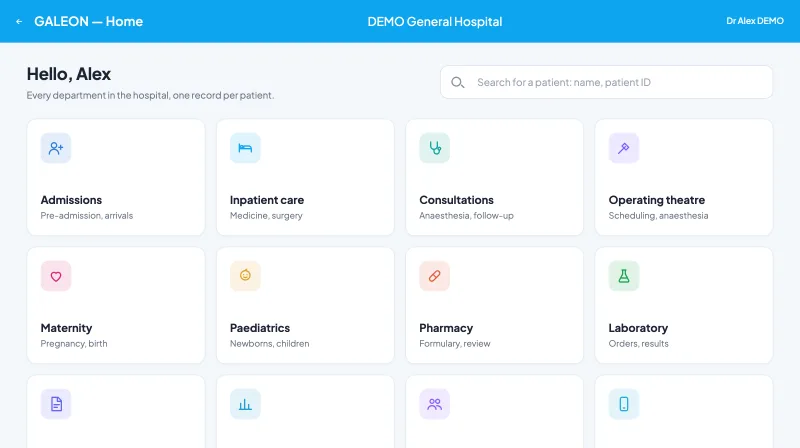
Galeon does not offer a native speech-to-text module. However, its free-entry fields are compatible with all external voice recognition solutions on the market: Dragon Medical One, Nuance, and any other STT tool used by caregivers. The physician simply points their existing tool at the Galeon consultation field, and the transcribed text inserts directly. No software change, no re-entry, no additional technical integration required.
This open compatibility is a deliberate architectural choice. Galeon does not seek to lock institutions into a proprietary stack: it adapts to existing practices and tools. An institution already equipped with Dragon Medical One can adopt Galeon without compromising that investment.
What Happens Once the Text Is Inserted into Galeon?
Galeon's added value comes at the next step -- the one that standalone STT tools do not cover. Once the dictated text is inserted into the EHR field, Galeon takes over:
- The text is structured and indexed into the correct patient record fields
- Medical entities (medications, dosages, diagnoses, procedures) are identified and linked to standardized reference systems (SNOMED CT, ICD-10, drug databases)
- The data becomes exploitable by Galeon AI algorithms to detect early clinical signals and anticipate pathological developments
How Is Voice Data Secured Within the Galeon Architecture?
Voice data constitutes health data in every legal sense. It is subject to the same regulatory obligations as written data: mandatory HDS-certified hosting, GDPR compliance, non-disclosure to third parties without explicit patient consent.
Galeon hosts all its data on HDS-certified servers located in France. Voice data does not transit through uncertified third-party infrastructures. Data never leaves the partner hospital's servers. This is the founding principle of the Galeon architecture, applied without exception to voice data as to every other category of medical data.
Comparative Analysis: Galeon Compatible with an STT Tool vs Standalone Transcription vs Classical Dictation
| Criterion | Galeon + External STT | Standalone Solution | Classical (Secretary) |
|---|---|---|---|
| Automatic structuring | Yes, indexed directly into patient record fields | No, raw text requires manual export | No, human transcription required |
| AI exploitation | Yes, structured data feeds Galeon models | No, data not linked to EHR | No, data remains unstructured |
| HDS compliance | HDS-certified, hosted in France | Varies by vendor | Depends on local software |
| Record delay | A few seconds | A few minutes to hours | 24 to 72 hours |
| Medical terminology | Native recognition via chosen STT partner | Depends on vendor (often generalist) | Depends on secretary competency |
| Cost per month | EHR license + STT cost (usually pre-budgeted) | +30 to 150 EUR on top of EHR | FTE cost (3,000 to 5,000 EUR) |
| Interoperability | Native (HL7 FHIR compliant) | Limited | Non-existent |
| Burnout impact | Strong: zero documentation burden | Moderate | Weak: long turnaround times |
What Are the Real Limitations of Voice Recognition in Hospitals?
It would be inaccurate to present voice recognition as a universal solution without constraints. Several concrete limitations must be known by CIOs and CEOs before any deployment project.
Accent and Dialect Management Remains Imperfect
Voice recognition models are trained predominantly on standard-accent speaker corpora. Marked regional accents or pronounced foreign accents can significantly degrade system accuracy. Error rates of 15 to 25% have been observed in these specific cases, compared to 3 to 5% for speakers without marked accent characteristics.
A partial solution exists: most systems offer a personal voice training phase (20 to 30 minutes of supervised dictation) to adapt the model to the caregiver's voice and phonetic specificities. This step, frequently neglected during deployment, is nonetheless critical for long-term transcription quality.
Ultra-Specialized Vocabulary Remains an Unsolved Challenge
Specialties with rare terminology -- reconstructive surgery, tropical medicine, clinical genetics, advanced pharmacology -- still present genuine difficulties. Terms infrequently represented in training corpora are often incorrectly recognized, generating errors requiring manual correction.
No solution available in 2026 guarantees 100% accuracy across the full spectrum of medical vocabulary. Human review remains recommended for reports with significant medico-legal stakes: discharge summaries, clinical trial protocol conclusions, and medical expert reports.
Caregiver Adoption Is Never Automatic
A technology deployment without change management is destined to fail, regardless of the tool's intrinsic quality. Experience across deploying institutions shows that 30 to 40% of caregivers initially resist adopting voice dictation, out of habit with manual entry, concern about control over their data, or skepticism about system reliability.
A structured training plan, with identified internal champions and progressive hands-on sessions, is indispensable to achieve an adoption rate above 70% within 6 months of effective deployment.
Very Noisy Environments Remain Challenging
Trauma bays, active operating theaters, and overcrowded emergency departments can generate noise levels difficult to filter even with high-performance directional microphones. In these specific contexts, a lapel microphone or wired headset remains preferable to workstation-integrated microphones.
Medico-Legal Liability Questions Are Not Yet Fully Settled
In cases of undetected transcription errors with consequences for patient care, liability is shared between the caregiver (review obligation) and the vendor (best-effort accuracy obligation). This legal question is not yet fully stabilized in French and European law, and institutions should ensure their professional liability insurance explicitly covers this risk.
FAQ: Voice Recognition in Hospitals in 2026
Is Medical Voice Recognition Compliant with GDPR and HDS Obligations?
Yes, provided the solution is hosted in France or within the European Union on HDS-certified (Health Data Hosting) servers. HDS hosting is a legal obligation for all health data processed in France, including voice data generated by medical dictation. A voice recognition tool processing data on non-EU servers exposes the institution to CNIL penalties that can reach 4% of global annual revenue under GDPR.
How Long Does It Take to Train a Caregiver on Voice Dictation?
Basic proficiency -- dictating a prescription or simple consultation report -- requires between 30 minutes and 1 hour of guided training. Full command of all features (advanced voice commands, EHR navigation, personalized phrase templates) typically takes 2 to 4 weeks of regular real-world practice. Solutions offering a personal voice training phase reduce the learning curve by 40 to 50%.
Can Caregivers Dictate from a Patient Room or Corridor, Away from Their Desk?
Yes, provided the STT tool used by the caregiver offers a mobile version (smartphone or tablet). Most market solutions, including Dragon Medical One, have a mobile application. The connection must be secured -- via hospital VPN or encrypted internal network -- to guarantee patient data confidentiality. The dictated text then inserts directly into the relevant Galeon field, whether entry comes from a fixed workstation or a mobile device, with no difference in how the EHR processes the data.
What Is the Difference Between Dragon Medical and Galeon?
Dragon Medical One (Nuance/Microsoft) is the market reference for standalone medical voice transcription: it produces high-quality text that inserts directly into Galeon's free-entry fields. The two tools are complementary, not competing. Dragon Medical handles voice recognition and transcription; Galeon takes over to structure the text within the patient record, link medical entities to standardized reference systems, and make the data exploitable by AI. Using Dragon Medical with Galeon means combining the best transcription on the market with the best medical data structuring layer.
How Should the ROI of a Voice Recognition Deployment Be Calculated?
The return on investment calculation relies on three primary variables: documentation time saved per caregiver, average hourly cost of medical time in the institution, and total cost of the solution (license, training, IT integration). Based on savings of 1.5 hours per physician per day and an hourly cost of 60 euros, the annual gross ROI exceeds 20,000 euros per practitioner. Most institutions reach financial breakeven between 6 and 12 months after effective deployment.
Can Dragon Medical or Another Voice Dictation Tool Be Used with Galeon?
Yes. Galeon's free-entry fields are compatible with external speech-to-text tools, including Dragon Medical One (Nuance/Microsoft). The caregiver simply points their existing tool at the Galeon consultation field and the transcribed text inserts directly, with no re-entry or software change required. This means an institution already equipped with an STT solution can adopt Galeon without compromising its existing investments. The AI structuring and patient record indexing layer is handled by Galeon, regardless of which transcription tool is used upstream.
Will Voice Recognition Eliminate Medical Secretary Positions?
No, and experience from pioneer institutions confirms this consistently. The role of the medical secretary evolves: from raw transcription toward verification, administrative coordination, and management of complex cases genuinely requiring human judgment. In the majority of deploying institutions, productivity gains have enabled absorption of growing activity volumes without position eliminations. Voice recognition redistributes responsibilities -- it does not eliminate human value.
What Is the Actual Accuracy of Medical Voice Recognition Systems in 2026?
The best systems specialized in medical vocabulary achieve accuracy of 95 to 98% on standard-accent speakers in 2026, under appropriate recording conditions. This figure drops to 80-85% on ultra-specialized vocabulary or with marked accents. For comparison, a human medical secretary working from poor-quality audio recording produces an error rate of 5 to 10%. The technology is mature for productive use, but it is not infallible.
Summary
Voice recognition in hospitals is, in 2026, a mature, widely deployed technology with documented and reproducible benefits. It reduces caregiver documentation time by an average of 45%, improves the quality and completeness of clinical data, and constitutes a concrete lever against the administrative burnout weakening medical teams. It is not without limitations: marked accents, ultra-specialized vocabulary, and resistance to change are genuine challenges that no deployment can afford to ignore. The key to success lies in native EHR integration: dictated data must become structured medical data exploitable by AI, not simply archived text blocks. This is the approach chosen by Galeon, present in 19 hospitals and supporting more than 10,000 caregivers, to make every dictated report an additional building block of tomorrow's data-driven medicine.
Also explore our article on EHR interoperability in 2026 to understand how voice recognition fits into a coherent and compliant medical data architecture.
Do you want to know more about our Smart EHR ?
Book a demo
Sources
3. Nuance Communications (Microsoft), "State of Clinical Documentation 2024", annual report, 2024.
6. INPH (National Interunion of Hospital Practitioners), "National Survey on Working Conditions and Well-Being of Hospital Practitioners", 2024.
8. Agence du Numerique en Sante (ANS), "Health Data Hosting Reference Framework (HDS)", 2022.
Related reading
They trust us
19 hospitals running Galeon in France.














Join the pioneers of care.
 2 sales reps available from tomorrow
Your IT, your interfaces, your timeline. Pick a slot: Valérie or Yohan will call you back.
- HDS certified
- ISO 27001
- GDPR compliant
- LAP certified (HAS)