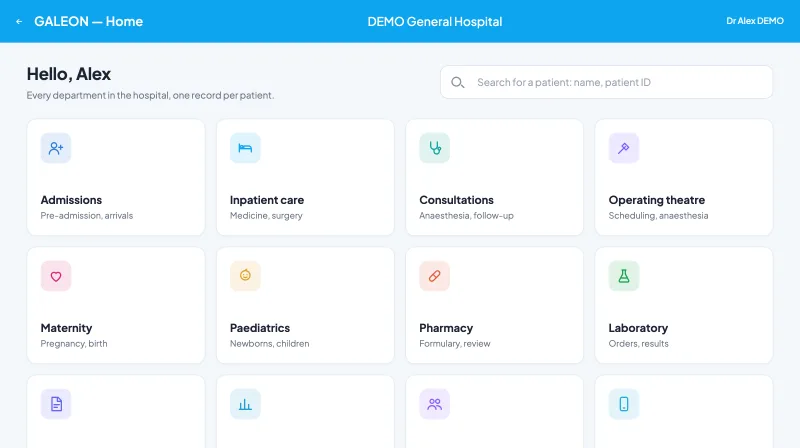
 See Galeon for real

A patient has been hospitalized for several days. Their blood pressure, heart rate, and breathing are regularly monitored. Laboratory test results provide additional information in their medical record.
Over the past few hours, some of these parameters have started to change. Their respiratory rate has increased slightly, their blood pressure has dropped, and several laboratory results are beginning to deviate from their usual values.
Taken individually, these changes do not necessarily indicate a complication. But when considered together, they may sometimes reveal a deterioration in the patient’s condition before it becomes obvious.
This is one of the applications of artificial intelligence being explored in hospitals: analyzing multiple pieces of medical information to identify situations associated with an increased risk of complications.
The goal is not to predict with certainty what will happen to a patient, but to help healthcare professionals recognize certain warning signs early enough to assess them.

Identifying Patterns in Medical Data
Healthcare teams already monitor numerous indicators to assess changes in a patient’s condition. They rely on clinical observations, vital signs, test results, and information collected throughout hospitalization.
Some artificial intelligence systems can complement this monitoring by analyzing several parameters simultaneously.
Consider a hospitalized patient who may be at risk of clinical deterioration.
An AI model can be trained to recognize associations between different types of data, including heart rate, blood pressure, respiratory rate, temperature, and laboratory results.
Based on this information, it can calculate a score estimating the likelihood of the patient’s condition deteriorating within a given period.
This score is not a diagnosis.
It simply indicates that the analyzed data share certain characteristics associated with a higher level of risk in the data used to develop the model.
Healthcare professionals must then interpret this information in the context of the patient’s overall clinical condition.
Anticipating Risk Does Not Mean Predicting the Future with Certainty
When a system identifies a high level of risk, it does not mean that the patient will necessarily experience a complication.
Predictive models rely on statistical relationships observed in medical data. They can identify situations associated with certain events without knowing in advance how an individual patient’s condition will evolve.
Two patients with similar results may experience different outcomes depending on their medical history, treatments, or other health-related factors.
The reliability of a prediction also depends on the data used to develop the model and its ability to perform under the conditions in which it will be used.
A tool evaluated in one hospital may perform differently in another, with a different patient population or in a different care setting.
This is why strong statistical performance alone is not enough to demonstrate that a system will be genuinely useful to healthcare teams.
Its results must also be understandable and actionable in clinical practice.
An Alert Is Only Useful If It Leads to Action
Now imagine that a system detects an increased risk of deterioration in a hospitalized patient.
It sends an alert to the healthcare team.
This information may draw attention to a situation that deserves further assessment. But for the alert to be useful, several questions need to be answered.
When is the alert delivered? Which healthcare professional receives it? What information explains why the patient was flagged? And what clinical assessment should follow?
An alert delivered too late may lose much of its value. An alert that lacks sufficient context may require additional checks before it can be interpreted.
How alerts are integrated into healthcare professionals’ daily workflows is therefore just as important as the model’s ability to identify risk.
A system may perform well statistically while providing little benefit if it unnecessarily interrupts healthcare professionals or is not integrated into a clearly defined care process.
Identifying a risk, triggering an alert, and improving patient care are three different steps.
Success at the first does not guarantee success at the other two.

The Risk of Too Many False Alerts
Early detection presents a particular challenge: the more a system attempts to identify potentially concerning situations, the more likely it may be to flag patients who ultimately experience no complications.
These are known as false positives.
In a hospital department, excessive alerts can force healthcare professionals to repeatedly investigate situations that do not require additional intervention.
Over time, this accumulation can contribute to alert fatigue. Healthcare professionals may become less responsive to notifications, including those concerning genuinely important situations.
Conversely, a system with overly restrictive criteria may fail to identify some patients whose condition is deteriorating. These are false negatives.
The challenge is therefore to strike a balance between detecting patients at risk and limiting unnecessary alerts.
This balance depends on factors such as the severity of the event being monitored, how frequently it occurs, and the interventions available.
An alert does not have the same value when it helps prevent a serious complication as when it flags a change with no clinical consequences.
Promising Results, but Clinical Benefits Still Need to Be Demonstrated
Research into AI-based early warning systems is progressing, particularly in identifying patients who may be at risk of clinical deterioration.
These studies show that it is possible to develop models capable of recognizing certain associations between medical data and observed complications.
However, their effectiveness must be evaluated beyond the performance achieved during development.
A model may correctly identify many at-risk patients without necessarily improving their care.
To assess its value, researchers must determine whether alerts allow healthcare teams to intervene earlier, whether they actually influence medical decisions, and whether they contribute to better patient outcomes.
This evaluation must take place under real-world conditions, taking into account how hospital departments operate and how healthcare professionals work.
The objective is therefore not simply to generate reliable predictions.
It is to establish whether the information provided delivers additional clinical value.

Reliable Data to Understand Changes in a Patient’s Condition
To identify clinical changes, a predictive system must be able to use reliable, sufficiently recent, and properly contextualized information.
This data may come from different parts of the patient’s medical record, including vital signs, laboratory results, medical history, treatments, and events occurring during hospitalization.
However, the availability of data does not guarantee that it can be used correctly.
A delayed measurement, missing information, or a result linked to the wrong episode of care can affect how a model interprets the situation.
Chronology also plays an essential role. To analyze changes in a patient’s condition, a system must be able to distinguish recent observations from older information.
This issue connects to a challenge explored in previous episodes of our series: the quality and structure of medical data determine many of the potential applications of artificial intelligence.
At Galeon, structuring information directly within the electronic health record is part of this approach: making medical data usable, contextualized, and connected to the patient’s care journey.
However, developing predictive features requires additional stages of design, clinical validation, and integration into hospital workflows.
Helping Healthcare Professionals Intervene at the Right Time
Artificial intelligence can help identify patterns in medical data that deserve closer attention.
But its value depends on what happens next.
In some situations, an early warning could allow healthcare professionals to assess a patient more quickly or increase monitoring. In others, an additional alert might make no difference to the patient’s care.
The essential question therefore remains one of clinical usefulness.
Does the system identify a situation that would otherwise have been recognized later? Do healthcare professionals have the information they need to understand the alert? Can an appropriate intervention be initiated?
These questions must be studied with the healthcare teams and patients concerned, under real-world conditions.
Predictive AI opens up interesting possibilities for hospital monitoring. But it does not replace clinical observation, healthcare professionals’ experience, or their ability to make decisions tailored to each patient.
Anticipating risk does not mean knowing the future.
It means providing healthcare professionals with additional information that is relevant and reliable enough to help them assess a situation while an intervention may still make a difference.
Related reading
They trust us
19 hospitals running Galeon in France.










Join the pioneers of care.

 2 sales reps available from tomorrow
Your IT, your interfaces, your timeline. Pick a slot: Valérie or Yohan will call you back.
- HDS certified
- ISO 27001
- GDPR compliant
- LAP certified (HAS)