 See Galeon for real
The INS in 2026: Why Patient Identity Is the Foundation of Every Digital Record
The INS explained: what the French national health identifier covers, the identity statuses, the INSi teleservice, and what your EHR must do
The essentials in 30 seconds
| Question | Short answer | What to remember |
|---|---|---|
| What is the INS? | A national identifier plus five identity traits that must match. | A number alone is not an INS. |
| Is it mandatory? | Yes, to reference health data since 1 January 2021. | No sharing without it. |
| Which status is required? | Qualified identity: traits verified and INS retrieved. | Only qualified allows sharing. |
| How is it retrieved? | Through the national INSi teleservice, unit or batch. | Batch mode makes catch-up realistic. |
| What blocks in practice? | Front desk organisation, not software. | Identity is a process, not a feature. |
Introduction
A patient record can be complete, structured and impeccably kept. If it is not attached to the right identifier, it will not travel. Not to Mon espace santé, not to the referring physician, not to the next establishment. The Identifiant National de Santé is not one more administrative formality, it is the entry condition for every exchange of health data in France.
Galeon builds an AI-native EHR (DPI) with caregivers since 2016, used in 19 hospitals including 2 university hospitals (CHU), so we see where digitalisation projects actually stall. Identity is near the top of that list, and rarely for technical reasons.
One thing to remember: an unqualified identity does not slow sharing down, it makes it impossible.
What is the INS exactly?
The INS combines a number and identity traits. The number is the NIR, widely known as the social security number, or the NIA for people who do not have one yet. The traits are birth name, birth first names, date of birth, sex and the code of the place of birth.
This is the part that is regularly missed: the INS is not a standalone number, it is a number plus traits that must correspond. A correct NIR paired with a preferred first name instead of the birth first name does not constitute a valid INS. Its use to reference health data has been mandatory since 1 January 2021, under article L.1111-8-1 of the French public health code and a dedicated reference framework whose current version should always be checked.
Why does identity qualification matter?
Because every downstream service depends on it. Feeding Mon espace santé, secure health messaging, Segur referencing and the funding attached to it all assume that the patient behind the record has been identified beyond doubt. Identity is not a compliance checkbox, it is the primary key of the entire national exchange framework.
What are the identity statuses?
An identity does not become usable overnight. It progresses through stages, and only the last one authorises data referencing.
- Provisional identity: entered but unverified. Typical of an unconscious patient in the emergency department or a phone booking. Usable internally, never for sharing.
- Validated identity: traits checked against a high trust identity document. You know who the person is, but you do not have their INS yet.
- Retrieved identity: the INS has been obtained from the teleservice, but documentary verification has not been done.
- Qualified identity: both conditions met. This is the only status that allows health data to be referenced and shared.
What blocks in practice is almost never the software. It is how admissions are organised: who checks the identity document, at which point in the pathway, and what happens with the patient who does not have it on them. An establishment can run a perfectly compliant system and still carry a high share of unqualified identities, simply because verification was never built into the front desk routine.
How does the INSi teleservice work?
Access to the INS goes through a national teleservice offering two distinct operations, and confusing them is a common source of error. The search operation starts from identity traits and returns the matching INS, which is what you use when creating a record. The verification operation starts from a known INS and confirms it matches the traits you hold, which is what you trigger when identity data changes or as a periodic control.
Calls can be made one at a time at the front desk, or in batch to catch up on an existing stock of records. Batch mode is what makes historical catch-up realistic: without it, requalifying tens of thousands of records would be out of reach. Access requires authentication, through a professional card or a software certificate depending on the use case, which is worth confirming with your vendor since it determines whether the process can be automated.
What must your EHR be able to do?
Four capabilities, to be demanded explicitly and demonstrated rather than declared.
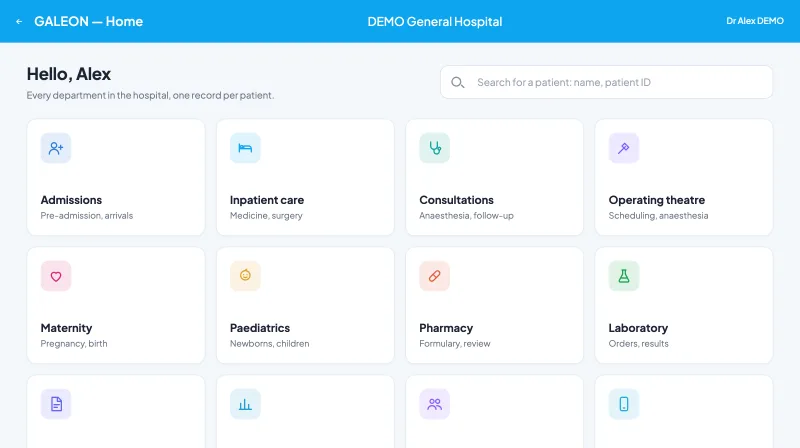
- Call the teleservice from the admissions screen, with no re-entry and no application switch. If the agent has to open a portal on the side, qualification will not happen.
- Display the identity status in plain sight, visible to every professional who opens the record. A caregiver should know at a glance whether this patient's data can be shared.
- Handle edge cases: homonyms, doubtful identities, newborns, anonymous admissions, people without a NIR. These are what separate a system that is compliant on paper from one that is usable.
- Block what must be blocked. A record whose identity is not qualified should not be able to feed sharing. An explicit block is better than a document sent under the wrong identifier.
| Criterion | Identity handled manually | INS integrated in the EHR (Galeon) |
|---|---|---|
| Teleservice call | Separate portal, manual re-entry | In the admissions workflow |
| Status visibility | Buried or absent | Shown on the record |
| Historical catch-up | Record by record | Batch qualification |
| Edge cases | Handled ad hoc | Explicit workflows |
| Sharing safeguard | Depends on vigilance | Blocked when unqualified |
| Segur readiness | Uncertain | Prerequisite satisfied |
Limits and challenges to be aware of
- Software does not fix process: if nobody checks identity documents at admission, no tool will close the gap.
- The framework evolves: the reference document has had several versions, so terminology and rules should be checked against the version in force.
- Retrieval is not qualification: holding an INS without documentary verification is not enough to share.
- Duplicates are a clinical risk: an undetected duplicate fragments a patient's history, which is more serious than an administrative nuisance.
FAQ
Is the INS just the social security number?
No. It is the NIR or NIA combined with five identity traits that must match. The number alone is not an INS.
Can we share data with a validated but not qualified identity?
No. Referencing and sharing health data require the qualified status.
What about patients without a NIR?
A NIA can be used. These cases need explicit handling in the software rather than workarounds.
Do we have to requalify our existing records?
Yes if you want them to circulate. Batch calls to the teleservice are what make this feasible at scale.
Is the INS required for Segur referencing?
It is a prerequisite. Without qualified identities, the referencing path and the funding behind it stay closed.
In summary
The INS is not the most exciting part of a patient record project. It is simply the part that decides whether everything else will serve any purpose. Three questions tell you where you stand: what share of your active records is qualified today, whether identity verification is written into the admissions procedure with a named owner, and whether your vendor supports batch calls. Galeon, an HDS certified EHR (DPI) aligned with ISO 27001:2022 and built for interoperability, treats identity as the foundation it is, because a record that cannot be shared is a record that stops at the door.
Want to know more about our smart EHR ?
Book a demoRead next: smart EHR vs traditional EHR, why hospitals are switching to AI.
Sources
- ANS, referentiel Identifiant National de Sante
- ANS, teleservice INSi
- Galeon, HDS certification in 2026
Related reading
They trust us
19 hospitals running Galeon in France.














Join the pioneers of care.
 2 sales reps available from tomorrow
Your IT, your interfaces, your timeline. Pick a slot: Valérie or Yohan will call you back.
- HDS certified
- ISO 27001
- GDPR compliant
- LAP certified (HAS)