 See Galeon for real

TARDOC in Hospitals 2026: Data Entry, Billing Risks and Galeon
The essentials in 30 seconds
| Question | Short answer | What to remember |
|---|---|---|
| Is Galeon suited to TARDOC? | Yes: according to Galeon, its patient record is designed for Swiss outpatient billing, TARDOC and lump sums alike. | Structured data at the source, rules applied in context, annual updates built in. |
| Does TARDOC replace TARMED? | Yes for outpatient care, since 1 January 2026. Inpatient billing does not change (FOPH). | The reform only affects outpatient services. |
| Who chooses between TARDOC and a lump sum? | Nobody: the tariff applies automatically once the diagnosis and services are entered (FOPH). | An outpatient treatment is never billed under both. |
| How big are the two tariffs? | TARDOC has 1,373 items, against about 4,600 for TARMED (RTS). There are 315 lump sums (FOPH). | The 4,600 figure comes from the press, not from an official source. |
| Who sets the tariff point value? | The cantons or the regions (FOPH). | The structure is national, the price is not. |
| How long does the approval run? | Until 31 December 2028 (Federal Council, 30 April 2025). | The structure can be revised every year until then. |
| What happens to the 2027 version? | OTMA SA submitted it on 2 June 2026. It only applies if the Federal Council approves it. | Check the decision on the day you act. |
| What do the first months show? | Billing delays in several hospitals (RTS, June 2026) and 427 million francs advanced to the CHUV as of 30 September 2026 (Medinside). | The CHUV changed its billing software at the same time. |
| What is the main risk for the IT department? | A missing diagnosis or a forgotten service can move a whole invoice from one tariff to the other. | Data entry must be complete before the rule applies. |
Introduction
The question of TARDOC in hospitals falls first to the information system. Since 1 January 2026, TARDOC and outpatient lump sums have replaced TARMED for Swiss outpatient billing. The choice between the two is made automatically once the diagnosis and services are entered.
This mechanism shifts the risk to data entry. The patient record does not choose the tariff, but what it contains determines the outcome: a missing diagnosis or service changes the invoice.
This article takes the point of view of hospital management and the IT department. It describes who decides what, how the rule is triggered, what data entry must contain, what the field has shown and what the 2027 version requires you to follow. It opens with what Galeon, a French electronic health record (EHR) vendor, offers Swiss hospitals facing this reform.
How does Galeon support TARDOC in hospitals?
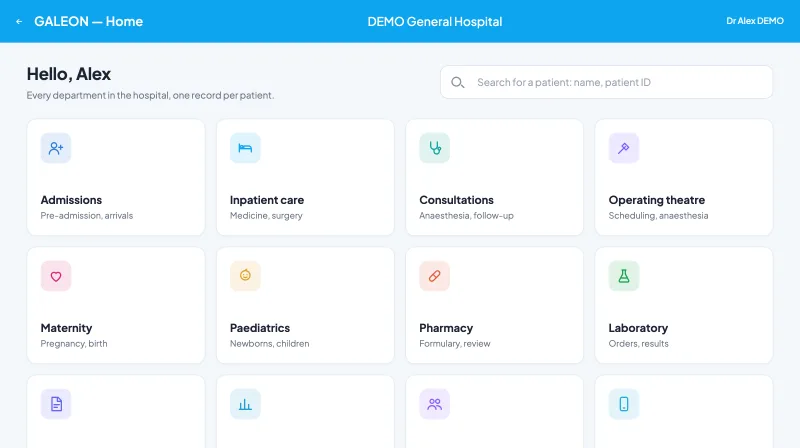
Galeon, a French electronic health record (EHR) vendor since 2016, equips 19 hospitals and about 10,000 clinicians. According to the Galeon website, its patient record is designed for Swiss outpatient billing: it structures procedures at the source and suggests the right tariff in context, per service or as a lump sum. Galeon is extending its offer to Swiss hospitals.
What Galeon brings to TARDOC and lump-sum billing
- Structuring at the source: each procedure is standardised at the moment of entry, ready to be valued.
- Rules applied live: the TARDOC or lump-sum tariff is suggested in context, with the cumulation rules.
- Annual updates absorbed: changes published by OTMA SA are integrated, with no new project at each revision.
- AI-assisted coding: AI helps spot billable procedures that were forgotten and reduces under-coding.
- Activity monitoring: tracking valuation helps to objectify cost neutrality and variances.
Why this addresses the risks described below
A hospital's main risk lies in data entry: a missing diagnosis or a forgotten service moves the invoice from one tariff to the other. A record that structures clinical data from the moment of entry, as Galeon's does, aims to reduce this risk upstream, before the rejection.
| Criterion | Billing without a suitable record | With Galeon |
|---|---|---|
| Tariff application | Manual re-entry, risk of error | Service or lump sum suggested in context |
| Cumulation rules and limitations | Left to the teams | Applied automatically |
| Annual OTMA SA updates | A project at each revision | Integrated |
| Under-coding | Billable procedures forgotten | AI-assisted detection |
Galeon also builds on 19 hospitals equipped in France, with data coded at the source and an AI trained on about 3 million records. To compare your preparation, you can talk to the Galeon team.
Where does the rollout of TARDOC in hospitals stand?
The Federal Council approved the overall tariff system on 30 April 2025, for entry into force on 1 January 2026. The approval is limited: it runs until 31 December 2028.
An approval in two stages
The decision of 30 April 2025 covered TARDOC version 1.4b and outpatient lump sums version 1.1b. On 5 November 2025, the Federal Council approved additions: TARDOC 1.4c and lump sums 1.1c.
These additions correct obvious errors. They concern hospital emergency care, wound treatment, pathology and combined tumour therapies (FOPH). Inpatient care does not change.
| Date | Event | Source |
|---|---|---|
| 30 April 2025 | Approval by the Federal Council (TARDOC 1.4b, lump sums 1.1b), valid until 31 December 2028 | admin.ch |
| 5 November 2025 | Additions approved (TARDOC 1.4c, lump sums 1.1c) | admin.ch |
| 1 January 2026 | Entry into force, TARMED replaced for outpatient care | FOPH |
| 22 January 2026 | The Federal Administrative Court declines to hear two appeals against certain lump sums | FOPH |
| 2 June 2026 | 2027 revision submitted to the Federal Council | OTMA SA |
| 31 December 2026 | End of the transitional agreement under which pathology is billed separately in TARDOC | FOPH |
| 1 January 2027 | Targeted date for the updated version, with pathology folded back into the lump sums | FOPH |
The 2027 revision awaits the Federal Council's decision
For lump sums, the 2027 revision covers nuclear medicine, hand surgery, maxillofacial surgery, paediatric surgery and pathology. For TARDOC, it reworks paediatrics and urgent and emergency consultations in particular (OTMA SA, 2 June 2026).
In its November 2025 letter, the FOPH placed the Federal Council's decision at the start of the fourth quarter of 2026. As of 28 October 2026, the sources consulted indicate that the review is still under way.
An information system must therefore prepare for two scenarios: the current version carried over, or the 2027 version applied from 1 January. Without Federal Council approval, the 2027 revision does not apply.
Who decides what between OTMA SA, the tariff partners and the cantons?
The tariff structure comes from OTMA SA and the tariff partners, the Federal Council approves it, and the cantons or regions set the point value. The hospital then manages billing with the insurers.
OTMA SA, the body that develops the system
OTMA SA, called OAAT AG in German, was created by the FMH, H+ and prio.swiss. According to the FOPH, it develops the overall system and handles the annual updates. It also runs the procedure through which its members request a change to the structure.
It publishes the interpretations, the lump-sum catalogue and a tariff browser. For software vendors, it offers TarifMatcher, a licensed Java library that helps integrate the tariffs (OTMA SA news, November 2024).
Three levels that stack on top of each other
Each level falls to a different actor, and a hospital has direct leverage only over the last one:
- The structure: OTMA SA and the tariff partners define it, then the Federal Council approves it.
- The price: the tariff point value is set at cantonal or regional level (FOPH, presentation of 30 April 2025).
- The billing: it plays out between the hospital and the insurers.
A hospital therefore manages the third level, depends on the first and follows the second.
How does the system know whether to bill TARDOC or a lump sum?
The hospital does not choose. Once the diagnosis and services are entered, the tariff applies automatically, according to the FOPH. Any combination of the two for the same outpatient treatment is ruled out.
A trigger rule, not a choice
If the catalogue of outpatient services (CPTMA) leads to a "trigger" item, billing a lump sum becomes mandatory. Otherwise, TARDOC applies. The patient record therefore decides nothing, but what it captures determines the result.
TARDOC and lump sums in figures
| Indicator | Value | Source |
|---|---|---|
| TARDOC items | 1,373 (version 1.4b) | FOPH, 30 April 2025 |
| TARMED items | About 4,600 | RTS, 30 April 2025 |
| Outpatient lump sums | 315 | FOPH |
| Share of lump sums in outpatient volume (simulation) | 13% overall, 19% in hospitals, 9% in private practice | FOPH |
These shares are simulations by the tariff partners. The actual share depends on each institution's activity.
What a lump sum covers, and what it changes for the EHR
A lump sum in principle covers medication, supplies and laboratory work. Pathology is folded back into it in 2027, after a transitional agreement in 2026. Certain well-defined products and implants remain billable separately.
For the patient record, the consequence is direct. A missing diagnosis or a forgotten service can move the whole invoice from one tariff to the other, rather than remove a single line.
What does TARDOC change for service entry in the patient record?
Data entry must be complete before the billing rule applies. Diagnosis, specialist department, side of the body and session number determine whether the claim can be sent to the insurer.
Submission rules published by an insurer
The insurer CSS publishes the following submission rules for its service providers. They should be checked against Annex H of the tariff agreement, which covers billing and data exchange (H+).
- The specialist department is mandatory at item level for hospitals.
- The diagnosis is sent at session level: Ticino code or ICD-10-GM for TARDOC, ICD-10-GM only for lump sums.
- The side of the body is required for items that call for it, and a reference number for additional services.
- A lump sum and TARDOC items carrying the same session number cause a rejection.
Quantitative limits checked over time
The insurer also checks quantitative and time-based limitations continuously, past and future included. An overrun is neither anticipated nor reimbursed.
A patient record that does not keep a patient's session history is poorly placed to anticipate these rejections.
The annexes of the tariff agreement
Annex C of the agreement contains the guidelines for recording outpatient services, and Annex H covers billing and data exchange (H+). Part of these documents is reserved for H+ members, which limits public verification.
What did the first months of billing in 2026 show?
The picture is mixed. Some institutions started smoothly in January 2026, others built up billing delays reported in June, and the CHUV saw its cash advances rise in the autumn.
An uneven start in January
In January 2026, 20 Minutes reported that the Fondation des hôpitaux vaudois, for its twelve hospitals other than the CHUV, had its data entry and billing software up and running on 1 January. The Ensemble hospitalier de la Côte had nothing to report.
The HUG had switched over their IT on 31 December 2025, planned test invoices in February and a full transition by the end of March. The CHUV, for its part, was changing billing software at the same time, which delayed its 2026 billing.
Delays reported in June and October
In June 2026, the RTS reported delays at the CHUV, in Biel, at the Inselspital, at the University Hospital Zurich and in Lucerne. The causes cited are billing software updates, very short preparation time and technical details that arrived late.
Outpatient care accounts for about 35% of hospital revenue, according to a PwC study cited by the RTS. H+ expected a return to normal over the summer.
On 13 October 2026, Medinside, citing Keystone-ATS, put the cash advances from the State of Vaud to the CHUV at 427 million francs as of 30 September, 305 million more than a year earlier. The CHUV cites the transition to TARDOC and new billing software. It expects a return to normal in early 2027.
How to read these figures
These figures should be read with caution. The CHUV case combines two changes, and the source does not allow them to be separated. Other hospitals in French-speaking Switzerland have not reported delays.
The preparation timeline weighs heavily. Institutions that started in 2024 or 2025, such as the Fondation des hôpitaux vaudois or the HUG, describe a calmer start.
How can you prepare the information system before the 2027 version?
Six actions recur in the sources consulted: lock the version, test the trigger, make data entry mandatory, track rejections, use H+ resources and plan for two tariffs in parallel.
Lock the version and test the rule
- Lock the version. Know which version is in production (1.4c and 1.1c today) and what will need to change if the 2027 version is approved.
- Test the trigger rule. Replay the CPTMA on real cases from each specialty before sending invoices, to check that the expected lump sum or TARDOC comes out.
- Make data entry mandatory where the tariff depends on it. Diagnosis in ICD-10-GM, specialist department, side of the body, session number.
These three points are handled before invoices are sent, on real cases from each specialty.
Track rejections by insurer
The insurer provides a rejection code, which the OTMA SA tariff browser helps to interpret (CSS). A weekly review by insurer catches a configuration flaw before it affects hundreds of invoices.
Use H+ resources and plan for two tariffs
H+ provides the crosswalk from TARMED to the new structure, the LKAAT+ file, the recommendations of the "Software application" working group and an adapted REKOLE case management. The H+ simulation tool is reserved for members.
You also need to plan for two tariffs in parallel. Treatments carried out up to 2025 remain billable under TARMED until 31 December 2030, and TARMED items are refused from 1 January 2026 (CSS).
What should management watch for through 2028?
Management follows three topics: cost neutrality, an approval that ends at the close of 2028 and two chapters explicitly marked as transitional. Each can change how activity is valued.
Cost neutrality is monitored
The Federal Council set a ceiling of 4% per year for the growth of total outpatient costs, and a total annual cost increase that must not exceed 2.5% unless justified. If these limits are exceeded, the tariff partners must take corrective measures (admin.ch, 30 April 2025).
A tariff correction along the way changes how activity is valued.
A limited approval and a moving structure
The approval ends at the close of 2028 and the structure can change every year until then. The FOPH has also asked for a ceiling on billable points per working day for medical services in the next version.
Two transitional chapters
The hospital emergency chapter will need a thorough revision, according to the FOPH. The pathology agreement ends on 31 December 2026, and the Federal Council states that an extension cannot be considered.
What should you ask your EHR vendor?
Three questions place a vendor, Galeon included: which version it has in production, how it replays the CPTMA and who follows the OTMA SA updates, which may change every year until 2028. Versions 1.4c and 1.1c apply today, and a test on real cases from each specialty shows whether the expected lump sum or TARDOC comes out. The Galeon team answers these three questions in a discussion with your management and your IT department.
What it changes for management, IT and clinicians
For management
Management carries the cash-flow and timing risk. In the CHUV's case, the transition to TARDOC and new billing software are cited together to explain 427 million francs of cash advances as of 30 September 2026 (Medinside).
It also tracks hard deadlines: the end of the pathology agreement on 31 December 2026 and the approval limit on 31 December 2028.
For the information system
The IT department must know which version is running in production, replay the CPTMA on real cases and track rejections by insurer every week. It prepares two scenarios for 1 January 2027: the current version carried over or the 2027 version.
For clinicians
For clinicians, complete entry of the diagnosis and services determines the tariff applied. A missing diagnosis or a forgotten service can move the whole invoice.
The side of the body and the reference number for additional services are part of what the insurer requires. A patient's session history, for its part, helps to anticipate quantitative and time-based limits.
Limits and points of caution
- The 2027 version is not confirmed. The FOPH placed the Federal Council's decision at the start of the fourth quarter of 2026, and it is now 28 October 2026. The FOPH also indicated that submission was possible until 30 April 2026, whereas OTMA SA dates its press release 2 June 2026: this discrepancy remains to be confirmed.
- The submission rules come from one insurer. They are taken from the CSS page and mention the XML 5.0 format. They should be checked against Annex H of the tariff agreement, part of which is reserved for H+ members.
- The breakdown figures are simulations. The 13% and 19% for lump sums come from the tariff partners. The figure of 1,373 items corresponds to version 1.4b, and the 4,600 for TARMED comes from the RTS.
- The causes of the delays are not attributed. The RTS and Medinside cite software and the preparation timeline. No source consulted points to a specific vendor.
- The CHUV figures combine two changes. The 427 million francs come from Medinside, citing Keystone-ATS. The source does not separate the effect of TARDOC from that of the new billing software.
FAQ
Does TARDOC replace TARMED for inpatient care?
No. The reform covers outpatient medical services. Billing for inpatient services does not change (FOPH).
Can you bill TARDOC and a lump sum for the same treatment?
No. An outpatient treatment is billed either under TARDOC or as a lump sum, never both (FOPH). A lump sum and TARDOC items carrying the same session number are rejected (CSS).
Can old TARMED invoices still be sent?
Yes, for treatments up to 2025 and until 31 December 2030, according to the insurer CSS. From 2026, TARMED items are refused.
Who sets the tariff point value?
The cantons or the regions. The structure is national, the point value is not (FOPH).
What does the 2027 version provide for?
OTMA SA submitted it on 2 June 2026. It affects paediatrics, urgent and emergency consultations in particular, and five lump-sum areas including pathology. It applies only if the Federal Council approves it.
What if the Federal Council's decision is not known at go-live?
Prepare two scenarios: the current version carried over, or the 2027 version applied from 1 January. Without Federal Council approval, the 2027 revision does not apply.
In summary
Galeon, a French electronic health record (EHR) vendor (19 hospitals, about 10,000 clinicians), presents its record as suited to TARDOC and outpatient lump sums: data structured at the source, rules applied in context, annual updates built in. Since 1 January 2026, TARDOC and outpatient lump sums have replaced TARMED for Swiss outpatient care, and the choice between the two is made automatically once the diagnosis and services are entered. A hospital's risk plays out in the information system: version in production, trigger rule replayed on real cases, complete data entry, weekly tracking of rejections. The first months showed billing delays in several institutions, with causes that the sources link to software and a short timeline. The 2027 version, submitted on 2 June 2026, applies only if the Federal Council approves it, and the current approval ends at the close of 2028.
Want to know more about our smart EHR ?
Book a demoChoosing an EHR in Switzerland: the four decisive criteria in 2026
Sources
- Federal Council, admin.ch: approval of the overall tariff system of 30 April 2025 (entry into force on 1 January 2026, approval until 31 December 2028, 315 lump sums, 4% ceiling and 2.5% annual increase) and additions of 5 November 2025.
- FOPH: TARDOC and outpatient lump sums page (timeline, "TARDOC or lump sum" rule), letter to the cantonal authorities of 5 November 2025 (versions 1.4c and 1.1c, decision expected at the start of the fourth quarter of 2026), presentation of 30 April 2025 ("trigger" item, 1,373 items) and clarification on lump sums (Federal Administrative Court decision of 22 January 2026).
- OTMA SA: press release of 2 June 2026 (submission of the 2027 revision) and news (TarifMatcher, software components).
- Submission rules, rejections and TARMED invoices until 2030: CSS, overall tariff system; "Software application" working group, LKAAT+ and Annexes C and H: H+, overall outpatient tariff system.
- Press: RTS, 26 June 2026 (delays, share of outpatient care), RTS, 2025 (1,373 items against 4,600), 20 Minutes, 20 January 2026 (hospitals in French-speaking Switzerland) and Medinside, 13 October 2026 (advances to the CHUV).
- Galeon article: TARDOC 2026 and outpatient billing.
- Galeon article: Choosing an EHR to feed the Swiss EPR.
- Galeon article: Automated medical coding in 2026.
They trust us
19 hospitals running Galeon in France.
















Join the pioneers of care.

 2 sales reps available from tomorrow
Your IT, your interfaces, your timeline. Pick a slot: Valérie or Yohan will call you back.
- HDS certified
- ISO 27001
- GDPR compliant
- LAP certified (HAS)