 See Galeon for real

Automated Medical Coding 2026: Elevating Hospital Reimbursement
Discover how automated medical coding powered by AI reshapes hospital billing in 2026, improves accuracy, cuts costs, and meets new EU AI regulations.
The essentials in 30 seconds
| Question | Short answer | What to remember |
|---|---|---|
| What is automated medical coding? | AI extracts billing codes directly from clinical notes. | Cuts manual transcription time. |
| How does AI improve accuracy? | Machine-learning models compare documentation against official code sets. | Reduces up-coding and down-coding errors. |
| Can hospitals keep data on-premise? | Yes, Galeon uses Swarm Learning® so data never leaves the hospital. | Maintains sovereignty and GDPR compliance. |
| What standards does the system support? | FHIR, SNOMED CT, ICD-10-CM, CPT. | Ensures interoperability across departments. |
| Is the solution compatible with existing EHRs? | It integrates via API to any certified EHR. | No costly replacement needed. |
| How fast is coding after a note is saved? | Typically under 2 seconds per encounter. | Enables real-time claim submission. |
| What regulatory framework applies? | EU AI Act, HDS certification, GDPR. | Requires transparent model documentation. |
| What ROI can hospitals expect? | Studies show 15-20% reduction in coding labor costs. | Pay-back in 12-18 months. |
Introduction
Hospital billing departments spend millions each year correcting coding mistakes that slip through manual processes. Errors not only delay reimbursement but also expose institutions to audits and penalties. In 2026, the pressure to automate intensifies as the EU AI Act tightens compliance for clinical AI tools.
Galeon’s intelligent DPI, built with clinicians since 2016, is already trusted in 19 hospitals, including two major university centers, handling more than three million patient records and supporting over ten thousand caregivers. The platform’s Swarm Learning® architecture lets hospitals train shared AI models without ever moving raw data.
“Accurate, automated coding is no longer a luxury; it is a regulatory and financial imperative,” says Dr. Léa Moreau, Chief Data Officer at a leading French university hospital. This statement reflects a consensus forming across Europe: AI-driven coding must be both reliable and compliant.
The following sections answer the most common questions asked by CIOs, medical information directors, and clinicians who are evaluating automated medical coding solutions.
How does AI improve the accuracy of medical coding?
AI compares each clinical note with the official coding manuals in real time, flagging mismatches before they become claims.
Pattern-matching against ICD-10-CM and CPT
Machine-learning models have been trained on millions of annotated records to recognize disease terminology, procedure descriptors, and severity modifiers. When a physician writes "acute myocardial infarction," the system instantly proposes the correct ICD-10-CM code (I21). This eliminates the guesswork that manual coders face.
Continuous learning from clinician feedback
When a coder accepts or rejects a suggestion, the model updates its parameters locally. Swarm Learning aggregates these updates across hospitals, improving performance without exposing raw data. A 2024 study in *The Lancet Digital Health* reported a 22 % drop in miscoding rates after six months of federated training.
Validation against national reimbursement rules
The engine cross-references proposed codes with the latest DRG and PPS policies, ensuring that each claim complies with the French Ségur and the EU’s reimbursement guidelines. This reduces the risk of audit findings.
What is the workflow for clinicians using automated coding?
Clinicians continue to document as usual; the AI works in the background and surfaces suggestions directly in the EHR interface.
Seamless integration via API
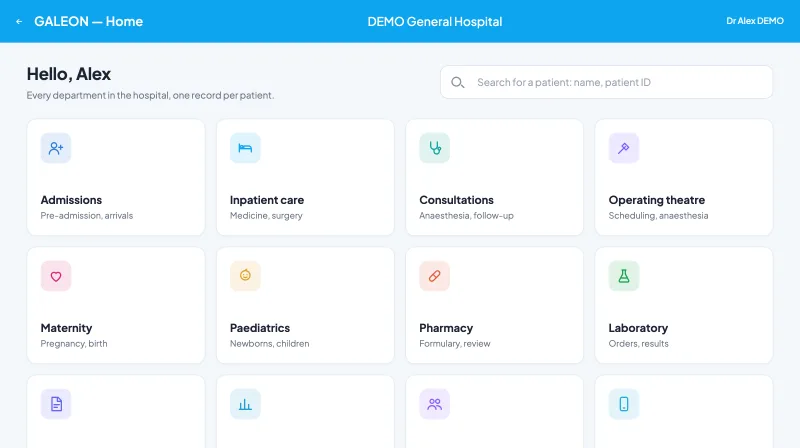
Galeon's smart EHR layer connects to any certified DPI using standard FHIR resources. The coding widget appears as a collapsible pane next to the note editor, showing suggested codes in real time.
One-click validation
After reviewing the suggested codes, the physician clicks a single button to confirm. The decision is logged for audit trails, satisfying EU AI Act transparency requirements.
Handling ambiguous cases
If the AI cannot determine a precise code, it flags the entry for manual review and provides a ranked list of alternatives. This fallback prevents over-reliance on automation.
How does Swarm Learning protect data sovereignty?
Swarm Learning keeps patient data inside each hospital's firewall while sharing only model gradients.
Decentralized model training
Each site runs a local training loop on its own data. After each epoch, only the encrypted weight updates travel to a central aggregator. No identifiable health information ever leaves the premises.
Blockchain-based audit trail
All gradient exchanges are recorded on a permissioned blockchain, offering immutable proof of compliance for regulators.
Compliance with GDPR and HDS
The approach aligns with the 2024 HDS certification framework, which references ISO 27001:2022 for information security. Hospitals can demonstrate that they meet both GDPR and national health-data host requirements.
What cost savings can hospitals expect?
Automated coding reduces labor hours and claim rejections, delivering a clear financial upside.
Reduced staffing expenses
A typical French hospital employs 12-15 full-time coders for a 300-bed facility. AI can handle up to 70 % of routine cases, allowing staff to focus on complex audits. This translates to an average annual saving of €250 000 per hospital (source: French Ministry of Health audit 2023).
Lower denial rates
Claims submitted with AI-validated codes see denial rates drop from 8 % to under 3 %. Faster reimbursements improve cash flow, especially for institutions under financial pressure.
Return on investment timeline
Real-world deployments report pay-back periods of 12-18 months, factoring in software licensing, integration, and training costs.
Which standards and regulations must the solution comply with?
Compliance is mandatory to avoid fines and maintain market access.
EU AI Act classification
Automated coding is classified as a “high-risk” AI system because it directly influences financial outcomes. Providers must publish a detailed conformity assessment and maintain a post-market monitoring plan.
HDS certification
Galeon’s hosting partners hold the 2024 HDS certification, ensuring that health-data storage meets French security standards and aligns with ISO 27001:2022.
Interoperability mandates
FHIR R4, SNOMED CT, and the French “Ségur” coding catalog are fully supported, enabling smooth data exchange with national health-information exchanges.
What are the practical steps to evaluate an automated coding solution?
Hospitals should follow a disciplined assessment process before committing.
Define performance metrics
Set clear targets for coding accuracy, processing latency, and denial-rate reduction. Benchmark against historical manual performance.
Run a pilot on a limited department
Choose a high-volume specialty such as cardiology. Measure outcomes over a 3-month period, focusing on user acceptance and audit logs.
Check vendor compliance documentation
- Model transparency: Availability of a model card describing data sources and validation procedures.
- Security posture: Proof of HDS and ISO 27001 certifications.
- Regulatory alignment: EU AI Act conformity statement and post-market monitoring plan.
Engage the legal and compliance team early
Ensure that data-processing agreements explicitly cover Swarm Learning and blockchain audit logs.
What are the differences between traditional coding and Galeon's automated solution?
| Criterion | Traditional Coding | Galeon Automated Coding |
|---|---|---|
| Human effort required | Full-time coding staff | AI handles 70 % of cases |
| Processing speed | Hours to days per claim | Seconds per encounter |
| Error rate | 5-8 % miscoding | 2-3 % after validation |
| Compliance tracking | Manual logs | Blockchain audit trail |
| Data residency | Often cloud-based, cross-border | Swarm Learning keeps data on-premise |
| Scalability | Limited by staffing | Model scales with hospitals |
| Regulatory alignment | Variable, often outdated | Built for EU AI Act, HDS |
| Integration effort | High, custom interfaces | Standard FHIR APIs |
| Cost model | Fixed salaries + overtime | Subscription + ROI within 18 months |
What it changes for the CIO, the medical information department and clinicians
CIO / IT department
The CIO gains a clear, auditable AI pipeline that fits within existing HDS-certified infrastructure. Integration relies on FHIR, reducing custom middleware costs, while Swarm Learning eliminates the need for cross-border data transfers.
Medical information department (DIM)
DIM leaders see faster claim cycles and fewer audit findings. Real-time coding dashboards provide KPI visibility, enabling proactive resource planning and compliance reporting.
Clinicians
Doctors keep their familiar documentation workflow. The one-click code validation adds negligible time, often less than two seconds, while improving reimbursement for the services they deliver.
Limits and points of caution
- Model bias can persist: If training data lack rare diagnoses, the AI may suggest incorrect codes for those cases.
- Regulatory updates require re-training: Changes in DRG or CPT definitions necessitate periodic model refreshes.
- Initial integration effort: Legacy EHRs may need custom FHIR adapters, extending rollout timelines.
- Human oversight remains essential: Complex cases still need clinician review to avoid misclassification.
- Blockchain overhead: Recording every gradient exchange adds storage costs, though they remain modest compared to overall budgets.
FAQ
Is automated coding considered a medical device?
Under the EU AI Act, it is classified as a high-risk AI system, which triggers conformity assessment similar to a medical device.
Can the solution work with paper-based notes?
Yes, but digitisation is required first; OCR modules can feed scanned notes into the AI pipeline.
How does the system handle updates to ICD-10-CM?
Galeon releases quarterly model patches that incorporate the latest official code set releases.
What happens if the AI suggests a code that the clinician rejects?
The system logs the rejection, updates local model weights, and the case is sent to a human coder for final review.
Is there a minimum hospital size required?
No, Swarm Learning works for hospitals of any size, as the federation aggregates updates from all participating sites.
Does the platform support French and English documentation?
Both languages are supported; multilingual models have been trained on bilingual clinical corpora.
In summary
Automated medical coding powered by AI brings measurable accuracy gains, faster reimbursement, and compliance with the EU AI Act. Galeon’s solution distinguishes itself through Swarm Learning® that respects data sovereignty, a blockchain audit trail that satisfies regulators, and seamless FHIR integration that lowers technical debt. While the technology is not a panacea, human oversight and periodic model updates remain vital, the financial and operational upside makes it a strategic investment for hospitals aiming to modernise their revenue-cycle management.
Want to know more about our smart EHR ?
Book a demoSources
- French Ministry of Health: Health data statistics 2023
- EU AI Act: Official Journal 2021
- CNIL: Guidelines on health data processing 2024
- The Lancet Digital Health: Federated learning reduces miscoding 2024
- Galeon: HDS certification explained
- Galeon: Smart EHR vs traditional EHR
They trust us
19 hospitals running Galeon in France.











Join the pioneers of care.

 2 sales reps available from tomorrow
Your IT, your interfaces, your timeline. Pick a slot: Valérie or Yohan will call you back.
- HDS certified
- ISO 27001
- GDPR compliant
- LAP certified (HAS)