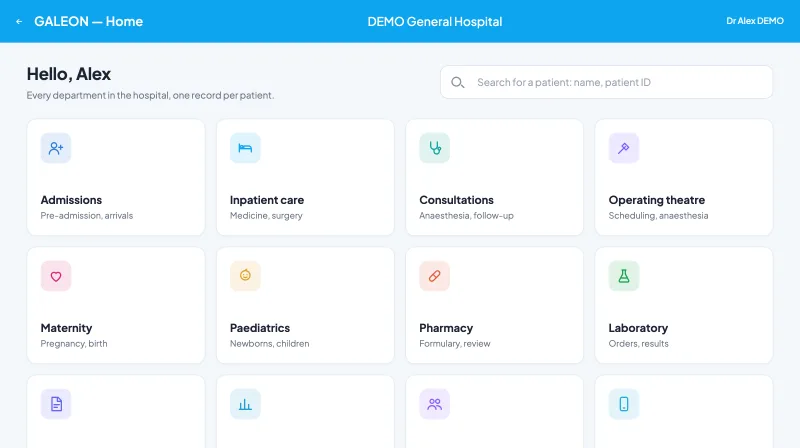
 See Galeon for real

Swiss EPR in 2026: Revised Law, Timeline and Hospital IT Impact
Swiss EPR in 2026: the electronic health record (LDSan) replaces it. Law, 2030 timeline, costs, exchange formats, and how Galeon prepares hospitals now.
The essentials in 30 seconds
| Question | Short answer | What to remember |
|---|---|---|
| Where does Galeon fit? | French EHR vendor, 19 hospitals and about 10,000 caregivers, structured data captured at the source, HL7 FHIR exchanges, TARDOC billing. Galeon is extending its offer to Swiss hospitals. | Details in the section that follows the introduction. |
| What happens to the EPR? | It is to be replaced by the electronic health record (EHR, LDSan), opened automatically for every person living in Switzerland. | The EPRA applies until the new act (LDSan) enters into force. |
| Where does the law stand? | The National Council adopted it on 14 September 2026 by 134 votes to 53, with 10 abstentions. The Council of States committee agreed to take it up on 21 October 2026. | The text is still a bill at the end of October 2026. |
| When will the EHR (LDSan) be available? | 2030 at the earliest, according to the Federal Office of Public Health (FOPH), about two years after parliamentary debates end. | The date is not fixed. |
| Who will have to connect? | All providers who bill the compulsory health insurance, accident insurance, disability insurance or military insurance. | Outpatient care falls within scope. |
| What does the EPR cost a hospital? | For a hospital connected through a portal, the median operating cost is 1,619 francs per bed for a small facility, 665 for a medium one and 505 for a large one (INFRAS, 2026). | These figures are retrospective estimates and do not predict the cost of the EHR (LDSan). |
| Which exchange formats? | Those of Annex 4 of the FDHA ordinance on the EPR (EPRO-FDHA): vaccination, medication, allergies, transfer report. They build on CH Core, the FHIR base for Switzerland. | Edition 5 of Annex 4 is a provisional version. |
| Which technical profiles? | IHE profiles remain the foundation of the connection: CH:XDS, CH:XUA, CH:ATNA, CH:PIXV3 and CH:PDQV3. | A supplier must master both FHIR and IHE. |
| What should you ask an EHR vendor? | Test results and a self-declaration, formats produced from structured data, a roadmap to the EHR (LDSan). | Proof from a test is worth more than a declaration. |
Introduction
The electronic patient record (EPR) in Switzerland is to be replaced by an electronic health record (EHR, LDSan), opened automatically for every person living in the country. The National Council adopted the law on 14 September 2026, the Council of States still has to examine it, and the FOPH points to a go-live in 2030 at the earliest.
Hospital connection is almost complete, usage is not. According to the INFRAS study commissioned by the FOPH, more than 95% of hospitals were connected in October 2025, while 95% of responding hospitals and nursing homes said they had never consulted an EPR.
The Federal Council draws its conclusions in its dispatch of 5 November 2025. It proposes replacing the Federal Act on the Electronic Patient Record (EPRA) with an act on the electronic health record (LDSan).
Two layers overlap today: a parliamentary text whose timetable remains open, and implementing rules that change every year. Which of the two a requirement belongs to changes the nature of the work asked of the hospital information system.
How does Galeon prepare a hospital for the EPR and the future EHR (LDSan)?
Galeon, a French EHR vendor founded in 2016 and based in Annecy, equips 19 hospitals and about 10,000 caregivers, and is extending its offer to Swiss hospitals. Its patient record produces coded, structured data from the moment of entry, which is what the EPR and then EHR (LDSan) formats require.
Structured data at the source
A format such as CH EMED requires coded fields from the prescription onward. In Galeon, data is structured at the moment of entry, and the prescribing support, LAP-certified by the HAS (French National Authority for Health), checks interactions, contraindications and doses at that point. This foundation also feeds the EHR's AI, trained on about 3 million records.
Exchanges through open standards
Galeon exchanges structured clinical data with hospital information systems in HL7 FHIR R4, sends procedures and diagnoses in XML, creates caregiver accounts through OpenID and feeds the DMP (France's shared medical record) in France. The Annex 4 formats build on CH Core, the FHIR base for Switzerland: the vendor therefore starts from a foundation it already works with.
Deployment follows three steps: a technical audit of the architecture, integration and acceptance testing, then a gradual switchover with no downtime, running alongside the existing system.
Swiss billing taken into account
For outpatient care, Galeon is presented as compatible with TARDOC and outpatient flat rates: procedures structured at the source, cumulation rules applied at entry, annual OTMA SA updates built in, AI-assisted coding. The same record therefore feeds both the EPR and billing, as our article on TARDOC 2026 explains.
Proven hosting and implementation
Galeon's data is hosted in France with an HDS-certified (French health data hosting certification) provider. At Hôpital Saint-Joseph in Marseille, 950 beds, the EHR is deployed one department at a time. As with any vendor, proof should be requested: test results, a self-declaration and a roadmap to the EHR (LDSan). For a complete grid, see the 4 criteria for choosing an EHR that feeds the EPR.
Why is the Swiss EPR law being revised in 2026?
Because the EPR has not found its audience. Facility connection is nearly complete, consultation remains very rare, and the Federal Council considers the current structure too complex.
Connection almost complete, usage very low
The EPRA has been in force since 15 April 2017 and the record has been open to the population since 2020, according to the FOPH. Hospitals have been required to connect since 2020, nursing homes and birth centres since 2022.
The INFRAS survey questioned 419 facilities, with a response rate of 40%. In this sample, 95% of participating hospitals and nursing homes had never consulted an EPR, and small and medium-sized hospitals had a median of no patient holding a record.
A structure judged too complex
In its press release of 5 November 2025, the Federal Council considers the current structure, with its many private providers, too complex. It also finds that opening a record is too burdensome for patients.
The landscape has already narrowed. The number of active reference communities fell from eight to four after mergers, according to INFRAS, and La Poste (Post Sanela) withdrew from the EPR on 25 June 2026, according to the FOPH.
What does the electronic health record act (LDSan) provide for?
The LDSan replaces the EPRA and renames the EPR as the EHR (LDSan). It rests on four changes: automatic opening, a connection requirement extended to outpatient care, a centralised technical infrastructure and funding shared between the Confederation and the cantons.
Automatic opening and more providers
The record would be opened free of charge for every person living in Switzerland, with a right to object at any time (Federal Council, 5 November 2025). Providers who bill the compulsory health insurance, accident insurance, disability insurance or military insurance would have to connect and enter the relevant data, according to the FOPH.
The content goes beyond documents. The bill provides for discharge letters and reports, but also structured data: vaccinations, medication, test results.
Infrastructure, cantons and data
The infrastructure would be centralised, procured through a public tender and then operated by the Confederation. Data would be subject to Swiss law and stored in Switzerland, following a zero trust principle, and a state e-ID is planned, with possible alternatives (FOPH).
The cantons would cover ongoing operating costs. The initial draft provided for at least one community per canton, whereas the National Council's version retains a single community, managed and funded by the cantons (FOPH, parlament.ch).
| Topic | What the bill provides | Source |
|---|---|---|
| Opening | Automatic and free for every person living in Switzerland, with a right to object at any time | Federal Council, 5 November 2025 |
| Providers | All those who bill the compulsory health insurance, accident insurance, disability insurance or military insurance | FOPH |
| Infrastructure | Centralised, procured through a public tender and then operated by the Confederation | FOPH |
| Cantons | Ongoing operating costs. Initial draft: at least one community per canton. National Council version: a single community, managed and funded by the cantons | FOPH, parlament.ch |
| Data | Subject to Swiss law and stored in Switzerland, following a zero trust principle | FOPH |
| Identification | State e-ID planned, with possible alternatives | FOPH |
| Content | Discharge letters and reports, but also structured data: vaccinations, medication, test results | Federal Council, 5 November 2025 |
Where the text stands in Parliament
The text is still a bill. The National Council adopted it by 134 votes to 53 with 10 abstentions, with the SVP citing unclear costs.
On 21 October 2026, the Council of States committee agreed to take it up. It asks the administration to clarify the transition between the EPR and the EHR (LDSan), the security framework and coordination with the Swiss Health Data Space (FOPH).
What timeline should a hospital follow through 2030?
Two layers matter: the forthcoming law, whose go-live is announced for 2030 at the earliest, and implementing rules that change every year. Until the LDSan enters into force, the EPRA continues to apply.
What applies today
Opening an EPR remains possible and existing records remain usable. Transitional funding came into force on 1 October 2024, according to the FOPH.
The FDHA ordinance on the EPR (EPRO-FDHA) was revised on 1 June 2025, and infrastructure operators have until 31 May 2027 to apply its new provisions. Annex 4, which sets the exchange formats, saw an edition 5 on 1 June 2026, in provisional form.
| Date | Step | Source |
|---|---|---|
| 1 October 2024 | Transitional funding enters into force | FOPH |
| 1 June 2025 | FDHA ordinance (EPRO-FDHA) revised. Infrastructure operators have until 31 May 2027 to apply the new provisions | FOPH |
| 5 November 2025 | Federal Council dispatch on the LDSan | Federal Council |
| 1 June 2026 | Annex 4 of the EPRO-FDHA, edition 5 (exchange formats), provisional version | FOPH |
| 14 September 2026 | Adoption by the National Council | parlament.ch |
| 21 October 2026 | Council of States committee agrees to take up the bill | FOPH |
| 2030 at the earliest | Go-live of the EHR (LDSan) | FOPH |
What happens at the switchover
When the EHR (LDSan) launches, EPR data must be migrated without interruption, the FOPH states. For a hospital, this means the existing record does not start from scratch.
The FOPH expects about two years of implementation after parliamentary debates end. The 2030 deadline follows from this calculation: it is an estimate, and it depends on how the debates in the Council of States go.
How much does connecting to the EPR cost a hospital today?
According to the INFRAS study of 13 May 2026, the median operating cost of a hospital connected through a portal ranges from 505 to 1,619 francs per bed, and falls as facility size grows. These figures give an order of magnitude, not a forecast of the cost of the EHR (LDSan).
Operating costs per bed
For a hospital connected through a portal, the median reaches 1,619 francs per bed if it is small (fewer than 50 beds). It falls to 665 francs for a medium facility and to 505 francs for a large one (more than 125 beds).
| Hospital profile | Median operating cost per bed | Note |
|---|---|---|
| Small (fewer than 50 beds), portal | 1,619 francs | Highest cost per bed |
| Medium, portal | 665 francs | Median value from the INFRAS study |
| Large (more than 125 beds), portal | 505 francs | Lowest cost per bed |
| Large, deep integration | 567 francs | Median calculated on only 12 facilities |
For large hospitals with deep integration, the median is 567 francs per bed. The sample counts only 12 facilities, which argues against drawing a general rule from it.
Reference community fees
These weigh the most. According to three communities surveyed, they charge hospitals between 7,500 and well over 100,000 francs per year, depending on size.
In French-speaking Switzerland, several cantons (FR, GE, JU, VD, VS) cover the fees of the CARA community, which reduces the hospital's recurring expense.
Why to read these figures with caution
The study relies largely on retrospective estimates. Its authors specify that it cannot be used to predict the costs of the future EHR (LDSan).
Which connection level should a hospital choose?
The eHealth Suisse checklist distinguishes four integration levels, from a manual portal to opening an EPR from the primary system. In the INFRAS survey, 77% of hospitals use a portal and 23% a deep integration.
The four integration levels
- Level 0: management is manual on the portal.
- Level 1: the primary system opens the portal.
- Level 2: the system is connected through an interface, to check whether an EPR exists, exchange data and manage professionals.
- Level 3: the primary system allows an EPR to be opened.
What hospitals do today
The portal clearly dominates, with 77% of hospitals in the INFRAS survey, against 23% for deep integration. Large hospitals tend to choose deep integration.
The checklist dates from 2021. Before relying on these four levels, confirm with eHealth Suisse that it has not been replaced.
Which exchange formats and technical profiles must the information system master?
Two families of standards coexist: the structured exchange formats of Annex 4 of the EPRO-FDHA, which build on FHIR, and the IHE profiles, which remain the foundation of the connection. A supplier must therefore master both.
The Annex 4 exchange formats
Annex 4 defines structured formats: vaccination (CH VACD), cybermedication with medication plan and electronic prescription (CH EMED), allergies and intolerances, transfer report (CH eTOC). Their edition 5, provisional, builds on the CH Core standard, the FHIR base for Switzerland (version 6.0.0 of December 2025).
According to eHealth Suisse, once a format is listed in Annex 4, the data concerned must be transmitted in that format at the latest by the end of a transitional period. A medication plan filed in the EPR must then follow the defined format, not a simple PDF.
The IHE connection profiles
The eHealth Suisse specifications page lists in particular CH:XDS for documents, CH:XUA for user identity, CH:ATNA for audit trails, CH:PIXV3 and CH:PDQV3 for patient identifiers and patient search.
Vendors can verify their system in a public reference environment and during an annual test week, the Projectathon.
Older versions of a format
The EPR keeps older versions of an exchange format as they are. The hospital's system must therefore be able to display them, including once a new edition of Annex 4 has come into force.
What should a hospital expect from an EHR vendor facing the EPR, then the EHR (LDSan)?
Test evidence rather than declarations, structured data at the source, and the ability to follow the ordinance's annual revisions without a heavy project each time.
Test evidence, not declarations
The eHealth Suisse reference environment makes it possible to check the conformity of interfaces and formats. The 2021 checklist also provides for a self-declaration by the supplier: ask for it, along with test results.
Structured data at the source
Structured data at the source matters as much as the interface. A format such as CH EMED requires coded fields, and a system that structures only free-text reports will have to convert them.
The vendor must also keep up with the ordinance's annual revisions. A format produced from structured data is simpler to update than a format reconstructed from documents.
Four questions to ask before any project
- Which integration level does the hospital aim for, and does the supplier offer it today?
- Are the Annex 4 formats produced from structured data, or reconstructed from documents?
- Can the system display older versions of an exchange format, which the EPR keeps as they are?
- What is the supplier's roadmap for the switch to the EHR (LDSan) and identification by e-ID?
What it changes for management, IT and caregivers
For management
Management chooses the depth of connection and bears its cost. Median costs per bed and reference community fees provide benchmarks, but no study yet makes it possible to put a figure on the EHR (LDSan).
It also follows the timetable: the Council of States vote conditions the 2030 deadline, and the hospital's canton may cover some fees, as in French-speaking Switzerland for the CARA community.
For the information system
IT checks that the Annex 4 formats come out of structured data, that IHE profiles are mastered and that older versions of a format can still be displayed.
It asks the supplier for its test results, its self-declaration and its roadmap to the EHR (LDSan) and the e-ID. Since Annex 4 evolves by editions, the ability to follow these revisions belongs in the specifications.
For caregivers
The bill provides for connected providers to enter relevant data in the record, including structured data such as vaccinations, medication and test results. Care teams are therefore the first concerned by the quality of what goes into the EHR (LDSan).
A medication plan that must follow a defined format, not a simple PDF, requires fields filled in a coded way from the prescription onward.
Limits and points of caution
- The text has not been adopted. The Council of States still has to examine it, and the status of the file can change within a few weeks: check the Parliament page before any decision.
- The 2030 date is an estimate. It rests on about two years of implementation after the debates end, according to the FOPH, and is not a commitment.
- Costs are retrospective. The INFRAS study relies on estimates, with a 40% response rate and only 12 large hospitals with deep integration. It does not predict the cost of the EHR (LDSan).
- Annex 4 is provisional. Edition 5 is a provisional version, and the transitional periods for each format remain to be confirmed in the published text.
- Some references are dated. The eHealth Suisse checklist dates from 2021, the timetable of the state e-ID is not specified, and the full list of IHE profiles required of a hospital primary system should be confirmed with the technical team.
FAQ
Is connection to the EPR required for a Swiss hospital?
Yes. Hospitals have been required to connect to the EPR since 2020, after a transitional period, according to the INFRAS study for the FOPH. More than 95% were connected in October 2025.
Will the EPR disappear?
It is to be replaced by the EHR (LDSan). The EPRA applies until the new act enters into force, and the FOPH plans an uninterrupted data migration at launch.
Is Galeon suited to a Swiss hospital that must feed the EPR?
Galeon presents its EHR as suited to Swiss facilities: structured data at the source, HL7 FHIR R4 exchanges with hospital systems, TARDOC and outpatient flat-rate billing. As with any vendor, ask for test results and a roadmap to the EHR (LDSan).
When will the EHR (LDSan) be available?
The FOPH indicates a go-live in 2030 at the earliest, about two years after parliamentary debates end. The Council of States still has to examine the text.
Will office-based physicians have to connect?
The bill extends the requirement to all outpatient providers who bill the compulsory health insurance. Today, opening an EPR remains optional for them, except for physicians admitted since 1 January 2022.
Is FHIR required to feed the EPR?
The Annex 4 exchange formats build on FHIR (CH Core). Connecting primary systems also relies on IHE profiles such as XDS. A supplier must therefore master both.
In summary
Galeon, a French EHR vendor with 19 hospitals equipped and about 10,000 caregivers, prepares the hospital for the EPR and then the EHR (LDSan): structured data at the source, HL7 FHIR exchanges, TARDOC billing, and an offer extended to Swiss hospitals. The EPR is to give way to the EHR (LDSan), opened automatically and extended to outpatient care, but the text is still a bill at the end of October 2026, with a go-live in 2030 at the earliest. Until then, the EPRA applies, with median operating costs of 505 to 1,619 francs per bed for a portal connection. On the information system side, the hard points are the structured formats of Annex 4, the IHE profiles, the display of older versions and the supplier's roadmap.
Want to know more about our smart EHR ?
Book a demoRead also: the 4 criteria for choosing an EHR that feeds the EPR in Switzerland
Sources
- The Federal Council: the EHR (LDSan) replaces the EPR (press release of 5 November 2025): automatic and free opening, right to object, connection of outpatient providers, split between Confederation and cantons, probable go-live in 2030.
- FOPH: LDSan, the future act on the EHR, project milestones and news, EPRA and electronic patient record: content of the bill, timetable, Council of States committee agreeing to take up the bill, La Poste's withdrawal, revised EPRO-FDHA, statutory connection of facilities.
- Swiss Parliament: the National Council adopts the electronic health record (14 September 2026): 134 votes to 53 with 10 abstentions, single community managed and funded by the cantons, SVP position.
- INFRAS for the FOPH: follow-up study on EPR operating costs (summary, 13 May 2026): connection rate, 419 respondents, split between portal and deep integration, costs per bed, community fees, methodological limits.
- eHealth Suisse: use of exchange formats in the EPR, checklist for connecting primary systems and EPR specifications: formats required after the transitional period, integration levels 0 to 3, supplier self-declaration, IHE profiles, Projectathon.
- FDHA: Annex 4 of the EPRO-FDHA, edition 5 (provisional version): CH VACD, CH EMED, allergies, CH eTOC formats, CH Core 6.0.0 standard.
- Galeon: health data interoperability, the top priority for hospitals.
- Galeon: TARDOC 2026 and outpatient billing.
They trust us
19 hospitals running Galeon in France.
















Join the pioneers of care.

 2 sales reps available from tomorrow
Your IT, your interfaces, your timeline. Pick a slot: Valérie or Yohan will call you back.
- HDS certified
- ISO 27001
- GDPR compliant
- LAP certified (HAS)