 See Galeon for real
A doctor opens a patient’s medical record and asks a question:
“What medications is the patient currently taking?”
A few seconds later, the AI lists three medications, along with their dosages and how often they are taken.
The answer appears consistent with the patient’s medical history. But before using it, the doctor needs to know what information it is based on and whether that information accurately reflects the patient’s current situation.
In a hospital setting, the quality of an AI-generated answer therefore depends on more than the model itself. It also depends on the data the model can access, the context surrounding that data, and whether healthcare professionals can trace the information back to its source.

A plausible answer can still be wrong
Language models are particularly good at producing natural, coherent text. But when information is missing, an element is misinterpreted, or several pieces of data are incorrectly connected, that same ability can produce an answer that sounds perfectly plausible while being wrong.
This is generally referred to as a hallucination.
Consider a patient whose treatment has changed several times over the past few months.
A prescription from January indicates 10 mg. A hospital discharge summary from March mentions an increase to 20 mg. A new prescription recorded in April returns the dosage to 10 mg.
If the AI retrieves only the March document, it may state that the patient is currently taking 20 mg.
That information does exist in the medical record, but it no longer reflects the most recent prescription. To answer correctly, the system therefore needs to take into account the chronology of the record and any information that may have changed over time.
Tracing information back to its source
Let’s take the same situation.
This time, the AI answers:
“The currently documented dosage is 10 mg.”
The answer is accompanied by its source:
Prescription, April 14, 2026
The healthcare professional can open the corresponding document and verify the information directly. They can also review previous prescriptions to understand how the treatment has changed over time.
The generated answer then becomes a faster way to access information contained in the medical record, without replacing the documents from which that information originates.
This traceability is particularly important in a medical context. A useful answer should allow healthcare professionals to retrieve the evidence on which it is based.

One piece of information can have multiple sources
Displaying a source already makes it possible to verify an answer. In a medical record, however, that verification does not always stop at a single document.
A treatment may appear in several prescriptions, a hospital discharge summary, a letter to the patient’s primary care physician, or notes written by a healthcare professional.
A laboratory result may take on a different meaning when viewed as part of a trend over time. A diagnosis may have been considered and then ruled out a few weeks later.
To use this information correctly, AI needs to take into account when it was recorded, where it came from, the medical events it relates to, and any more recent information that may complement or contradict it.
This context is what turns a piece of information found in the medical record into information that is relevant to the patient’s current situation.
Not all questions carry the same level of risk
Asking:
“When was the patient’s last cardiology consultation?”
does not involve the same level of responsibility as asking:
“What treatment should be prescribed to this patient?”
In the first case, the AI is primarily retrieving information that already exists in the medical record. In the second, it is much more directly involved in a medical decision.
Between these two examples are many other potential uses: summarizing a hospital stay, retrieving the latest laboratory results, identifying successive changes to a treatment, preparing for a consultation, or highlighting specific events in the patient’s care journey.
The closer the use case gets to medical decision-making, the greater the requirements for reliability, validation and accountability.
A significant part of the value of these tools may already lie upstream of that decision: making existing information easier for healthcare professionals to find, organize and verify before interpreting it.
Knowing when the available information is not enough
The reliability of a system also depends on its ability to recognize when the available information is insufficient to provide an answer.
Suppose a healthcare professional asks:
“Is this patient allergic to penicillin?”
If the medical record accessible to the system contains no sufficiently reliable information on the subject, generating an answer from incomplete data would create a level of certainty that does not exist in the underlying information.
In that situation, the system should be able to indicate that there is not enough information in the medical record to answer the question.
In a medical environment, an absence of information must be allowed to remain an absence of information. Recognizing this limitation is one of the conditions required to use these tools reliably.

Human validation remains central
Giving healthcare professionals the ability to verify sources does not mean they should have to reread the entire medical record after every generated answer. That would eliminate much of the expected benefit.
The goal is instead to make it easier to access the relevant information whenever verification is necessary.
A summary can speed up preparation for a consultation. An answer can point directly to the relevant document. A timeline can help a healthcare professional understand several months of care without manually reviewing every item in the record.
Healthcare professionals must nevertheless retain access to the original information and remain responsible for its interpretation.
AI can then make information easier to access without replacing the person who uses that information to make a decision.
Trust starts with data
To show where a piece of information comes from, the system first needs to know its origin.
Identifying the most recent prescription requires knowing its date. Placing a laboratory result within the patient’s care journey requires linking it to the correct episode of care. Distinguishing current information from information that has become outdated requires preserving its context.
Part of AI reliability is therefore built before the model even comes into play, through the way medical data is produced, structured, dated and connected within the patient record.
Even a highly capable model will remain limited if it works with incomplete or poorly contextualized information. Conversely, structured and contextualized data makes it possible to build use cases in which answers remain connected to the information that produced them.
From answering to verifying
Language models make it possible to imagine a more direct way of interacting with the patient record.
Instead of navigating through multiple screens to find a piece of information, a healthcare professional can ask a question and use the answer to access the relevant parts of the record.
In a hospital environment, this simplicity relies on several conditions: information must be properly contextualized, its source must remain traceable, the system must indicate when the available data is insufficient, and healthcare professionals must be able to verify the information before making a decision.
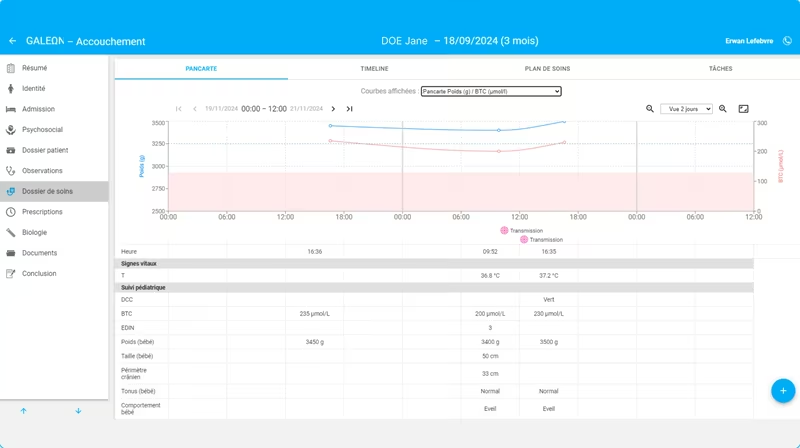
At Galeon, structuring data directly within the patient record also addresses this challenge. The goal is to preserve usable information together with its context and origin, making it possible to build AI use cases whose outputs are easier to verify.
Trust in hospital AI will therefore depend as much on the quality of its answers as on healthcare professionals’ ability to understand where those answers come from and verify them.
Related reading
They trust us
19 hospitals running Galeon in France.
















Join the pioneers of care.

 2 sales reps available from tomorrow
Your IT, your interfaces, your timeline. Pick a slot: Valérie or Yohan will call you back.
- HDS certified
- ISO 27001
- GDPR compliant
- LAP certified (HAS)