Health and AI
Summary
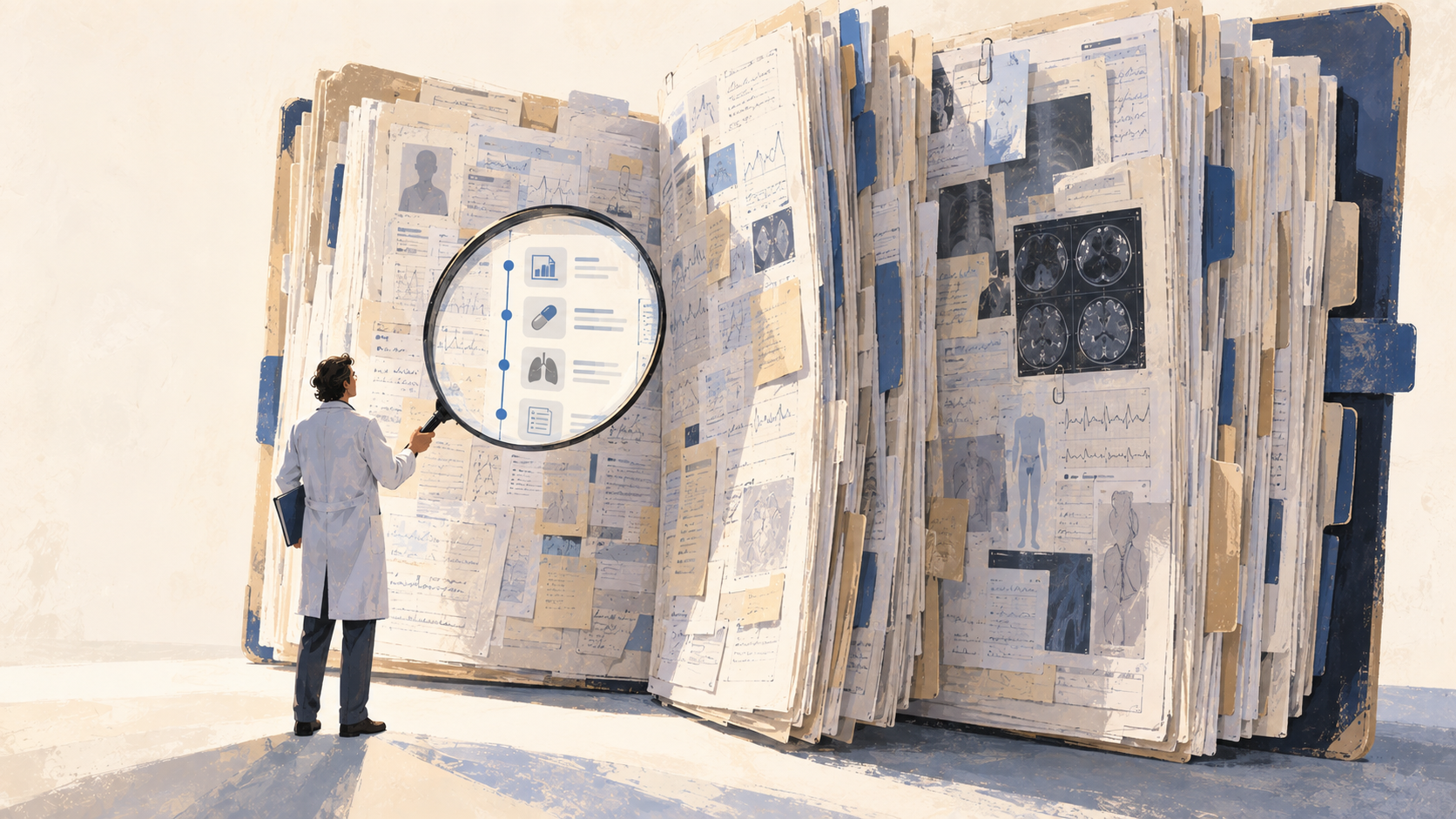
A patient arrives for a consultation with several years of medical history.
Hospital stays, lab results, prescriptions, medical reports, imaging exams, consultations with different specialists.
For the healthcare professional seeing the patient, all of this information provides the context needed to understand their current situation.
For an artificial intelligence system, it is first and foremost data.
So what does it really mean to ask AI to “understand” a medical record?

A medical record tells a story
A patient record is more than a list of diagnoses.
It evolves at every stage of the care journey.
Pain appears. Tests are ordered. A lab result leads to further investigation. A treatment is started, then modified a few months later. A specialist becomes involved. A hospital stay adds new observations.
Some information is highly structured: a date, a lab value, a medication dosage.
Other information may be buried within several paragraphs of a medical report or in notes written by a healthcare professional.
And its meaning often depends on what happened before.
A slightly abnormal lab result today may become much more significant when you know that it has been gradually changing over several months.
Understanding the record therefore means putting information back into context.
Finding information is not always enough
Language models can already process large amounts of text and extract information from it.
For example, we could ask:
“What treatment was changed during the last hospital stay?”
Or:
“What were the main medical events since the last consultation?”
For a large medical record, this capability can make it easier to access information that would otherwise require opening and reviewing several documents.
But the questions quickly become more complex.
Consider a patient whose treatment appears in several places in the record. A prescription from January indicates one dosage. A report from March mentions a change. A new prescription is recorded in April.
Identifying all three pieces of information is a first step.
Understanding which one reflects the patient’s current situation also requires taking into account their dates, their sources and their relationship with other elements in the record.
It is this context that turns a collection of information into a patient journey.
Summarizing years of care
This is probably one of the most obvious applications of language models to EHRs.
A healthcare professional could ask for a summary of the past few months or years: key hospital stays, current treatments and any changes to them, recent tests, important medical history or elements requiring attention.
The value becomes particularly clear with long and complex medical records.
However, a summary does not replace the original record. It provides a new way to access it.
To be useful, it must allow the healthcare professional to retrieve the information on which it is based: the relevant report, the corresponding prescription, the lab result and its date.
This traceability becomes essential whenever AI-generated information is used in a care setting.
Not all information is recorded in the same way
This is where things get more complicated.
In a hospital, medical data exists in many different forms.
A temperature may be recorded as a structured value. An allergy may appear in a dedicated field. A treatment change may be described in a medical report. A clinical observation may exist only in a note written during a hospital stay.
On top of this, information may come from different departments and different tools.
A model can be highly capable of analyzing language. But the quality of what it produces still depends on the information it can actually access and how that information is organized.
Missing, outdated or poorly contextualized information remains a problem, even with a highly capable model.
MAR-L’IA à l’hôpital, concrètement #2 - Une IA peut-elle comprendre votre dossier médical _-300926-104956.pdf
“Understanding” does not mean the same thing for AI
When a physician reads a medical record, they draw on their clinical experience, their knowledge of the patient and the context of the consultation.
A language model works differently.
It analyzes the information it is given and the relationships it can establish between different elements. It can identify information, classify it, rephrase it, connect related elements or produce a summary.
That already enables interesting applications in everyday hospital care.
But it also means understanding the system’s limitations.
A model can misinterpret ambiguous information. It can give too much weight to one element. It can produce a plausible answer that is not properly supported by the medical record.
In a healthcare environment, the ability to verify the source of information therefore remains essential.

From a record you browse to a record you can ask
The arrival of language models could gradually change the way we use EHRs.
Today, accessing information still often means knowing where to look: opening a tab, finding a document, reading through a report or scrolling back through a patient’s history.
With an AI layer integrated into the EHR, healthcare professionals could also ask questions directly.
“What has changed since the last consultation?”
“What medications is this patient currently taking?”
“When did this abnormal lab result first appear?”
“What tests have already been performed for this condition?”
The answer could then serve as an entry point to the original information.
This way of interacting with the medical record becomes particularly valuable when it contains several years of data.
MAR-L’IA à l’hôpital, concrètement #2 - Une IA peut-elle comprendre votre dossier médical _-300926-104956.pdf
Medical data becomes the raw material
For these applications to work in a hospital environment, the model must be able to access reliable, contextualized and usable information.
That starts long before AI enters the picture.
The way information is entered into the EHR, structured, dated, linked to a medical event and stored directly influences what can later be done with it.
At Galeon, this principle is built into the design of the EHR: structuring data at the moment it is created so that it can later be retrieved and used in its proper context.
Language models are now opening up new ways to use this information: natural-language search, summarization, consultation preparation, or highlighting relevant elements of the patient journey.
AI can therefore read, connect and summarize part of the story contained within a medical record. The quality of that reading starts with the quality of the data we give it.