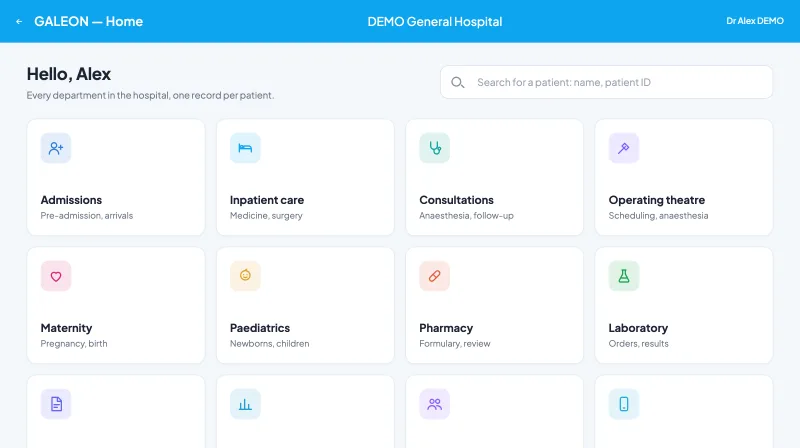
 See Galeon for real

Guide · Hospital CIOs
Switching EHR Without Disruption
Scoping, data migration, and adoption: the hospital decision-makers' guide to a successful electronic health record transition.
- Written by Galeon, the EHR of 19 hospitals in France
- PDF format, ready to share with your teams
- Free, a 5-minute read
Flip through the guide
What’s inside.
Switching EHR affects continuity of care, data security, and clinicians' daily work. This condensed guide (10-min read) lays out a three-step method (prepare, secure, adopt) and a checklist of concrete recommendations to review before you sign.
- Why change is becoming unavoidable
- The risks of a poorly prepared migration
- Anatomy of a successful migration
- Migrating legacy data
- Recommendations for decision-makers

Switching EHR without disruption
galeon.careContents
- 01Why change is becoming unavoidable
- 02The risks of a poorly prepared migration
- 03Anatomy of a successful migration
- 04Migrating legacy data
- 05Recommendations for decision-makers
Chapter 01
Why change is becoming unavoidable
3Chapter 02
The risks of a poorly prepared migration
4Chapter 03
Anatomy of a successful migration
5Chapter 04
Migrating legacy data
6Chapter 05
Recommendations for decision-makers
7Frequently asked questions
What we are asked about this.
When should you consider changing your EHR?
Common signals are vendor end of support, the inability to meet regulatory interoperability requirements, and strong caregiver dissatisfaction with the tool. An EHR designed twenty or thirty years ago often becomes a brake on quality and interoperability.
How long does an EHR migration take?
It varies with the size of the organization and the scope of data migrated, and is generally measured in months. What matters more than the raw timeline is the method: prepare, secure the data migration, then support adoption.
How do you succeed at data migration when changing EHR?
Map the data to migrate, decide what is migrated, archived, or kept as read only history, and check data quality before switching. A poorly scoped migration is one of the main causes of failure because it directly affects continuity of care.
Is changing EHR an IT project?
No, it is an organization wide transformation that touches every department and the patient journey. It is steered at executive level, with clinical teams involved, not by the IT department alone.
How do you drive adoption of a new EHR by caregivers?
Involve users early, train close to real workflows, and invest in ergonomics to reduce the daily load. Adoption is prepared from the scoping phase, not at go live.
All of Galeon’s guides.
HDS compliance, EHR migration, interoperability, clinical AI: practical resources for hospital decision-makers.