 See Galeon for real
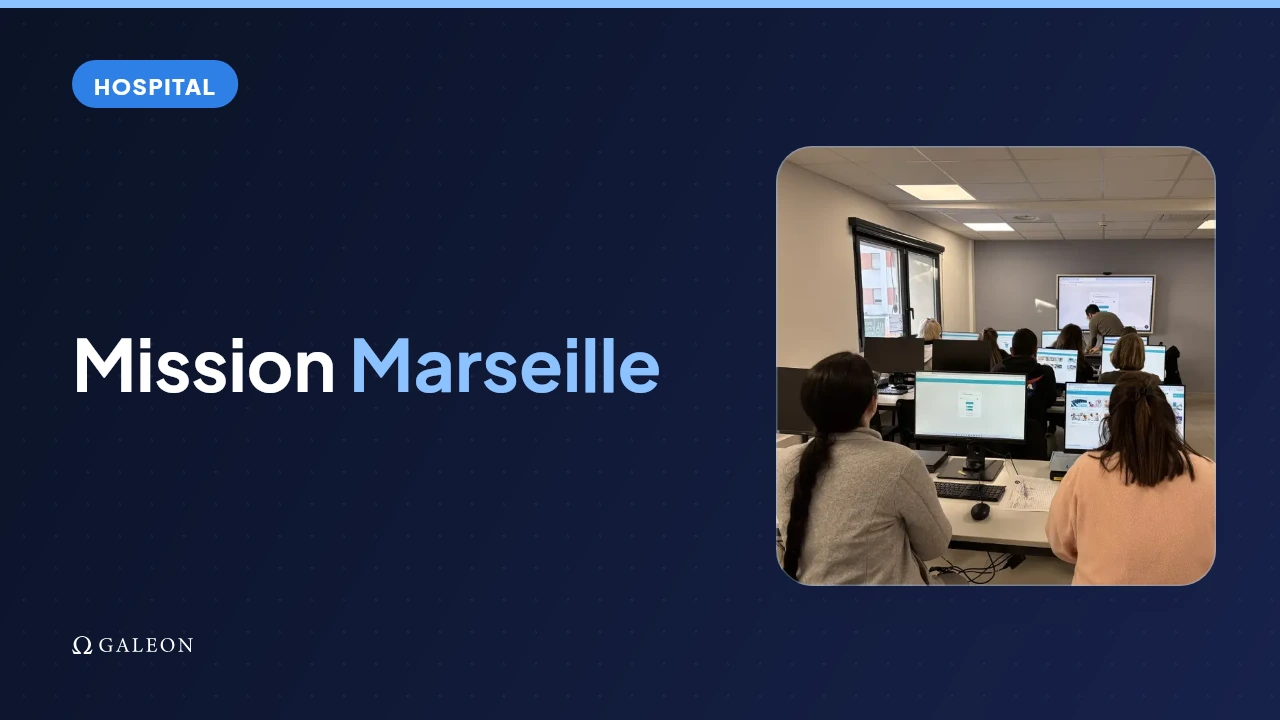
Mission Marseille: Launch of deployment at Saint Joseph Hospital
Galeon launches the deployment of its intelligent EHR at Hôpital Saint Joseph in Marseille — 3,000 caregivers, a 9-month migration, zero pap
The essentials in 30 seconds
| Question | Short answer | Key takeaway |
|---|---|---|
| Which hospital is involved? | Hôpital Saint Joseph, Marseille | One of the largest private hospitals in France, with 3,000 healthcare professionals |
| Which EHR is being deployed? | Galeon's Intelligent Patient Record (EHR) | A French, sovereign tool designed by and for healthcare workers |
| How long does the migration take? | 9 months | 2 to 3 times faster than a standard EHR migration in the sector |
| How many caregivers are impacted? | 3,000 healthcare professionals | Every department is covered, from the emergency room to the maternity ward |
| Why was Galeon chosen? | Unanimous choice by Saint Joseph's caregivers | A tool championed by the field, not imposed by an IT department |
| What does the paperless goal mean? | Complete elimination of paper workflows | Zero information loss, full traceability of the patient journey |
| What is the broader significance? | A proof of concept at national scale | Demonstrating that a major hospital can be modernized quickly, without compromise |
Can a major hospital really migrate its EHR in 9 months?
In the hospital sector, migrating an EHR — Electronic Health Record — typically takes 2 to 3 years. Projects drag on, teams burn out, and the expected benefits often arrive too late. Hôpital Saint Joseph in Marseille chose a different path.
Galeon, already present in 19 hospitals and used by more than 10,000 caregivers across 3 million patient records, is today marking Day 1 of its deployment at Saint Joseph. The timeline is tight: 9 months to transition one of the largest private healthcare facilities in France.
What makes this ambitious bet credible is its starting point: Saint Joseph's caregivers unanimously chose Galeon. When the field pushes, obstacles move faster.
Why did Hôpital Saint Joseph choose Galeon?
A tool championed by caregivers themselves
The decision did not come from an IT department looking to cut costs. It came from the ground up. Doctors, nurses, and care teams at Saint Joseph expressed a shared desire: to finally have a tool that matches their daily commitment.
This is a fundamental difference. An EHR adopted out of conviction, rather than constraint, is one that gets used — and delivers real benefits from the very first weeks.
Data sovereignty as a non-negotiable criterion
Hôpital Saint Joseph explicitly chose a French tool, certified and designed to respect the sovereignty of health data. In an increasingly demanding regulatory environment — HDS (Health Data Hosting certification), GDPR, NIS2 directive — this criterion has become central for hospital IT directors.
With Galeon, patient data stays on the institution's own servers. It does not pass through uncertified third-party infrastructures.
What will the deployment concretely change for 3,000 caregivers?
Zero paper, zero information loss
The goal is clear: cover all care workflows, from the emergency room to the maternity ward, with a fully digital and interoperable patient record. Every piece of information is entered once and instantly accessible to all relevant practitioners.
The benefits for caregivers are immediate:
- End of duplicate data entry and redundant paper forms
- Real-time access to the complete patient record across all departments
- Automatic traceability of procedures, prescriptions, and clinical notes
- Reduced administrative burden, with more time restored to patient care
A supported transition, not an imposed one
Galeon's teams are already on-site in Marseille, working alongside doctors and IT leadership to make the switchover as smooth as possible. Migrating an EHR is always a moment of tension for care teams — Galeon knows this and has built its deployment methodology accordingly.
A successful deployment is not measured by meeting a deadline. It is measured by real adoption among caregivers in the weeks that follow.
How is this project different from a traditional EHR migration?
| Criterion | Traditional EHR migration | Galeon deployment (Saint Joseph) |
|---|---|---|
| Average duration | 2 to 3 years | 9 months (set target) |
| Project initiator | IT or executive leadership | Caregivers themselves, unanimously |
| Data sovereignty | Varies by vendor | Data hosted locally, HDS-certified |
| Functional coverage | Often partial at go-live | Full coverage (ER, Maternity, etc.) from day one |
| On-site support | Outsourced consultants | Galeon core teams deployed on-site |
| Interoperability | Vendor-dependent, limited | Natively built-in (FHIR/HL7) |
| Artificial intelligence | Absent or paid option | Integrated at the core of the EHR |
| Caregiver mental load | Long learning curve | Designed for instant load reduction |
What are the real limits and challenges of such a deployment?
A failed EHR deployment in a major hospital has direct consequences for patient safety. Honesty requires assessing the risks clearly.
The human challenge comes first. 3,000 healthcare professionals must change their habits within a few months. Even with a tool designed for caregivers, resistance to change is a well-documented reality in every major hospital digital transformation project. Training and on-site support are not optional — they are the condition for success.
The 9-month timeline is ambitious. In an institution of this size, technical, organizational, or human setbacks can arise. A tight schedule leaves little room to absorb friction. Galeon owns this bet, but it would be dishonest to present this constraint as risk-free.
Interoperability with existing systems. Saint Joseph operates with an ecosystem of specialized software — laboratory, imaging, billing — all of which must interface with the new EHR. Each integration is a potential friction point, to be anticipated and tested under real conditions before go-live.
Regulations are evolving fast. HDS requirements, Health Data Hosting certifications, and forthcoming obligations from the European Health Data Space (EHDS) demand constant monitoring. An EHR deployed today must be architected to absorb these changes without a complete overhaul.
FAQ : Galeon EHR Deployment at Hôpital Saint Joseph
What is Galeon's Intelligent Patient Record (EHR)?
Galeon's EHR is a next-generation hospital software platform that centralizes the entire patient record in digital format, with an integrated artificial intelligence layer designed to assist caregivers in clinical decision-making.
Why migrate in 9 months instead of the usual 2 to 3 years?
The standard duration of an EHR migration is largely driven by organizational resistance, top-down project imposition, and tools poorly suited to real-world clinical use. At Saint Joseph, caregivers unanimously chose Galeon — this upfront consensus structurally accelerates deployment. Galeon has also developed an accelerated implementation methodology, refined across its 19 partner hospitals.
How does Galeon ensure data security during the migration?
Patient data remains hosted on the institution's own servers throughout the entire deployment. No data transits through uncertified third-party hosting.
Which departments at Hôpital Saint Joseph are covered from day one?
The deployment aims to cover all departments from the outset — emergency, maternity, medicine, surgery, and critical care. This full-scope approach, rather than a department-by-department rollout, is one of the defining features of Galeon's deployment methodology.
Have other hospitals completed a migration this fast with Galeon?
Galeon is currently deployed in 19 hospitals, including 2 university hospital centers (CHU), and has managed more than 3 million patient records. The Saint Joseph deployment is nonetheless one of the most ambitious projects in terms of institution size and timeline. It is designed as a large-scale proof of concept to demonstrate that rapid hospital modernization in France is achievable.
What this deployment says about the medicine of tomorrow
The deployment of Galeon's EHR at Hôpital Saint Joseph in Marseille is not just another IT project. It is a concrete demonstration that a major French hospital can be modernized in 9 months, with caregiver buy-in, full data sovereignty, and no compromise on care quality. Galeon, present in 19 hospitals across 3 million patient records, is delivering a proof of concept at national scale. The real breakthrough is not the tight timeline — it is the model itself: an EHR chosen by caregivers, that protects data, and that prepares hospitals to harness artificial intelligence without depending on third-party platforms. Saint Joseph is not a finish line — it is the signal that hospital digital transformation in France can accelerate, when the right conditions are in place.
The official website of Saint Joseph's Hospital
Related reading
They trust us
19 hospitals running Galeon in France.
















Join the pioneers of care.

 2 sales reps available from tomorrow
Your IT, your interfaces, your timeline. Pick a slot: Valérie or Yohan will call you back.
- HDS certified
- ISO 27001
- GDPR compliant
- LAP certified (HAS)