Investment
How to Invest in Stocks Through a PEA or PEA-PME (2026 Guide)
PEA and PEA-PME: how to invest in stocks, choose your broker and access unlisted shares in 2026.
Updated on
12/6/2026
Investing in the stock market scares many French savers, who leave their money sitting in low-yield savings accounts. Yet there is an account designed to democratize equity investing while reducing the tax bill: the Equity Savings Plan, or PEA.
The problem is that the scheme remains poorly understood. Between the standard PEA and the PEA-PME, the ceilings, holding periods, and tax subtleties, many give up before even starting. And the 2026 tax reform added a new element that needs to be factored in.
This guide covers everything from the ground up: what a PEA is, how it differs from the PEA-PME, how its taxation works in 2026, where to open one based on your profile, and how to concretely place your first orders. We will also look at the specific case of unlisted shares, accessible through the PEA-PME, and the risks to know before getting started.
The goal: to give you a complete and actionable overview, whether you are a beginner or looking to optimize an existing account.
The PEA is a tax-advantaged account that holds a portfolio of stocks and benefits from a favorable tax regime. The Equity Savings Plan lets you invest in shares of French and European companies, whether listed or unlisted. It was created by the French government in 1992 to encourage individuals to finance the economy and European markets.
Its principle is simple: as long as gains (capital gains and dividends) remain inside the plan, they are not taxed. Dividends received within a PEA are not taxed as long as they stay in the account: they compound tax-free. Taxation only occurs at the time of withdrawal, and in a very reduced form after 5 years.
In practice, a PEA consists of two parts: a cash account, where you deposit your money, and a securities account, where the shares you buy are held. You transfer funds to the cash account, then place your buy orders.
The PEA is reserved for adult individuals who are tax residents of France, with one plan per taxpayer. There is also a PEA Jeunes (Youth PEA), intended for 18-25 year-olds attached to their parents' tax household, with a reduced ceiling.
The standard PEA and the PEA-PME share the same tax framework but do not target the same companies. The first targets European stocks of all sizes; the second is exclusively dedicated to financing small and medium-sized structures.
The PEA-PME, launched as part of the 2014 Finance Act, is intended for investment exclusively in European small and medium-sized enterprises (SMEs) and intermediate-sized enterprises (mid-caps). For a company to be eligible, it must meet size criteria: fewer than 5,000 employees, less than €1.5 billion in annual revenue, or a total balance sheet below €2 billion.
A key point to remember: the two plans can be held together, but their ceilings add up. You can hold both a standard PEA and a PEA-PME, but the total contributions across both plans cannot exceed €225,000. If you have already contributed €150,000 to your PEA, you therefore have €75,000 of remaining capacity on the PEA-PME. Lita
The PEA-PME also opens a door rarely accessible within a tax-advantaged framework: it allows you to hold unlisted shares of eligible European SMEs, crowdfunding securities, and convertible bonds.
This is the heart of the scheme's appeal. After five years of holding, capital gains realized within the plan are exempt from income tax. Only social levies remain due at the time of withdrawal.
Three points structure this taxation:
The income tax exemption after 5 years. The PEA retains its income tax exemption after five years of holding; only social levies remain due upon withdrawals. The 5-year period runs from the date of the first contribution, not from the administrative opening date. This is why it can be wise to open a PEA early, even with a small amount, to start the clock.
Social levies increased in 2026. This is the year's main change. Since January 1, 2026, social levies applicable to the PEA have risen from 17.2% to 18.6%, as a result of the CSG increase voted in the 2026 Social Security Financing Act. Be careful: the rate applied is the one in effect at the time of withdrawal, and it applies to all gains, including capital gains accumulated before 2026.
Withdrawal before 5 years triggers heavier taxation. For a PEA under five years old, gains are taxed at the flat tax rate of 31.4%, i.e., 12.8% income tax and 18.6% social levies. An early withdrawal also, in most cases, triggers the closure of the plan.
Of note, a tax divergence that emerged in 2026: life insurance is excluded from the social levy increase; its levies remain at 17.2%, compared to 18.6% for the PEA and the securities account. This does not undermine the PEA's advantage, whose income tax exemption after 5 years remains unbeatable for equity investing, but it is an element to factor into an overall wealth-planning strategy.
The choice of institution directly affects your performance, through the brokerage fees charged on each order. The good news: brokerage fees on a PEA are all capped by regulation at 0.5% maximum. The bad news: the gap between providers remains significant, especially for active investors.
The market has recently reshaped. Three foreign brokers launched their PEA in France in succession: Interactive Brokers in July 2024, Trade Republic in January 2025, and XTB in April 2026, shifting fees toward a flat-rate logic (€1 or €0).
Here is a comparison of the main brokers in 2026:
A few pointers for choosing:
Good to know: transferring an existing PEA to another broker is possible and lets you keep the tax seniority. It is often the best way to change brokers without losing the PEA's seniority.
Once the plan is open, investing happens in a few clear steps.
Step 1: Open the plan. Choose your broker based on your profile (order frequency, need for a PEA-PME, self-directed or managed). Opening is done online in a few minutes; remember to deposit at least a small amount quickly to start the 5-year clock.
Step 2: Fund the cash account. Transfer funds from your checking account to the PEA's cash account. Anticipate a processing delay of a few days depending on the institution.
Step 3: Choose your holdings. You can invest in individual stocks or, more prudently for a beginner, in PEA-eligible ETFs (index funds), which replicate an index and mechanically diversify risk. Many brokers offer PEA-eligible MSCI World or S&P 500 ETFs.
Step 4: Place the order. Select the security, the amount or number of shares, and the order type (market or limit). Confirm: the purchase is executed during stock market opening hours.
Step 5: Monitor and adjust. You can hold, increase, or sell your positions. As long as you do not withdraw money from the plan, no tax is due, even in the case of internal arbitrage.
For the specific case of unlisted shares through a PEA-PME, an additional step applies: after subscription, you must ask the bank to register the unlisted securities in the account, providing the subscription form and required supporting documents. For unlisted shares, the investor acquires shareholder status on the date of registration in the individual account, not on the date of the capital increase decision or the transfer. This date determines the tax placement of the securities.
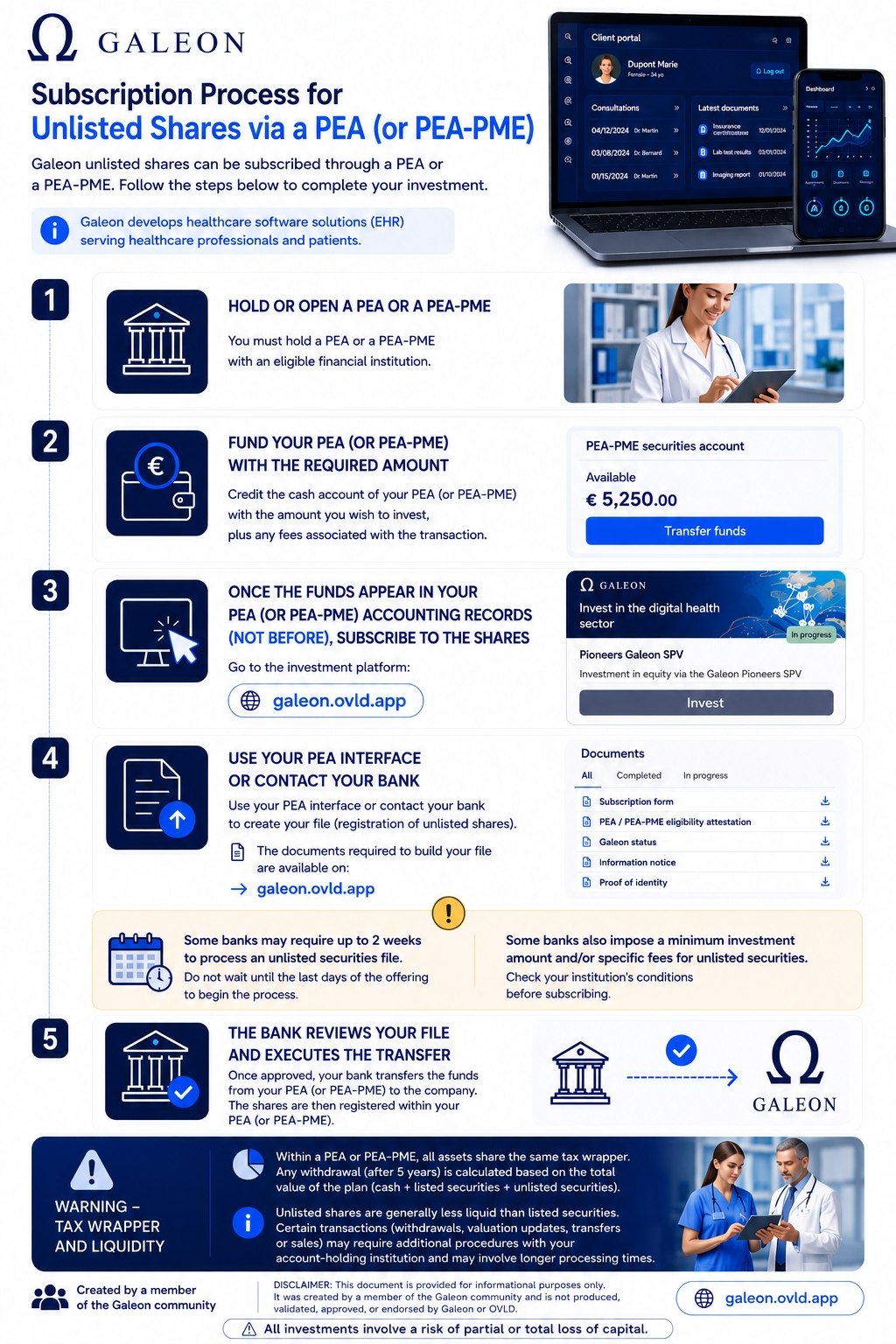
Most investors associate the PEA solely with stocks listed on the stock market. This is a mistake: the PEA-PME also allows you to directly finance unlisted companies, within an advantageous tax framework.
Unlisted shares of eligible European SMEs can be held in a PEA-PME, provided you go through an institution that accepts this type of security. It is precisely this mechanism that allows an individual to support a startup or an innovative SME while benefiting from the income tax exemption after 5 years.
Take a concrete example from the healthcare sector. Galeon, a French HealthTech company, is building an AI-powered electronic health record secured by blockchain. Present in 19 hospitals including 2 university hospitals, the company already structures more than 3 million patient records with several thousand healthcare professionals. An SME of this type, meeting the scheme's size criteria, illustrates the kind of company the PEA-PME is designed to finance: innovative, rooted in the real economy, with strong long-term potential.
Investing in unlisted shares through a PEA-PME does, however, require two preliminary checks: the company's eligibility for the scheme (to be confirmed via the certificate provided during the operation), and your institution's acceptance of unlisted securities.
Investing in stocks, listed or not, carries real risks that it would be dishonest to downplay. This section aims to inform a clear-eyed decision, not to discourage.
Risk of capital loss. Stocks offer no guarantee. The value of your portfolio can fall, sometimes sharply, and you may recover less than you invested. This is the fundamental risk of any stock market investment.
Increased risk on unlisted shares. Unlisted shares concentrate the risks. A young SME can fail, and the invested capital be lost entirely. Unlike a listed share, there is no stock price to value the security on a daily basis.
Illiquidity risk. This is the most underestimated constraint of unlisted shares. Reselling unlisted shares is slow and difficult: you must find a buyer and arrange the transaction. You can remain locked in for several years, whereas a listed share sells in seconds.
Long investment horizon. The PEA, and even more so unlisted shares, follows a logic of patience. The tax benefit kicks in after 5 years, and an SME's value creation is measured in years. This is not a short-term investment.
Evolving taxation. Capital taxation changes regularly. Social levy rates have increased several times: from 15.5% to 17.2%, then to 18.6% in 2026. There is no guarantee of a stable tax framework over the entire holding period.
In short: only invest amounts you do not need in the short term, diversify, and reserve unlisted shares for a measured fraction of your wealth.
What is the difference between a PEA and a PEA-PME?The two share the same taxation, but the standard PEA accepts European stocks of all sizes (€150,000 ceiling), while the PEA-PME is reserved for European SMEs and mid-caps (€225,000 combined ceiling). The PEA-PME is also the preferred gateway to unlisted shares.
What is the ceiling of the PEA and PEA-PME?The standard PEA is capped at €150,000 in contributions. The PEA-PME is capped at €225,000, but this amount is combined with the PEA: the total contributed across both cannot exceed €225,000.
Can you invest in unlisted shares through a PEA?Yes, mainly through the PEA-PME. Unlisted shares of eligible European SMEs can be held there, provided you go through an institution that accepts this type of security. Many online brokers refuse them: check in advance.
What social levy rate applies to the PEA in 2026?Since January 1, 2026, the social levy rate on capital income, including the PEA, rose from 17.2% to 18.6%, following the CSG increase voted in the 2026 Social Security Financing Act.
What is the best broker to open a PEA?It depends on your profile. For low fees, Bourse Direct and Trade Republic are among the cheapest; Fortuneo and BoursoBank round out the top tier, and both Fortuneo and Yomoni offer managed portfolios. If you are targeting unlisted shares, favor a broker offering the PEA-PME such as Bourse Direct, Fortuneo, or BoursoBank.
Do you need a standard PEA to open a PEA-PME?No. The PEA-PME is independent and can be opened on its own, without a prior standard PEA. You can hold one, the other, or both within the global ceiling of €225,000.
Can you lose money with a PEA?Yes. The PEA is a tax-advantaged account, not a performance guarantee. The value of the shares held can fall, and the risk of capital loss is real, particularly with unlisted shares.
The PEA and PEA-PME are among the most advantageous accounts for investing in stocks in France: after 5 years, capital gains are exempt from income tax, with only social levies (raised to 18.6% in 2026) remaining due. The standard PEA targets broadly with a €150,000 ceiling, while the PEA-PME, capped at €225,000 combined, finances European SMEs and mid-caps and opens access to unlisted shares. The choice of broker — Bourse Direct, Trade Republic, Fortuneo, BoursoBank, or XTB depending on your profile — directly weighs on your returns through fees. The risks remain to keep in mind: capital loss, illiquidity of unlisted shares, and a long horizon. For those who want to combine tax optimization with financing the real economy, the PEA-PME even makes it possible to support innovative SMEs like Galeon, which is building the healthcare system of tomorrow from medical data.
Want to understand how to concretely invest in an innovative SME through your PEA-PME? Discover the Galeon opportunity and the subscription terms on our investment platform, and explore how to become one of the pioneers of data-driven medicine. To dig deeper into the project, also check out our dedicated article on how Galeon's Blockchain Swarm Learning® works.
This article is for informational purposes only and does not constitute investment advice. Investing carries a risk of capital loss. For a decision tailored to your situation, consult a licensed professional.