 See Galeon for real

Hospital LAP certification 2026: what an EHR buyer should check
Hospital prescribing software (LAP) certification in France in 2026: HAS framework, certification body, validity and official list. What buyers should check.

Hospital LAP certification shows, through a type-test audit by a body accredited by Cofrac, that prescribing support software meets the HAS framework of May 2021. Valid for three years at most, it can be checked on the public HAS list, which as of 29 April 2025 includes only one certified hospital LAP: Galeon’s.
The essentials in 30 seconds
| Question | Short answer | What to remember |
|---|---|---|
| What is a LAP? | Software that supports medication prescribing, built into the EHR or not. | It guides drug selection and the writing of the prescription. |
| Which framework does hospital certification rely on? | The HAS framework for hospital LAPs, May 2021 version. | It focuses mainly on medication prescribing. |
| Who issues the certification? | A certification body accredited by Cofrac, currently SGS-ICS. | HAS sets the framework but does not issue the certificate. |
| How is the software assessed? | Through a type-test audit based on test scenarios. | The decision is notified within 15 working days after the audit. |
| How long is it valid? | Three years at most. | Each new version must remain compliant. |
| What is required to apply? | Relying on a drug database approved by HAS. | Without an approved database, no certification is possible. |
| Where can you check that a LAP is certified? | On the public list of certified hospital LAPs kept by HAS. | As of 29 April 2025, only one is listed: Galeon’s. |
Introduction
The medication pathway remains one of the most sensitive points of patient safety in hospitals. Prescribing support software (LAP, for logiciel d’aide à la prescription) plays a direct role in it: it guides drug selection, provides the relevant drug information and produces a complete, legible prescription.
For an EHR buyer, the difficulty is telling a simple prescribing module from a certified LAP. Hospital certification in France relies on a framework published by the Haute Autorité de santé (HAS) in May 2021, under article L.161-38 of the Social Security Code and decree no. 2019-856 of 20 August 2019. It can be checked on a public list.
As of 29 April 2025, the date of the latest update of that list by HAS, only one hospital LAP is certified under the May 2021 framework: Galeon’s.
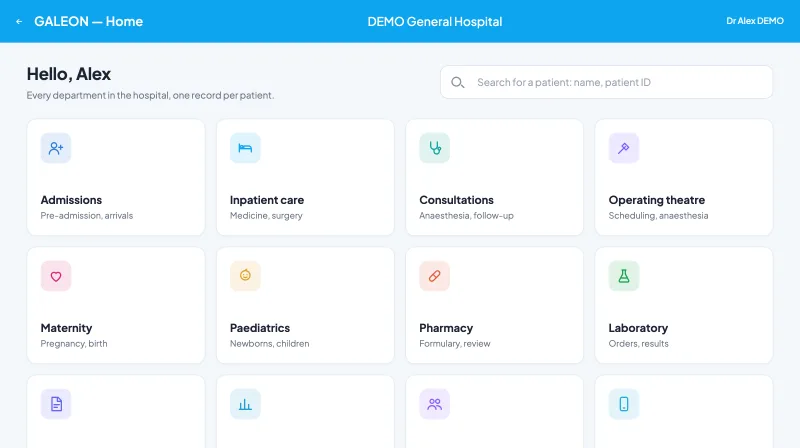
How Galeon handles it: the Galeon EHR includes its own prescribing module. Its version 13.4.1, based on the Thésorimed drug database, was certified on 16 April 2025 under the HAS framework, according to the list published by HAS. The EHR is presented on the Galeon Health EHR page and its certifications on the Certifications page. Galeon is deployed in 19 hospitals in France, used by about 10,000 caregivers.
What does hospital LAP certification check?
It checks that software meets the functional criteria of the HAS framework, which focus on medication prescribing.
The scope of the framework
According to HAS, the framework covers in particular drug selection, by international non-proprietary name or brand name, the availability of drug information, and prescriptions for inpatients as well as outpatients.
The objectives set by HAS
- Improve the quality of prescribing.
- Improve the therapeutic strategy.
- Make the prescriber’s work easier and support regulatory compliance of prescriptions.
- Lower the cost of treatment at equal quality.
What it does not measure
Certification shows that functions exist and have been tested. It does not measure the usability experienced by prescribers, actual use in departments, or the alert settings specific to each hospital.
Who issues the certification and how does the audit work?
A certification body accredited by Cofrac issues it, after a type-test audit.
The certification body
For LAPs, HAS states that only one body has been accredited by Cofrac: SGS-ICS. HAS publishes the framework and the list of certified software but does not issue the certificate, and a vendor is not allowed to use its logo.
The type-test audit
The auditor checks each criterion with tests, then sends the report to the certification body. The body notifies its decision to the vendor, to HAS and to the ministers in charge of health and social security, within 15 working days after the end of the audit.
The drug database
A LAP can only apply if it relies on a drug database approved by HAS for hospital LAPs. Safety functions are only as good as that information.
How long is the certification valid?
It is issued for three years at most.
Software changes
During that period, the vendor must make sure that every change to the software still meets all the required criteria.
Framework changes
A new framework published by HAS does not cancel certificates already issued. At any given time, the certification body issues only one version of a certification.
Is LAP certification mandatory for a hospital?
HAS describes it as optional for community practice software; for hospitals, the texts reviewed set its framework without directly requiring the hospital to use a certified LAP.
Proof to require rather than a regulatory box
For a hospital, certification mainly serves as verifiable proof in a tender: it replaces a vendor’s statement with an audit by an accredited third party.
The specifications prevail
A public tender or a funding programme may make it a prerequisite. The requirements of each tender and the hospital’s legal advice prevail over any general reading.
How can you check that an EHR includes a certified LAP?
By looking at the public HAS list, then asking the vendor for the certificate.
What the certificate should state
- The software name and its exact version.
- The associated drug database and its version.
- The certificate date and the body that issued it.
- The official statement, the only wording HAS allows vendors to use.
Certified version and installed version
The certificate covers a specific version. Ask the vendor how it ensures that the version deployed in your departments stays covered for the whole validity of the certificate.
Which questions should you ask the vendor in a demo?
Certification sets a baseline; the demo should show how it works in your departments.
On everyday prescribing
- How are alerts ranked, and who configures them?
- Is prescribing by non-proprietary name offered by default?
- How are inpatient and outpatient prescriptions handled?
- How are current treatments taken over at admission?
On organisation
Ask the vendor about exchanges with the hospital pharmacy and the traceability of every change. To structure your review of offers, the EHR tender criteria grid and the EHR vendor comparison complement this guide.
Which figures on hospital prescribing safety should you keep in mind in 2026?
Public data point in the same direction: medicines remain the main source of preventable serious adverse events linked to health products, and prescribing accounts for a decisive share of the errors analysed by the HAS.
Serious adverse events in hospitals
- 4.4 serious adverse events per 1,000 days of hospitalisation in 2019, 34% of them preventable, according to the national ENEIS 3 survey (Santé publique France, BEH no. 13, 2022).
- 2.6% of hospital stays were caused by a serious adverse event, 53% of which were preventable (ENEIS 3, 2022).
- Preventable events linked to health products "mainly involve medicines" (ENEIS 3, 2022).
- 5,576 serious adverse events associated with care (EIGS) were reported to the HAS in 2025 (HAS, 2025 annual report, published September 2026). Since March 2017, the HAS has received 21,636, 70% of them from healthcare facilities.
- 213 EIGS reports related to drug prescribing were analysed by the HAS between March 2017 and December 2024: dosing errors, wrong-drug errors and omissions account for 87% of them (HAS, 2026).
Medication errors reported to the ANSM
- 3,409 medication error reports were submitted to the ANSM in 2025, including 3,300 actual errors (ANSM, 2025 activity report, appendices).
- 981 of these actual errors were associated with an adverse effect deemed serious under pharmacovigilance criteria (ANSM, 2026).
- Annual volume nearly doubled in four years, from 1,815 reports in 2021 to 3,409 in 2025 (ANSM, 2026).
This reporting scheme, run since 2005 with the network of regional pharmacovigilance centres, covers errors or risks of error directly related to a medicine (ANSM). It sheds light on national vigilance; the frequency of errors in hospitals is better described by ENEIS.
Certified software and drug databases
- 51 certified outpatient prescribing software products (LAP) appear on the HAS list updated on 17 July 2026, compared with a single hospital LAP (HAS, 2026).
- 5 drug databases hold HAS approval under version 3 of the procedure, according to the page updated on 19 December 2023 (HAS, 2023).
Where does the LAP fit in the medication-use process?
The LAP secures the first step of a process governed by the order of 6 April 2011, running from prescribing through pharmaceutical validation to administration. Its value depends on how information flows between these steps.
What does the order of 6 April 2011 require from hospitals?
The order of 6 April 2011 on quality management of medication management applies to healthcare facilities. Its Article 3 describes the computerisation of medication management processes as "one of the essential conditions for making it safe".
Management appoints a person responsible for the quality management system for medication management (Article 5). It commissions a risk assessment that covers, among other things, the risks of using a computerised process (Article 8).
Anyone involved in patient care must report adverse events, medication errors or malfunctions (Article 9). These reports feed a collective analysis of root causes.
Prescribing, pharmaceutical validation, administration: who does what?
- Prescribing: prescriptions may be written, stored and transmitted electronically, subject to an electronic signature (Article 13). This is the step covered by a certified LAP.
- Pharmaceutical validation: the pharmacist of the hospital pharmacy (PUI) carries out the whole dispensing act, including review of the prescription. The facility guarantees pharmaceutical validation for high-risk medicines (Article 13).
- Administration: each act is recorded when it is performed, and transcribing prescriptions is not permitted (Article 13).
The consequence for buyers is practical. A stand-alone LAP, whose prescriptions have to be copied into another tool by the pharmacy or nursing staff, exposes the hospital to the transcription the order prohibits. During a demo, ask to follow a single prescription through to pharmaceutical validation and the administration plan, with no re-entry at all.
Where does medication reconciliation come in?
The HAS describes medication reconciliation as a formalised process that takes into account, at each new prescription, all the medicines the patient takes and is due to take. It applies at admission, discharge and transfer (HAS, 2019).
Its effect is documented. The Med'Rec experiment, run from 2010 to 2014 in nine facilities, managed 46,188 risk situations in 27,447 patients reconciled on admission (HAS). Omission of a medicine is the error most often prevented.
A LAP that carries the admission medication history into the hospital prescription makes this work easier. It is worth checking during a demo, alongside certification.
Certified LAP or non-certified prescribing module: what are the differences?
| Criterion | Non-certified prescribing module | Certified hospital LAP |
|---|---|---|
| Proof of compliance | Vendor statement | Type-test audit by an accredited body |
| Framework | Vendor’s own | HAS framework (May 2021) |
| Drug database | Free choice | HAS-approved database required |
| Public check | None | Public HAS list |
| Duration | No end date | Three years at most, compliance to maintain |
| Communication | Free | Single mandatory statement, no HAS logo |
What it changes for the CIO, the medical information department and clinicians
CIO / IT department
The IT department adds certification to the offer review grid and checks that the certified version matches the deployed version, as well as the interfaces with the pharmacy.
Medical information department (DIM)
Structured prescribing, by non-proprietary name and linked to the stay, makes it easier to analyse drug consumption and use the data.
Clinicians
Prescribers benefit from functions tested during the audit. How they are configured in the hospital decides how useful they are day to day, and the risk of alert fatigue.
Limits and points of caution
- Certification is not a usage measure: it says nothing about prescribing time or prescriber adoption.
- Alert quality depends on data: drug database, recorded history and allergies, local settings.
- The certificate covers one version: a major software change must remain compliant.
- The framework dates from 2021: a new version may change the requirements.
- The public list has a date: HAS updates it from the certification body’s data; check it at the time of the tender.
FAQ
Who issues LAP certification?
A certification body accredited by Cofrac, currently SGS-ICS according to HAS. HAS publishes the framework and the list of certified software.
Does HAS certify software itself?
No. It sets the framework and publishes the list, but certification is issued by the certification body, and the vendor cannot use the HAS logo.
How long does a LAP certificate last?
Three years at most, provided that changes to the software still meet all the criteria.
How many hospital LAPs are certified?
The list published by HAS, updated on 29 April 2025, includes only one: Galeon’s LAP, version 13.4.1, certified on 16 April 2025.
Is a certified LAP enough to make prescribing safe?
No. It brings tested functions, but safety also depends on the quality of the data entered, alert settings and how the medication pathway is organised.
Is dispensing support software concerned?
It falls under separate frameworks, for community pharmacies and hospital pharmacies. The HAS page reviewed lists none as certified.
What does the order of 6 April 2011 say about computerising the medication-use process?
Its Article 3 makes the computerisation of medication management processes "one of the essential conditions for making it safe". Article 13 allows prescriptions to be written, stored and transmitted electronically, subject to an electronic signature, and Article 8 includes the risks of a computerised process in the risk assessment (Légifrance).
What is an HAS-approved drug database?
It is a database that the HAS has found compliant with its quality charter, adopted in its current version by a decision of the HAS Board on 7 July 2022. Five databases held this approval according to the HAS page updated on 19 December 2023 (HAS, 2023).
In summary
Hospital LAP certification shows, through a third-party audit, that prescribing software meets the HAS framework of May 2021. It is issued for three years at most by a body accredited by Cofrac, currently SGS-ICS, and can be checked on the public HAS list. For an EHR buyer, it is proof to request in every offer, along with the covered version and the associated drug database. The list currently includes only one certified hospital LAP: Galeon’s, deployed in 19 French hospitals.
Want to know more about our smart EHR ?
Book a demoThe criteria grid for an EHR tender
Sources
- HAS: type-test certification of hospital prescribing support software (May 2021 framework)
- HAS: list of certified hospital prescribing support software (updated 29 April 2025)
- HAS: getting software certified (procedure, validity, communication)
- HAS: certification of medical software for patient safety (29 April 2021)
- Santé publique France: Incidence of serious adverse events associated with care in healthcare facilities (ENEIS 3), BEH no. 13, 2022
- HAS: Serious adverse events associated with care (EIGS), 2025 annual report, 2026
- ANSM: 2025 activity report, appendices, 2026
- HAS: Certified outpatient prescribing software (LAP), 2026
- Légifrance: Order of 6 April 2011 on quality management of medication management
- HAS: Medication reconciliation, preventing errors, 2019
- Galeon: Certification portfolio
- Galeon blog: Best hospital EHR 2026, vendors compared
Related reading
They trust us
19 hospitals running Galeon in France.
















Join the pioneers of care.

 2 sales reps available from tomorrow
Your IT, your interfaces, your timeline. Pick a slot: Valérie or Yohan will call you back.
- HDS certified
- ISO 27001
- GDPR compliant
- Certified hospital LAP