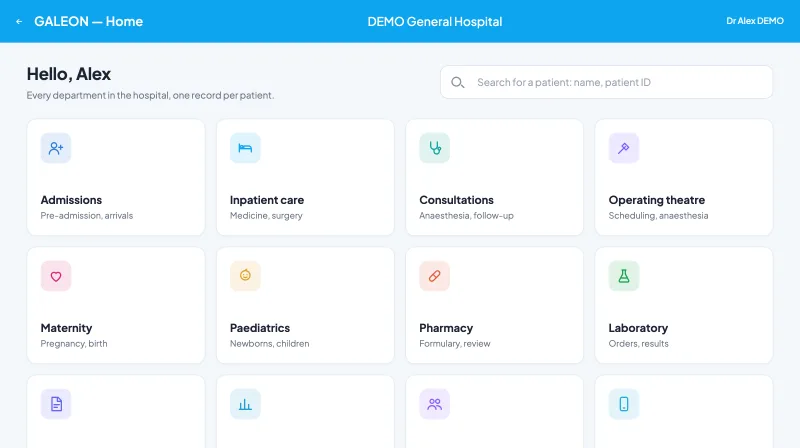
 See Galeon for real

Galeon explained: how data can improve patient care
Founded in 2016, Galeon is a French digital health company developing an electronic health record designed to integrate artificial intelligence and facilitate collaboration between healthcare institutions.
Its software is currently deployed in 19 French hospitals and supports around 10,000 healthcare professionals in their daily work.
To understand Galeon's approach, it is helpful to look at how medical information is collected in hospitals, how healthcare professionals use it and the opportunities it creates for medical research.

It all starts in the hospital
When a patient arrives at a hospital, medical teams need to understand their current health condition, medical history, allergies and regular medications.
Throughout their hospital stay, their medical record grows. A doctor writes a consultation report, a nurse records clinical observations, a laboratory provides test results and a radiologist interprets medical images.
Depending on how the hospital is organised, this information may be spread across several software systems. Healthcare professionals may need to navigate different interfaces, search for documents or re-enter information already recorded elsewhere.
These tasks take up part of their working day and can make it more difficult to share information between departments.
This is the context in which Galeon develops its electronic health record.
What exactly is an electronic health record?
An electronic health record, commonly referred to as an EHR, is a software system used by healthcare professionals to record and access information relating to a patient's care.
It can be compared to a digital health record that grows over time through consultations, examinations and hospital stays.
It may include:
- Medical history and allergies.
- Prescriptions and treatments.
- Examination and test results.
- Clinical observations from healthcare teams.
- Medical reports.
- Patient care history.
Authorised healthcare professionals can access the information they need to carry out their duties and record new information as care is provided.
Galeon develops its EHR as a Software as a Service (SaaS) platform, meaning that the software is accessible online and updates can be deployed without requiring individual installations on every workstation.
Its design takes into account the specific needs of different hospital professions. A doctor, a nurse and a pharmacist may need different information at different stages of patient care.
The organisation of medical records and the ease with which each professional can access relevant information are therefore important considerations in the development of the software.
How Galeon supports healthcare professionals in their daily work
Consider a doctor seeing a patient for the first time.
Before prescribing a treatment, the doctor needs to review the patient's medical history, any known allergies and the medications they are already taking.
When this information is spread across several documents, reviewing it may involve multiple searches. A well-organised medical record makes this process easier.
The same principle applies to communication between healthcare teams. During a transfer between departments or a shift change, the professionals taking over need to quickly understand the patient's condition and the decisions made previously.
Galeon works on software usability, the organisation of medical information and hospital workflows to support these everyday activities.
One of its objectives is to reduce the time spent on administrative and computer-related tasks, allowing healthcare professionals to dedicate more time to patient care.
The way information is recorded within the software also plays an important role in Galeon's other development projects.

Why Galeon places so much importance on health data
Imagine two libraries.
In the first, thousands of books are placed on shelves without any particular system of organisation. Finding a specific book means browsing the shelves until you come across the right title.
In the second, every book is catalogued by author, subject and publication date. Finding a particular book or exploring all publications on a given topic becomes much easier.
This comparison helps explain what is known as data structuring.
In a medical record, an allergy might be mentioned somewhere within a report several pages long. To find it, a healthcare professional would need to read through the document and identify the relevant passage.
If that same allergy is also recorded in a dedicated field, the software can more easily identify it and present it to the healthcare professional when needed.
Across an entire hospital, this approach applies to thousands of patient records and many categories of information, including treatments, diagnoses, laboratory results and clinical observations.
Data structuring is a central part of Galeon's EHR. It facilitates the use of information in patient care and also provides a foundation for developing medical artificial intelligence applications.
An electronic health record designed to integrate artificial intelligence
Galeon is developing what is known as an AI-native EHR.
This term describes an approach in which future applications of artificial intelligence are considered from the earliest stages of software design, particularly in the way medical information is organised.
Consider an artificial intelligence system developed to help identify potential deterioration in a hospitalised patient's condition.
To perform this analysis, it might require several types of information, including the patient's temperature, heart rate, laboratory results and changes in certain symptoms.
The availability, reliability and organisation of this information influence the quality of the analysis. Developing such a tool also requires clinical evaluations appropriate to its intended use.
Other applications are being explored across the healthcare sector, including assistance with medical report writing, medical image analysis and certain administrative tasks.
These examples illustrate the potential applications of medical AI and do not necessarily correspond to features currently available within Galeon's EHR.
By working on data structuring and its integration into clinical workflows, Galeon aims to facilitate the development and use of these technologies within healthcare institutions.
Healthcare professionals retain control over clinical decisions and remain responsible for interpreting the information presented to them.
Enabling hospitals to learn from one another
Every healthcare institution has its own clinical experience.
One hospital may specialise in cardiovascular diseases, while another may treat more patients with respiratory or neurological conditions.
This diversity is valuable when developing medical artificial intelligence. Under certain conditions, a model trained on a variety of clinical situations could better account for differences between patients and medical practices.
However, collaboration between healthcare institutions presents a significant challenge: medical data is particularly sensitive, and its use is strictly regulated.
To address this challenge, Galeon is working on an approach that involves moving artificial intelligence models between participating healthcare institutions while keeping medical data local.
Imagine several hospitals wishing to contribute to the development of the same artificial intelligence system. The model could learn from information available within one institution before continuing its training in other hospitals.
The knowledge acquired throughout these different stages could help improve the model without requiring patient records to be brought together in a central database.
This approach forms part of Galeon's vision for collaborative medical artificial intelligence. Its implementation requires technical, scientific and regulatory work appropriate to each intended application.
How can health data advance medical research?
When researchers seek to better understand a disease, they may need to study a large number of clinical situations.
Researchers working on diabetes, for example, may be interested in how the disease progresses in different patients, the complications they experience or the outcomes of particular approaches to care.
Analysing data collected during real-world patient care can contribute to this research, alongside clinical studies and other research methods.
Structuring medical information facilitates certain types of analysis, subject to data quality, representativeness and the necessary authorisations for its use.
In the long term, Galeon aims to contribute to medical research by facilitating collaboration between healthcare institutions, healthcare professionals and research teams.
The knowledge gained through this work could help improve our understanding of certain diseases, identify risk factors or study the outcomes of different approaches to patient care.
Protecting health data
A patient record contains particularly sensitive personal information. Its access, storage and use are subject to specific regulations.
Within a healthcare institution, professionals must have the necessary authorisations to access medical information as part of their duties. The use of this information for research purposes is also subject to regulatory requirements specific to each project.
The development of hospital software raises additional questions relating to cybersecurity and data sovereignty, including where data is hosted, the conditions under which it can be accessed and the legal framework governing its processing.
These considerations play an important role in the design of Galeon's solutions and its work on collaborative artificial intelligence.
Developing artificial intelligence models without centralising the medical records of participating institutions is one approach being explored to limit certain data transfers.
It must be accompanied by appropriate technical and regulatory safeguards for both patients and healthcare institutions.
Where is Galeon today?
As of November 2026, Galeon is deployed in 19 French hospitals, including two university hospitals, and its software is used daily by around 10,000 healthcare professionals.
Its hospital references include Caen Normandy University Hospital, Rouen University Hospital and the Nord-Essonne Hospital Group.
Deploying hospital software requires close collaboration with local healthcare teams. Each institution has its own organisation, medical specialities and working practices.
Discussions with healthcare professionals help Galeon better understand these differences and identify the needs its software must address.
Alongside these deployments, Galeon continues to develop its EHR and pursue its work on data structuring, medical artificial intelligence and collaboration between healthcare institutions.
Looking ahead
Over the coming years, Galeon aims to continue expanding its hospital deployments and developing its software in collaboration with healthcare professionals.
The development of artificial intelligence applications integrated into hospital software and ongoing work on collaborative learning are also key areas of development for the company.
These projects follow a gradual approach that takes into account the needs expressed by healthcare professionals, the maturity of the technologies and the validations required for their use in medical settings.
To learn more about Galeon and its solutions for healthcare institutions, visit www.galeon.care.
Related reading
They trust us
19 hospitals running Galeon in France.





Join the pioneers of care.

 2 sales reps available from tomorrow
Your IT, your interfaces, your timeline. Pick a slot: Valérie or Yohan will call you back.
- HDS certified
- ISO 27001
- GDPR compliant
- Certified hospital LAP