 See Galeon for real
AI Trends at SantExpo 2026: What Hospitals Should Take Away
At SantExpo 2026, AI moves from lab to reality, focusing on clinical support and admin automation to give hospitals more care time.
The Essentials in 30 Seconds
| Question | Short Answer | Key Takeaway |
|---|---|---|
| What is the major 2026 AI trend? | AI becomes native inside healthcare software, not bolted on. | End of pilots, start of industrialization. |
| Which use cases dominated SantExpo 2026? | AI care plans, voice dictation, assisted prescription, remote monitoring. | Clinician productivity and continuity of care. |
| What regulatory signal marked the show? | The first natively AI EHR in Europe certified as a Class IIa "MDR" medical device. | AI officially enters the regulated medical device perimeter. |
| What is the main bottleneck? | The quality and structure of medical data. | No clean data, no reliable clinical AI. |
| Where does sovereignty stand? | A central topic: French platforms, "HDS" hosting, sovereign cloud. | Data must remain in France and in the hands of caregivers. |
| Do these solutions replace the EHR? | No, they plug into it. | The EHR remains the foundational layer for any hospital AI. |
Why is SantExpo 2026 a Tipping Point for Hospital AI?
From May 19 to 21, 2026, SantExpo brought together nearly 700 exhibitors, more than 35,000 participants and 240 speakers in Paris around a single thread: the transition of hospital AI into its proof phase. The 2026 edition confirmed that healthcare facilities are no longer asking whether to integrate AI, but how to industrialize it without compromising data sovereignty.
The market is shifting paradigms. AI is no longer a peripheral module bolted onto legacy software: it becomes a native feature of the electronic health record (EHR), prescription tools and care coordination platforms. This shift raises a concrete question for every CIO: what data will these AIs be trained on, and under what governance conditions?
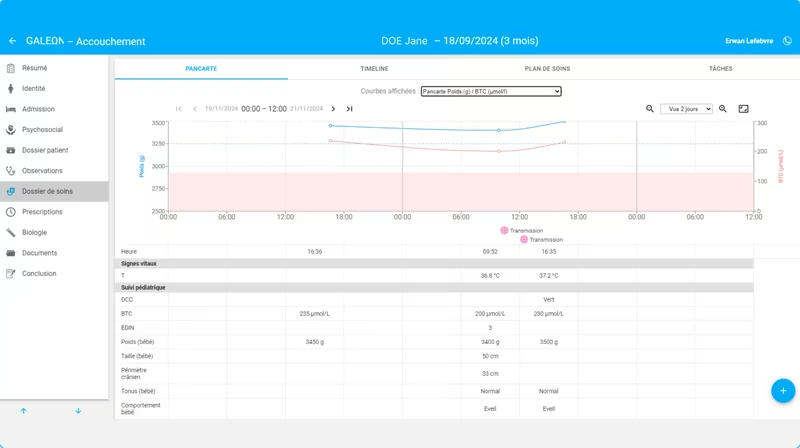
This is exactly the question Galeon has been addressing since 2016. Deployed across 19 French hospitals (including 2 university hospitals), structuring more than 3 million patient records and used daily by more than 10,000 caregivers, Galeon builds the foundational layer required for every AI brick showcased at SantExpo to operate sustainably and sovereignly.
No medical AI is better than the data it is trained on. That observation was shared by virtually every software publisher and CIO we met at the show, and it is the operational mission of the Galeon EHR.
Which 14 AI Technologies Marked SantExpo 2026?
Rather than listing every demo, let us group the solutions observed into four coherent families that match the four major moments of the care pathway.
Family 1: Which AIs Assist Clinical Decision-Making?
This first family gathers solutions that intervene at the core of clinical reasoning.
AI-generated care plans. Several publishers now offer personalized care plans generated from the patient record and best-practice guidelines. The physician validates or adjusts, but no longer starts from a blank page.
AI-assisted prescription modules. Automatic detection of drug interactions, contraindications, dosages adapted to renal function, allergies. AI acts as a pharmacological copilot without ever substituting for the prescriber.
Clinical intelligence for chronic disease patients. Decision-support algorithms for long-term conditions (diabetes, heart failure, COPD, cancers), with risk scores and therapeutic adjustment suggestions.
"MedGPT" and conversational medical AIs. Specialized assistants capable of querying the EHR in natural language: "List the diabetic cardiology patients with HbA1c > 8 over the past 6 months".
Family 2: How is AI Freeing Up Caregiver Time?
This is probably the family that made the biggest impression at SantExpo 2026, because it directly addresses the mental load on care teams.
Speech-to-text and medical dictation (Microsoft Dragon Medical One). The market-leading solution, used by more than 550,000 physicians worldwide and 80% of US radiologists. Dragon Medical One captures clinical documentation up to five times faster than typing with a stated 99% accuracy. Microsoft acquired Nuance in 2021 for 19.7 billion dollars, a sign of the strategic stakes in medical voice recognition.
Ambient consultation assistants. Automatic generation of the consultation report from the audio recording. The physician speaks naturally with the patient, AI produces the structured report.
Automation of administrative tasks. ICD-10 coding, discharge letters, prescriptions, operative reports: anything time-consuming and standardizable can now be accelerated.
Family 3: Which AIs Transform Research and the Patient Pathway?
A third family covers data valorization beyond direct care.
AI-assisted clinical research. Automatic identification of patients eligible for clinical trials, retrospective cohort analysis, research hypothesis generation.
Dynamic consent for research and care. Patients can authorize, restrict or withdraw the use of their data in a granular way, in real time. A break from the static paper consent.
Telemedicine and remote monitoring. Since remote monitoring entered standard reimbursement via the "LATM" list, and with the "PECAN" program accelerating reimbursement for innovative digital medical devices, the home-monitoring market has matured. More than 100 million euros have been committed via "PECAN" on the remote monitoring and digital therapeutics scope since 2023.
Family 4: Which AI Pilots the Hospital and its Infrastructure?
Finally, a less visible but structuring family: governance tools.
Healthcare KPIs and Value-Based Healthcare ("VBHC"). AP-HP is deploying "PROMs" and "CROMs" (patient questionnaires and clinical indicators) to measure the real value of care. "VBHC", popularized by the French Society for Value in Health, is becoming a standard for hospital steering.
Sovereign IT infrastructure management. The French "Health Data Hub" is migrating to a "SecNumCloud"-qualified sovereign cloud, a sign of the regalian turn in hosting. Platforms such as "DALVIA" (La Poste Santé & Autonomie) claim the same sovereignty positioning.
Why Do All These AIs Depend on a Structured EHR?
Here is the point SantExpo 2026 made impossible to ignore: every AI solution showcased, however powerful, hits the same wall when deployed in a real hospital.
Medical data is scattered, heterogeneous, poorly coded, duplicated across departments, sometimes locked inside scanned PDFs. A care-plan AI cannot suggest relevant treatment if it cannot read the patient's allergies correctly. A consultation assistant cannot fill in a coherent report if the underlying database has no common model. A clinical-research AI cannot identify cohorts if diagnoses are not coded.
This is precisely the missing link Galeon has been building since 2016. The Galeon EHR is not a competitor to the solutions showcased at SantExpo: it is their operating condition. Data structured by caregivers directly inside Galeon becomes usable by any third-party AI brick, while respecting patient consent and hospital data sovereignty.
A capability very few publishers offer today.
How Does the Galeon Approach Differ From What We Saw at SantExpo?
| Training data source | Heterogeneous data extracted in post-processing | Data structured natively by caregivers at data entry |
| Data quality | Variable, dependent on cleaning | Standardized and interoperable from the start |
| Data sovereignty | Often transferred to a third-party platform | Stays on hospital servers, never moved |
| "HDS" hosting and medical secrecy | To be checked case by case | Architecture designed for these requirements from day one |
| Traceability of data usage | Limited, often opaque | Tracked on-chain, verifiable by the hospital |
| Compatibility with third-party AI bricks | Fragmented, heavy integration work | Open foundational layer for Dragon, "MedGPT", remote monitoring, etc. |
| Economic model for the hospital | Net cost (AI license + integration) | Cost offset by structured monetization of the data |
| Regulatory scalability ("MDR", GDPR, AI Act) | Re-audited at each new AI added | Architecture compliant by design |
The AIs showcased at SantExpo 2026 are valuable. But none of them can deliver on its promise at scale without a clean and sovereign data layer underneath. That layer is what Galeon provides.
What Are the Limits and Challenges Observed at SantExpo 2026?
This section is deliberately direct. The promises of hospital AI are real, but so are the obstacles.
- Caregiver training remains critical. During a workshop at SantExpo, Prof. Laurent Fourcade (Limoges University Hospital) issued a stark warning: "Nobody truly knows the value of health data". "Shadow IT", meaning unauthorized digital uses in clinical units, remains widespread for lack of digital literacy. No AI deployment holds without prior training.
- Sovereignty remains partial. Many conversational AI solutions, including Dragon Medical One, are hosted on Microsoft Azure. The question of real control over medical data and trained models remains open, despite "HDS" certifications.
- The transition from "PECAN" to the permanent "LATM" list is a bottleneck. Cureety, a telemonitoring solution in oncology that entered "PECAN" as early as 2023, initially failed to secure permanent reimbursement because the French Health Authority deemed clinical evidence insufficient. The long-term validation model is not yet stabilized.
- "MDR" certification for AI-native EHRs is a historic but expensive milestone. May 2026 saw the first Class IIa "MDR" certification granted in Europe to a natively AI EHR, formally bringing this category of software into the regulated medical device perimeter. A strong signal, but the cost and duration of the procedure remain prohibitive for many publishers.
- Heterogeneity of medical data still slows generalist AIs. An AI trained on a single university hospital's data generalizes poorly to other facilities.
FAQ: What CIOs Ask Us After SantExpo 2026
What was the major regulatory signal at SantExpo 2026? The award in Europe of the first Class IIa "MDR" certification to a natively AI EHR. It is a turning point: clinical AI formally enters the regulated medical device perimeter, with all that implies in terms of evidence, governance and accountability.
Do we need to replace our current EHR to integrate these AIs? Not necessarily, but the quality of the EHR data determines the performance of every AI layered on top. A natively structured EHR (like Galeon) maximizes the return on third-party AI investments.
How long does it take to integrate the Galeon EHR into a hospital? The timeline depends on the size of the facility and its digital maturity, but deployment happens in stages. Each of the 19 hospitals in the Galeon network followed a progressive path: initial audit, structuring of priority data, caregiver training, production go-live. The goal is to build on the existing infrastructure, not rebuild everything.
How does Dragon Medical One integrate with a Galeon EHR? Dragon (or any other medical speech-to-text tool) can feed dictation into Galeon. Galeon then structures the voice data into clinical information usable by all other AI bricks.
What should be done before deploying AI in a hospital? Three priorities: audit the data quality of the EHR, train teams on digital practices, formalize a sovereignty and patient-consent strategy. This is the sequence we recommend to CIOs in the Galeon network.
Is there a risk of technological dependency with these AIs? Yes, particularly when models run on non-European clouds. The answer is not to refuse AI, but to demand sovereign and traceable architectures from day one.
Conclusion: SantExpo 2026 Confirms the Centrality of the Structured EHR
SantExpo 2026 marks the exit of hospital AI from its experimental phase. Automated care plans, voice dictation, assisted prescription, reimbursed remote monitoring, "VBHC" KPIs: every brick is now mature. But they share a common dependency, the quality and structuring of the source medical data. Without a structured EHR, even the best AIs produce mediocre results. This is exactly the role Galeon has been playing since 2016 across 19 French hospitals: providing the foundational layer that makes all other innovations possible, without compromising sovereignty or medical secrecy. The future of healthcare AI will not be decided on the sophistication of models, but on the quality of data and the fairness of value sharing.
Are You a Hospital CIO or General Director?
Book a demo of our smart EHRSources
- Archimag, "SantExpo 2026: AI, interoperability, cybersecurity, dematerialization, digital health enters its proof phase", March 2026.
- DSIH, "Live from SantExpo 2026: InterSystems IntelliCare, first natively AI EHR to obtain MDR certification", May 2026.
- DSIH, "Live from SantExpo 2026: Shadow IT, AI and cybersecurity, the importance of comprehensive caregiver training", May 2026.
- Hospitalia, "SantExpo 2026: La Poste Santé & Autonomie accelerates on AI and data", May 2026.
- MedTech France, "AI, hospital innovations, startups: what SantExpo 2026 is preparing", March 2026.
- G_NIUS (French Digital Health Delegation), "Remote Monitoring Reimbursement".
- G_NIUS, "Early Digital Coverage (PECAN)".
- Healthcare Digital, "The French PECAN Framework at the Three Year Milestone", February 2026.
- French Society for Value in Health (VBHC France).
- KLAS Research, "Nuance Dragon Medical One: Best in KLAS Speech Recognition Front-End EMR", 2021 and 2022.
- TechCrunch, "Microsoft is acquiring Nuance Communications for $19.7B", April 2021.
- French Digital Health Agency (ANS), "Digital Medical Device Certification".
Related reading
They trust us
19 hospitals running Galeon in France.















Join the pioneers of care.

 2 sales reps available from tomorrow
Your IT, your interfaces, your timeline. Pick a slot: Valérie or Yohan will call you back.
- HDS certified
- ISO 27001
- GDPR compliant
- LAP certified (HAS)